
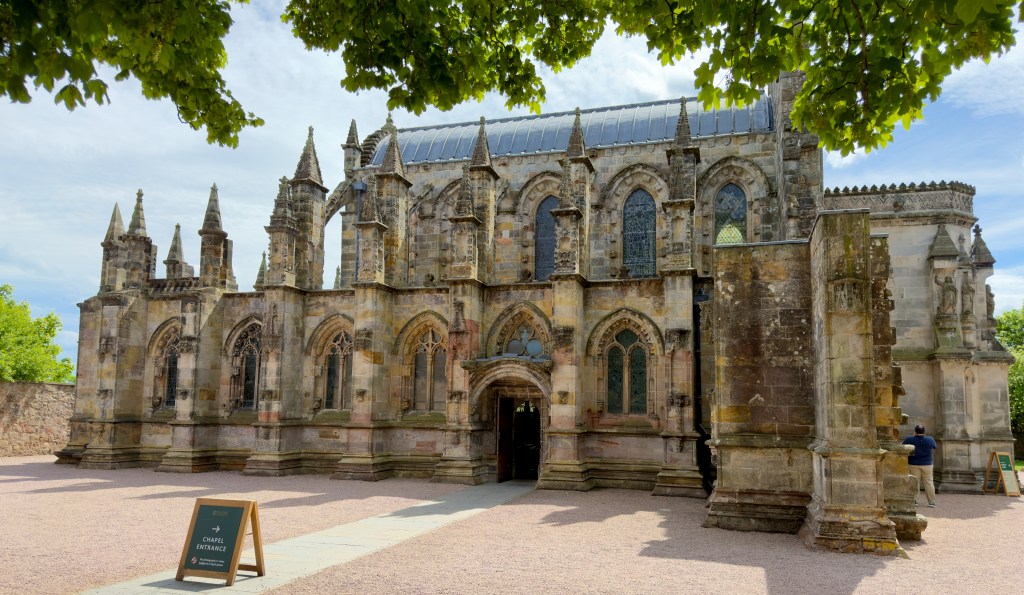
Rosslyn Chapel is a stunning medieval structure situated just outside the village of Roslin in Midlothian. It captivates visitors not only with its extensive stone carvings but also with its mystery and inspiration for tales involving the Knights Templar, the Holy Grail, Ley Lines, and Dan Brown’s The Da Vinci Code.
Founded in 1446 by Sir William St. Clair, construction of the chapel started on 20 September 1456. It was established as the Collegiate Church of St Matthew, serving as a place for a provost, prebendaries, and choristers. The church’s main functions included celebrating the Mass, the Divine Office, and praying for William St Clair, his family, and others connected to him.
This was part of the normal late-medieval Catholic concept of intercession for the dead. And more than thirty-seven collegiate churches in Scotland, usually privately funded by a noble family, were built between the reigns of James I and James IV (1406 to 1513).
Interestingly, what we see today is only part of the much larger design intended. Sir William died in 1484, and he was buried in the unfinished chapel. Excavations in the 1800s uncovered foundations extending a further 30 metres beyond the west end, indicating that a full cruciform church with nave and transepts was originally intended.
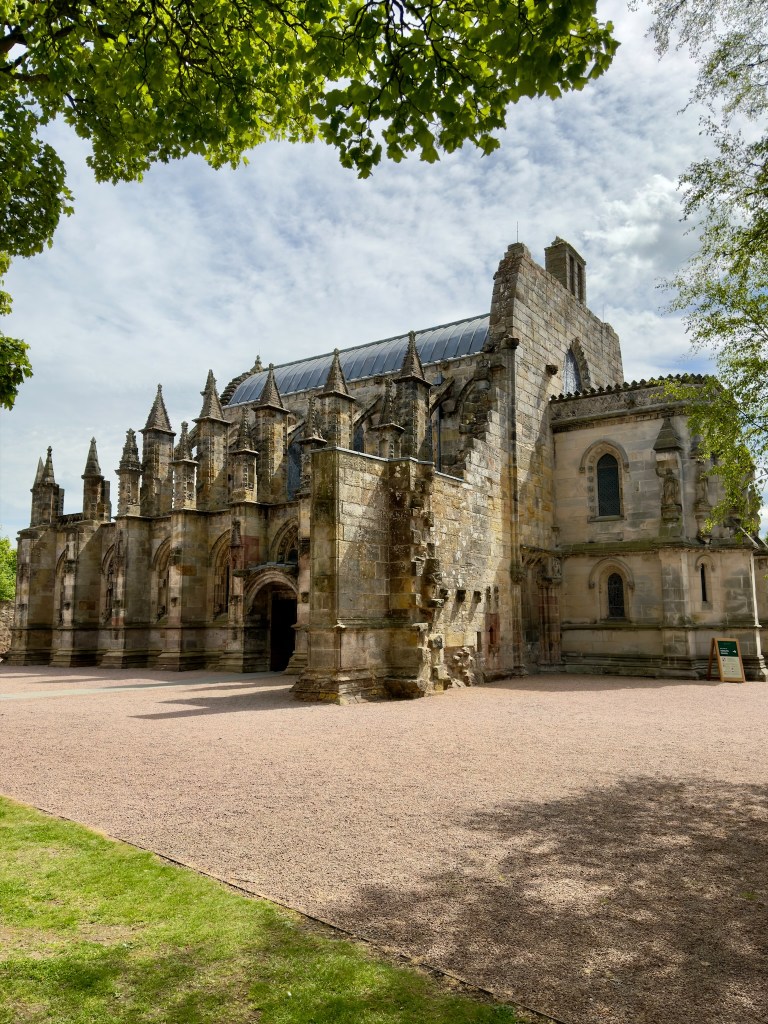
In fact, Sir William’s son, Sir Oliver St. Clair, roofed the choir and its stone vault but then went no further with the construction. The building you visit is therefore the choir of an unfinished church, which is why it is compact yet unusually dense with carving. It appears that all the ornamental ambition of a cathedral programme was concentrated into a much smaller footprint.
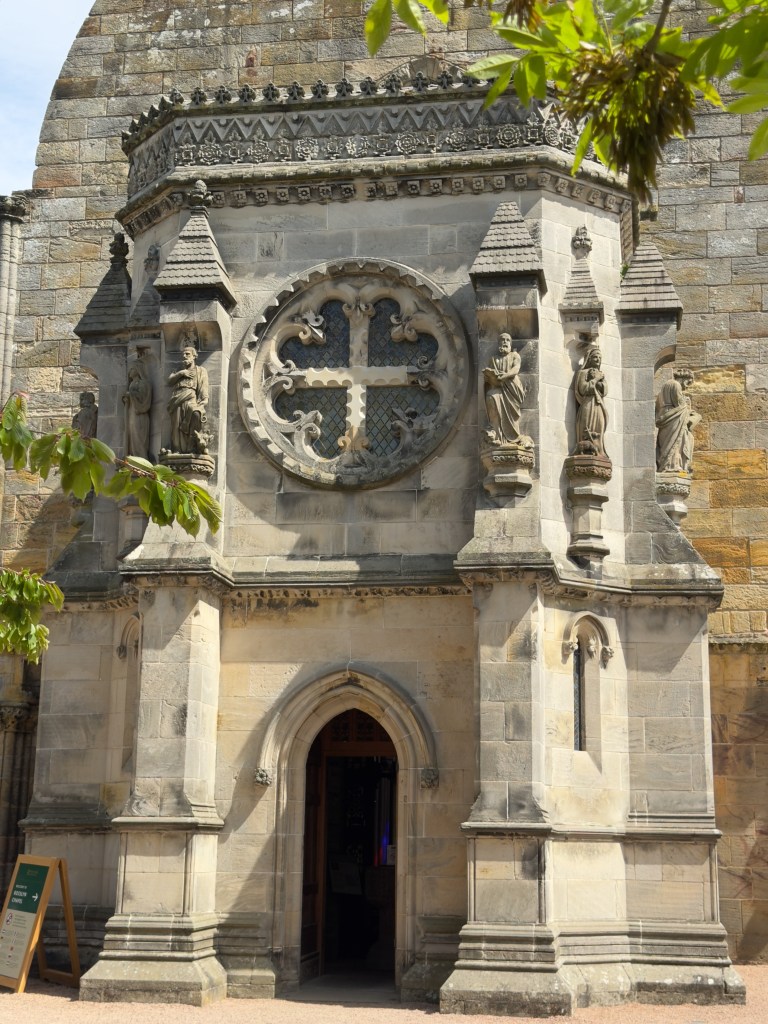
Indeed, the interior is covered with an extraordinary quantity of carved stonework, including the “Green Men”, foliage, angels, biblical imagery, saints, symbolic figures, grotesques and geometric patterns. Some of the best-known features include the Apprentice Pillar, the Master’s Pillar, and the Lady Chapel at the eastern end.
The Apprentice Pillar is probably the most celebrated piece of carving in the chapel.
According to a later legend, a master mason received a vision showing him how to carve the pillar. While he was away obtaining the necessary inspiration, or, in some versions, travelling to see a comparable pillar, the apprentice completed it himself. The master returned, saw that the apprentice’s work was superior to his own and, in a jealous rage, killed him. The story is almost certainly legend rather than documented history, but it became deeply associated with the chapel and helped create the romantic image of Rosslyn as a place of hidden knowledge.
Among Rosslyn’s many intricate carvings is a sequence of 213 cubes or ‘boxes’ protruding from pillars and arches with a selection of patterns on them. It is unknown whether these patterns have any particular meaning. Many people have attempted to find information coded into them, but no interpretation has yet been proven. Some, in fact, are not original, having been replaced in the 19th century due to erosion damage.
The St. Clair family were Catholic, and remained so well after the Reformation. As such, the presbytery records from nearby Dalkeith are significant. On 26 February 1571, the chapel’s priests all resigned after the endowment that funded their work was seized by force as the Reformation took hold.
Later in 1589, William Knox, brother of leading reformer John Knox, was censured for baptising the Laird of Roslin’s child in the chapel.
Then, after repeated warnings to remove the altars, Oliver St. Clair (not the founder’s son) was summoned in 1592 to appear before the General Assembly of the Kirk and threatened with excommunication unless the altars were demolished. The family complied by the end of August that year, and thereafter the Chapel was no longer used for prayer.
The following year, the Presbytery forbade the minister of Lasswade from burying a member of the St. Clair family in the Chapel.
But almost a century later, the chapel was still sufficiently associated with Catholicism that it became a target of anti-Catholic violence. On 11 December 1688, a mob from Edinburgh, joined by people from Rosslyn itself, attacked the chapel and damaged it. Contemporary descriptions characterised the objects they were attacking as “Popish and idolatrous”.
So the Reformation eventually took its toll. But the Rosslyn St. Clair family continued Catholic worship and practices at Rosslyn Chapel into the 1580s and early 1590s. After which, they most likely worshipped in private.
But reformed religious practices weren’t the only ones to affect Rosslyn Chapel. In 1650, Oliver Cromwell’s troops, under General Monk, attacked nearby Rosslyn Castle, the ancestral home of the St. Clair family. The Chapel was spared, though it was used to stable the troops’ horses. In the same year, another Sir William St. Clair of Rosslyn died at the Battle of Dunbar, fighting Cromwell. He is believed to be the last knight buried in full armour in the vault below the Chapel (said to be the family custom).
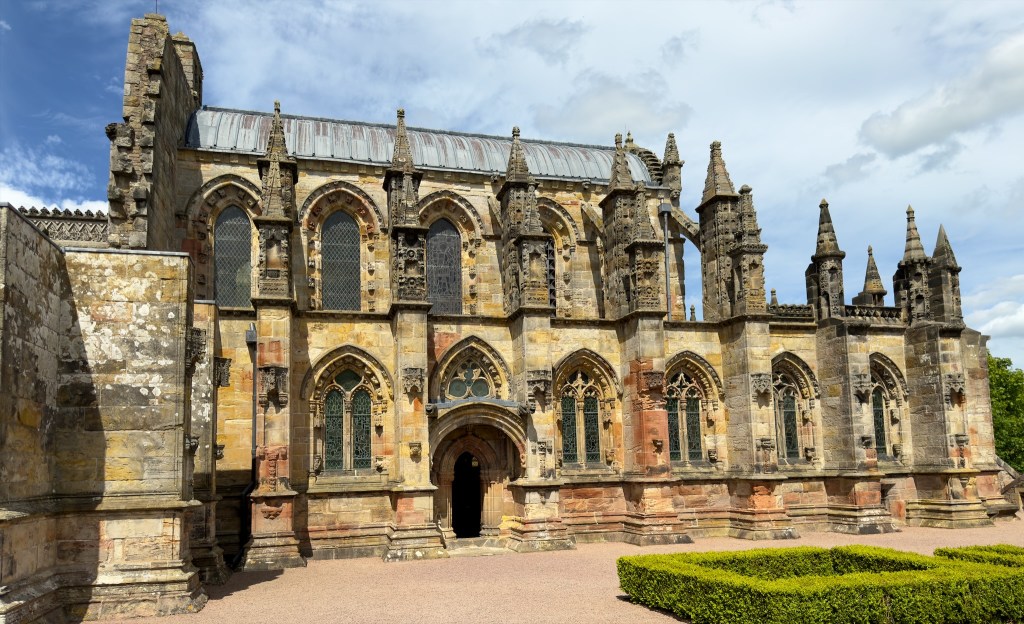
Between 1592 and the 1730s, the chapel had essentially no maintenance. The first documented repair came in 1736, when Sir James St. Clair relaid the floor and reglazed the windows, the earliest concerted preservation effort since the Reformation.
By now a picturesque ruin, it became a magnet for the Romantic imagination: Robert Burns and the painter Alexander Nasmyth visited in 1780; Sir Walter Scott’s 1805 poem “The Lay of the Last Minstrel” popularised the legend that the chapel appears ablaze the night before a St. Clair baron dies; and Wordsworth visited on three occasions.
This literary attention is directly responsible for the chapel’s survival as a recognised heritage object rather than a forgotten ruin. What’s more, the preservation case made to Queen Victoria in the 1840s drew explicitly on this reputation.
The chapel’s restoration was initiated by James Alexander St Clair-Erskine, 3rd Earl of Rosslyn, who took over in 1837. He arranged for external repairs by Edinburgh architect William Burn. Interior restoration began in 1861, led by architect David Bryce.
The chapel was rededicated on 22 April 1862 by the Bishop of Edinburgh, serving the Scottish Episcopal Church. Sunday services resumed after 270 years.
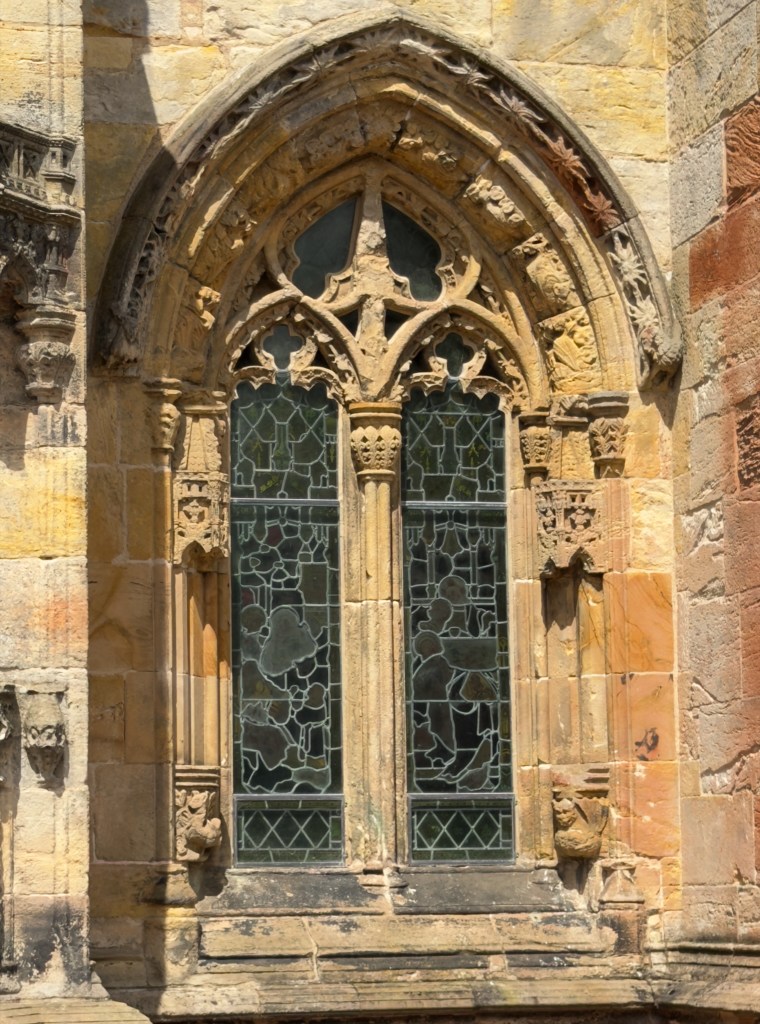
Today, a modern visitors centre next to the chapel grounds has helped improve the management of visitor numbers. This became necessary following the publication of Dan Brown’s book, The Da Vinci Code, and the subsequent film starring Tom Hanks, which saw visitor numbers rise significantly.
As we know, the book has helped associate the chapel with the Knights Templar, the Prieuré de Sion, and the Holy Grail. Indeed, a character in the book actually says the Knights Templar built Rosslyn. Yet building work on the Chapel began 139 years after the Knights Templar were officially destroyed. So the chapel’s association with these mysteries, while intriguing, are unlikely to be anything more than stories.
Even so, they have helped to make Rosslyn Chapel a popular attraction. Step inside and you will see why it inspires, mystifies and staggers today’s visitor.
Unfortunately, the taking of photographs inside the chapel is forbidden.
(A note about the St. Clair name: During the 15th century, the name Sinclair became more widely used as an alternative to St. Clair. Modern usage today tends to prefer Sinclair, but the Rosslyn branch of the family has traditionally used St. Clair).
Rosslyn Chapel: OS National Grid Reference NT 27489 63073
Further reading
The Earl of Rosslyn, 2019, Rosslyn Chapel (Rosslyn Chapel Trust)
Roddy Martine, 2006, The Secrets Of Rosslyn Chapel (Birlinn)
Rosslyn Chapel (official website)
New World Encyclopedia Rosslyn Chapel
Wikishire Rosslyn Chapel




Leave a comment