
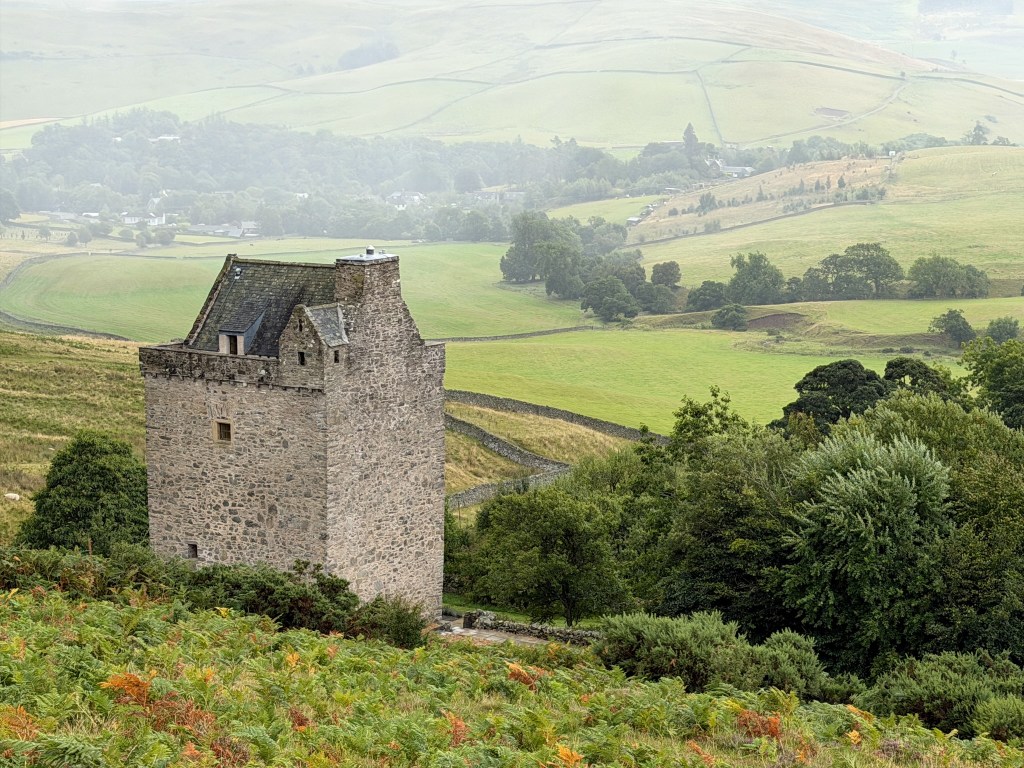
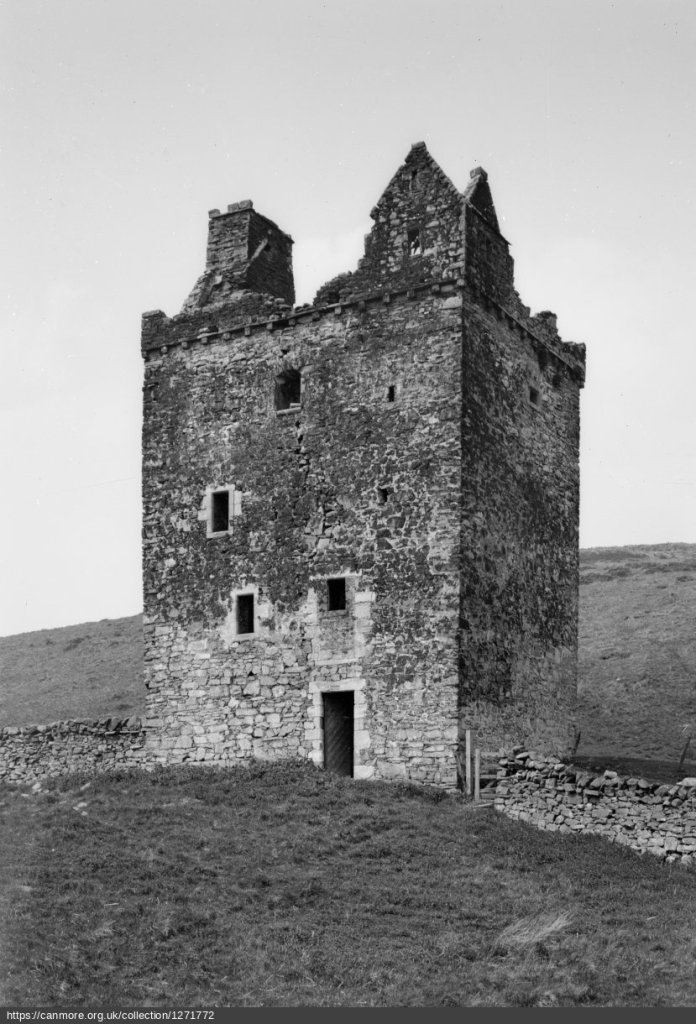
This privately owned tower house stands on a hill overlooking the Ettrick Water, northwest of Ettrickbridge. Before its renovation (1987-1996), it was an austere, roofless ruin dating back to the Border Reivers era.
But before the tower was built, the land was part of the Black Douglas lordship of Ettrick until 1455. The Scottish Crown then acquired the land following the Douglas forfeiture. From the 1460s, the Cranstouns, as Baillies of Ettrick, established tenure and drew income from their holdings, although it is unclear whether they lived there.
The Humes acquired the Ettrick bailliary in 1490, but the Cranstouns retained Kirkhope under tenancy arrangements and subsequently secured stronger hereditary tenure.
So when was Kirkhope Tower built?
That isn’t clear. In 1543, at the start of the Rough Wooing, the Armstrongs, acting on behalf of the English, raided and burned property in Kirkhope. But no evidence of a tower was documented.
Alistair Maxwell-Irving believes the tower was probably built shortly after the 1543 raid, a date consistent with its crude style and lack of provision for firearms. However, the authors of the Addyman Archaeology report suggest a broader range, from 1535, when legislation encouraged defensive buildings, to 1600, as the Royal Commission’s assessment states.
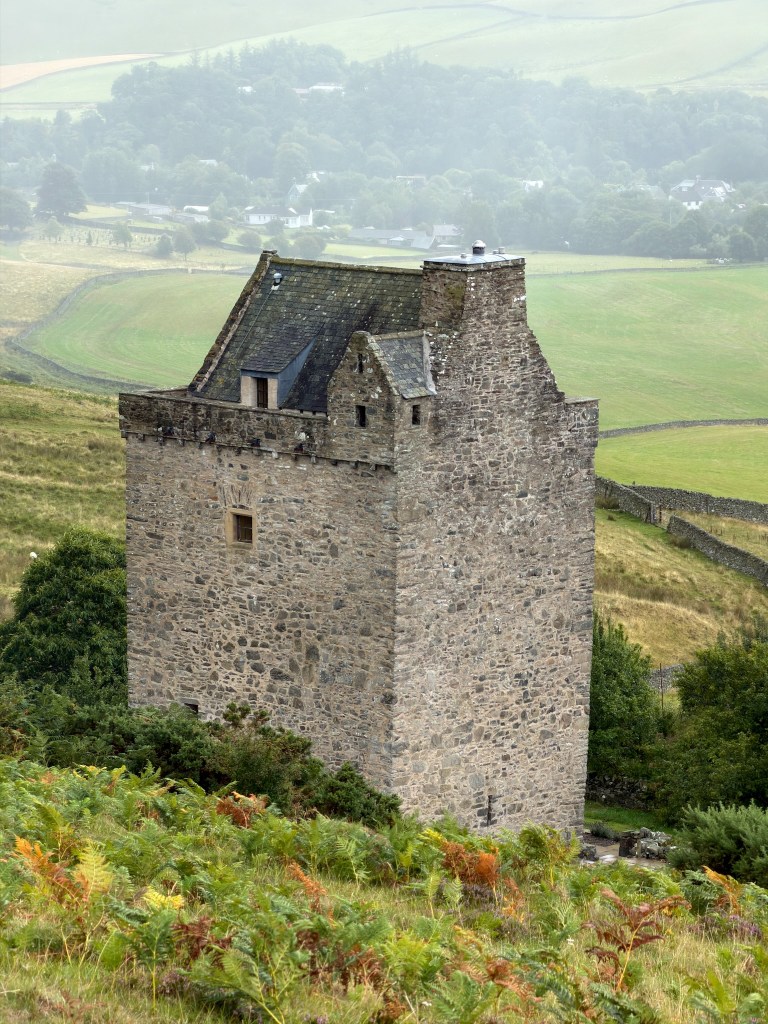
The first actual mention of a tower dates from 1582. By then, the Scott family of Harden may have lived in the tower as tenants of the Cranstouns.
Set on a steep hillside with a deep ravine to the east, Kirkhope Tower commanded views across the Ettrick Valley and beyond. It was a simple structure, roughly built from local Silurian rubble and lacking refinement. Rising to four storeys with an attic, it measured 8.6 by 6.9 metres, with walls 1.5 to 1.8 metres thick.
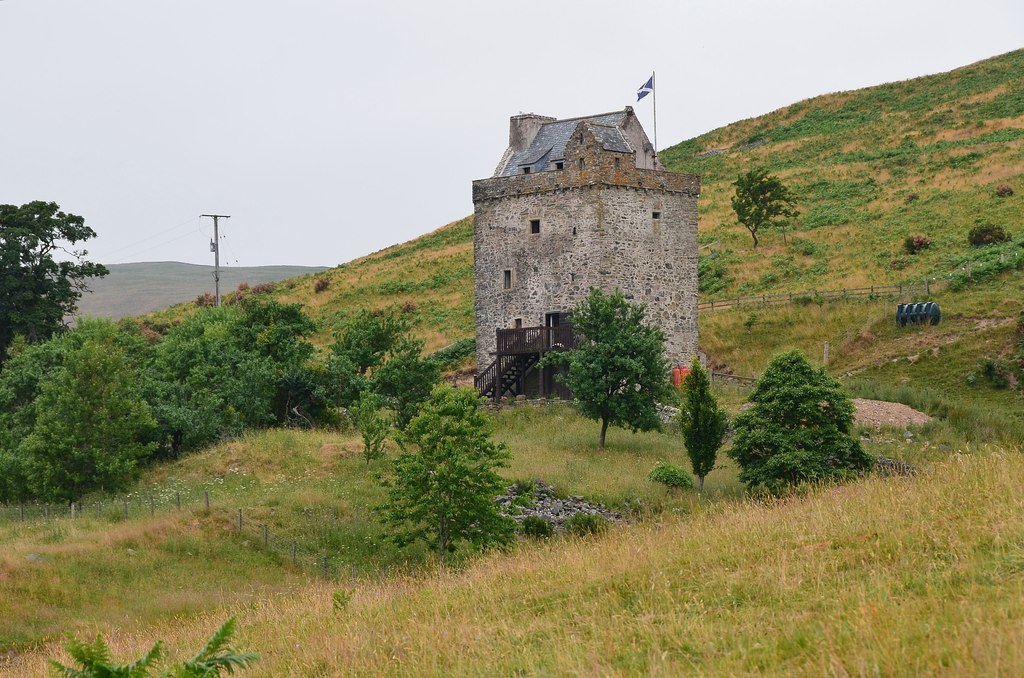
The tower had two entrances: one in the basement and one on the first floor, reached by a wooden forestair. Usually with such layouts, the only internal route between the basement and first floor was a wooden ladder and ceiling hatch, allowing the first floor to be secured easily in times of trouble. But at Kirkhope, neither entrance had a Yett or drawbar, and a stair between them was readily accessible. It seems that entrance security was not a consideration.
As was common with tower houses, the basement was vaulted, and the main living area was on the first floor. Square gabled caphouses stood over the south-east and north-west corners, the latter serving as a sentry box.
Excavations at the site, carried out in 2012, revealed the remains of the original barmkin wall and various outbuildings.
In 1608, the Cranstouns sold Kirkhope to Walter Scott of Harden (Auld Wat), though tradition places him at Kirkhope before the purchase (see above). The Scotts of Harden were a substantial border family whose power rested on land, family alliances and armed followers. Auld Wat was himself a notorious Reiver, but his activities cannot be attributed to Kirkhope Tower since Harden, near Hawick, was also a Scott residence and estate.
Official records document his participation in Bothwell’s attack on Falkland Palace in 1592, the subsequent plundering of Tweedside, and the burning of Liddesdale along with Gideon Murray of Elibank, for which they both received a pardon in 1599. Auld Wat also played a key role in the 1596 rescue of Kinmont Willie from Carlisle Castle. An English report on the rescue refers to Auld Wat as Buccleuch’s “chief man” (Walter Scott of Buccleuch, the architect of the Kinmont Willie rescue).
In 1576, Auld Wat married his cousin Mary Scott of Dryhope, known as The Flower of Yarrow. Even after the Union of the Crowns in 1603, as reiving declined, records cited in his historical biography list accusations about his activities in the English Border country and the peacekeeping obligations imposed on him and his sons.
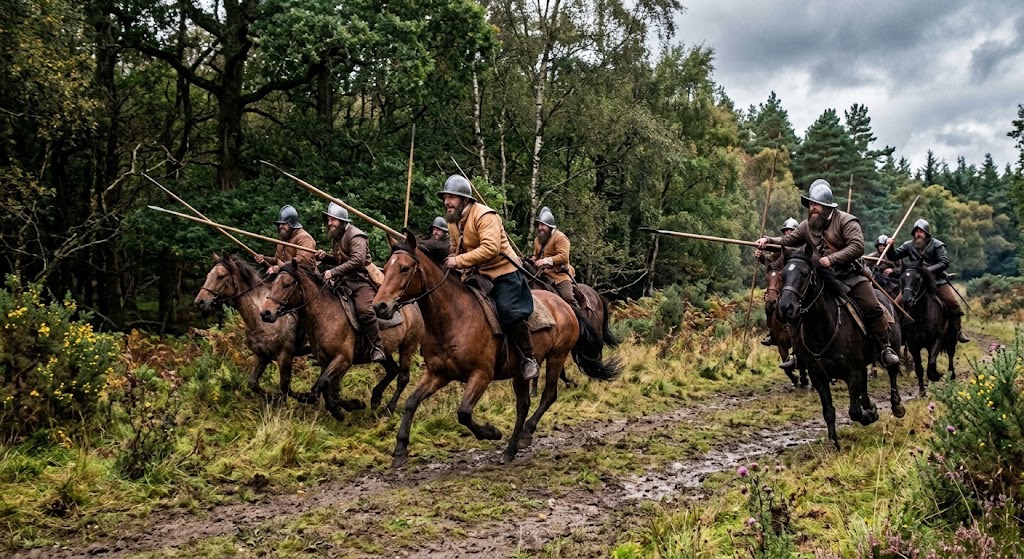
Overall, a picture emerges of a man for whom livestock plundering, house-burning, and armed attacks were normal activities.
At some point, Auld Wat’s son, William, inherited Kirkhope Tower. We also know that Wat’s second wife, Margaret Edgar, lived at Kirkhope in 1629. Whether other close relatives lived at the tower is not known, but the Scotts of Harden remained in possession through the 17th century. However, their mounting debts meant that by 1689, they had sold their interests in Kirkhope to Anne Scott, Duchess of Buccleuch.
From that date, Kirkhope became just another tenanted property on the Buccleuch estate. It remained inhabited until the late 19th century, when it was abandoned. Peter and Gillian Clarke began its modern restoration after buying the tower from the Buccleuch estate in 1987. The current owner, Robert Miller, who purchased it in 2019, carried out further refurbishments. Today, the tower is rented out as a holiday home.
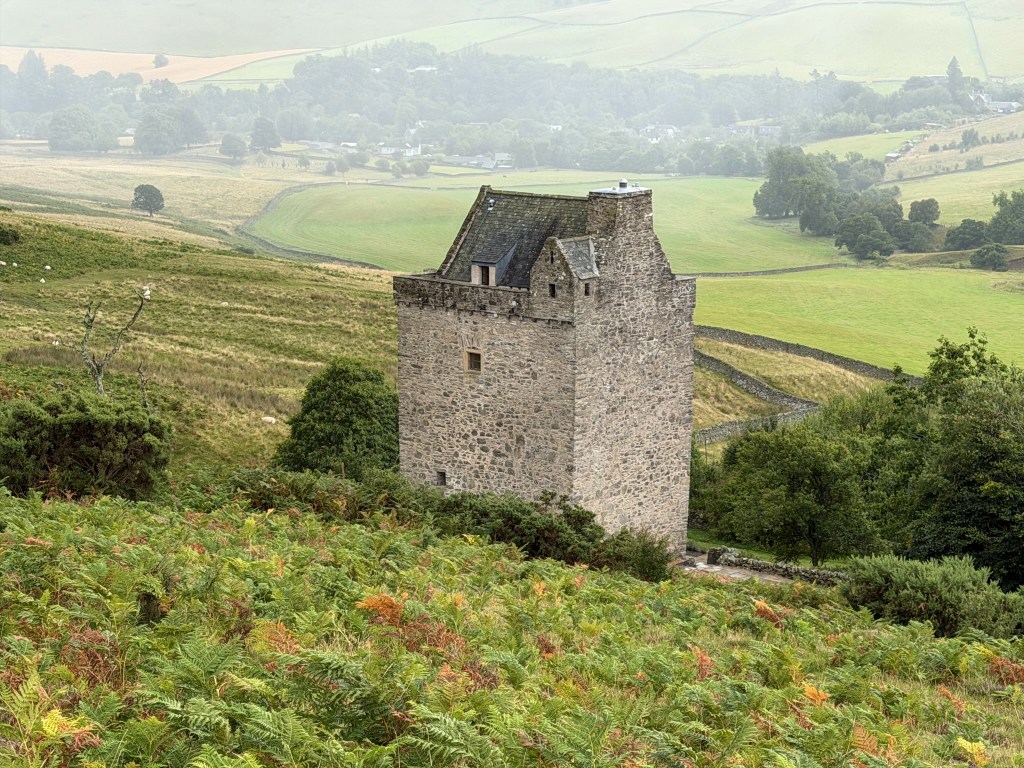
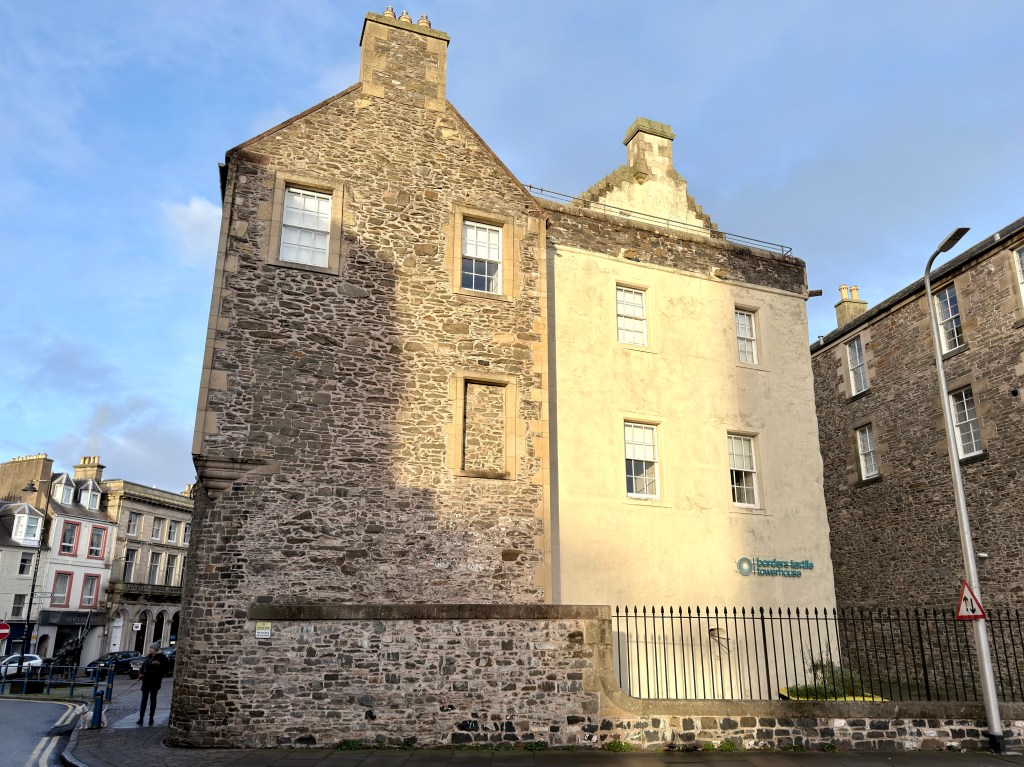
Getting to Kirkhope Tower is fairly straightforward. It lies about 1.6 miles (2.5 km) by car from nearby Ettrickbridge and is signposted from the B7009. The tower is not open to the public, so please respect the privacy of any occupants and view it from the south or the hill to its north.
(Photographs taken by David in 2026, unless stated)
Kirkhope Tower: OS National Grid Reference NT 37872 25053
Further reading
Alistair Maxwell-Irving, 2014, The Border Towers of Scotland 2 (Maxwell-Irving)
Mike Salter, 1994, The Castles of Lothian and the Borders (Folly Publications)
Kirkhope Tower Website
Reivers Kirkhope Tower
Ross Camerson & Tom Addyman 2012 Kirkhope Tower Addyman Archaeology
Wikisource Scott, Walter 1550-1629 Dictionary of National Biography 1885-1900 Vol 51




Leave a Reply