
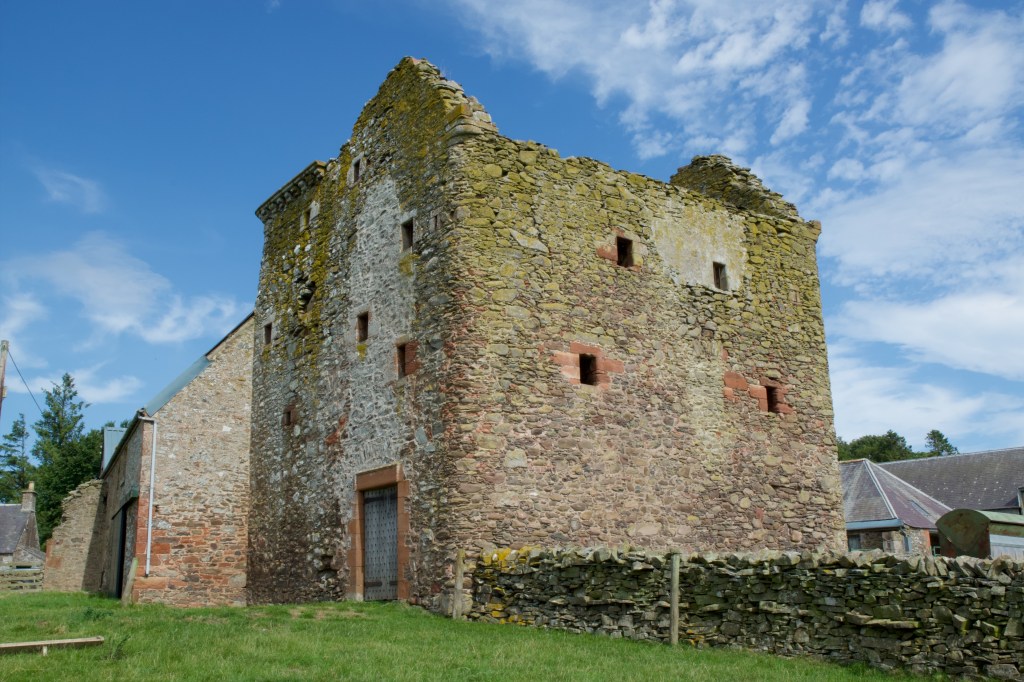
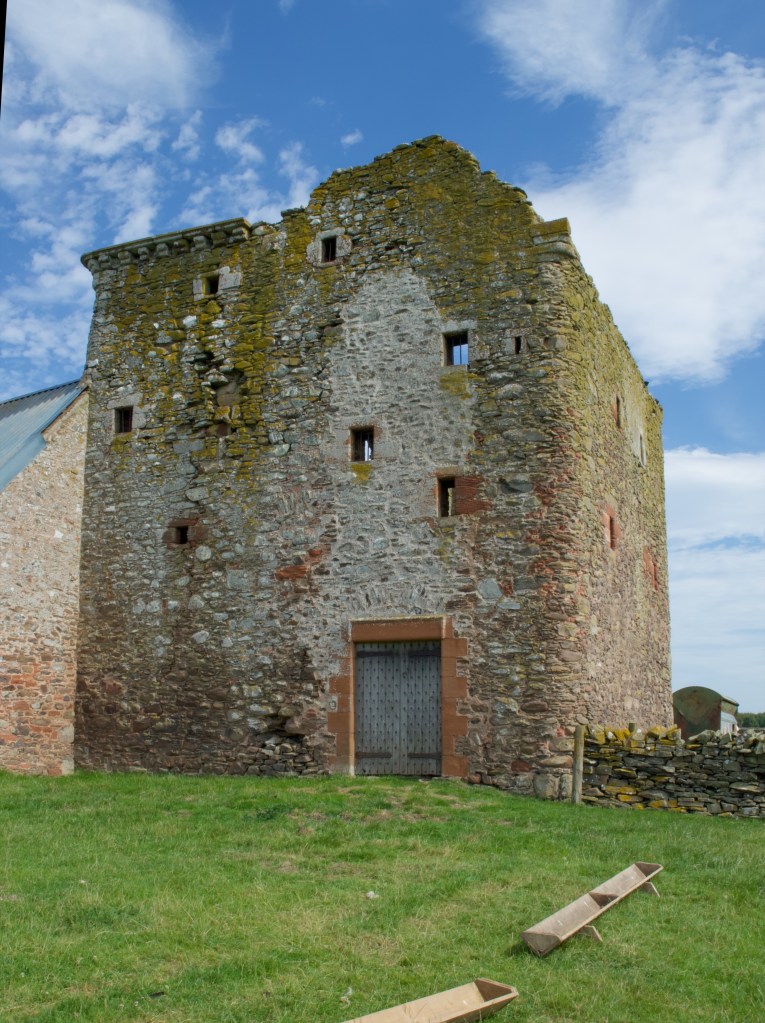
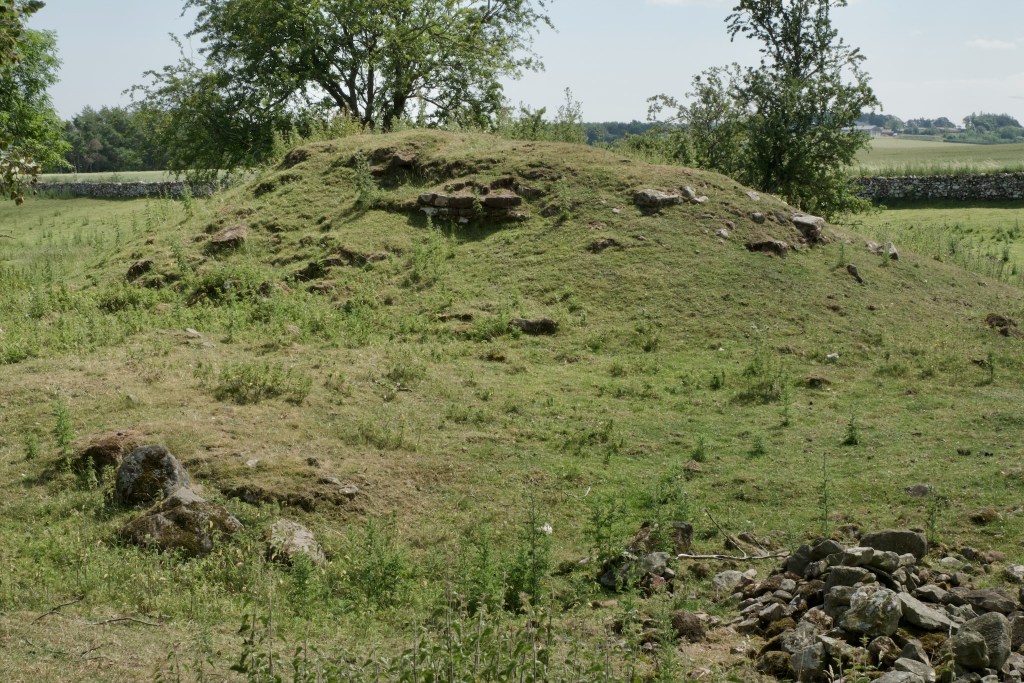
Among the perhaps lesser-known historic tower houses of the Scottish Borders is Evelaw Tower. It stands in the former county of Berwickshire, about 8 miles (13 km) west of Duns, on the southern side of Eve Law. Today it is a ruin amongst farm buildings, but much of the tower still stands to approximately wall-head height.
The name has appeared in a variety of forms over the centuries: Evelie, Ivelie, Iflie, Yfle and Yiffle. The late nineteenth-century Ordnance Gazetteer of Scotland describes Evelaw Tower as Ively.
These earlier names imply that the modern “Evelaw,” which includes the Scots word for hill (law), might be a later reinterpretation of the original place-name. Unsurprisingly, the local pronunciation would have varied, possibly being “EYE-vee” or “EYE-vlee.”
Before the tower was built, the lands appear to have belonged to Dryburgh Abbey. They occur in the abbey’s rental material from approximately 1535 onwards, and in 1550 a tenant named Janet French (Jonet Frainche) is recorded as holding Evelaw under the abbey. She then passed a third of the lands to her son Robert Watson.
After the Reformation, former ecclesiastical lands were converted into secular lordships and redistributed to nobles and local lairds. The decisive moment for Evelaw came in 1576 when the Dryburgh Abbey lands were acquired by William Douglas and his wife Mariote Douglas.
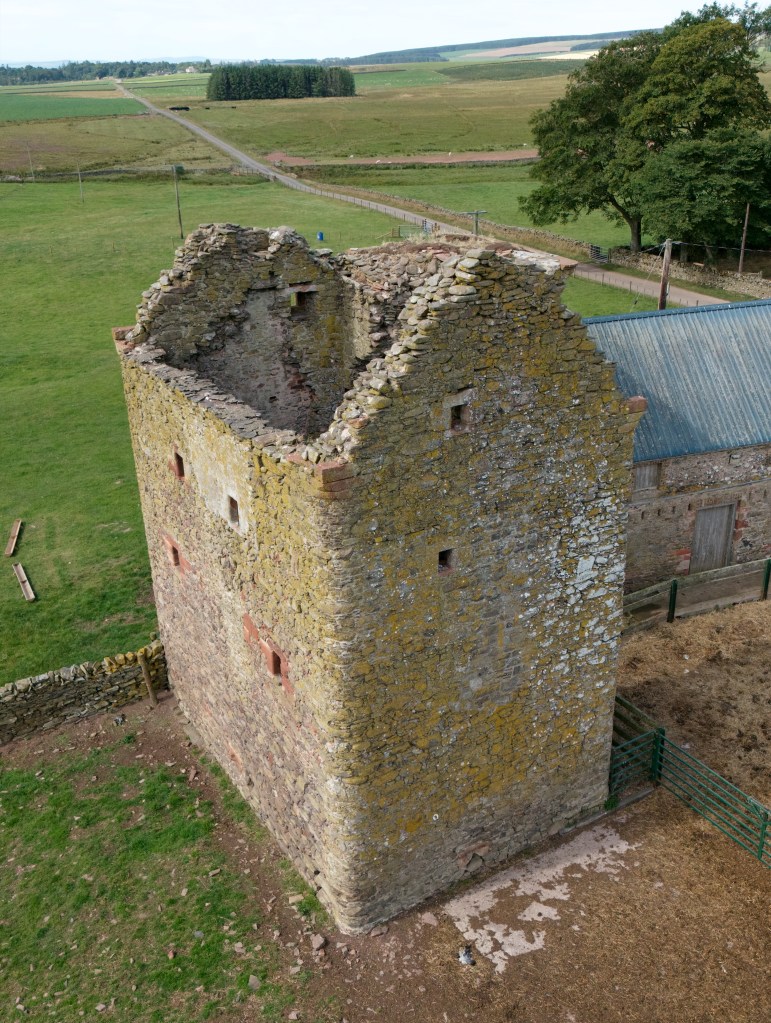
It is believed that the tower was built shortly afterwards, possibly before 1600, although Historic Environment Scotland describes it as “the early seventeenth century.”
But why build a tower house when the great Anglo-Scottish wars were over?
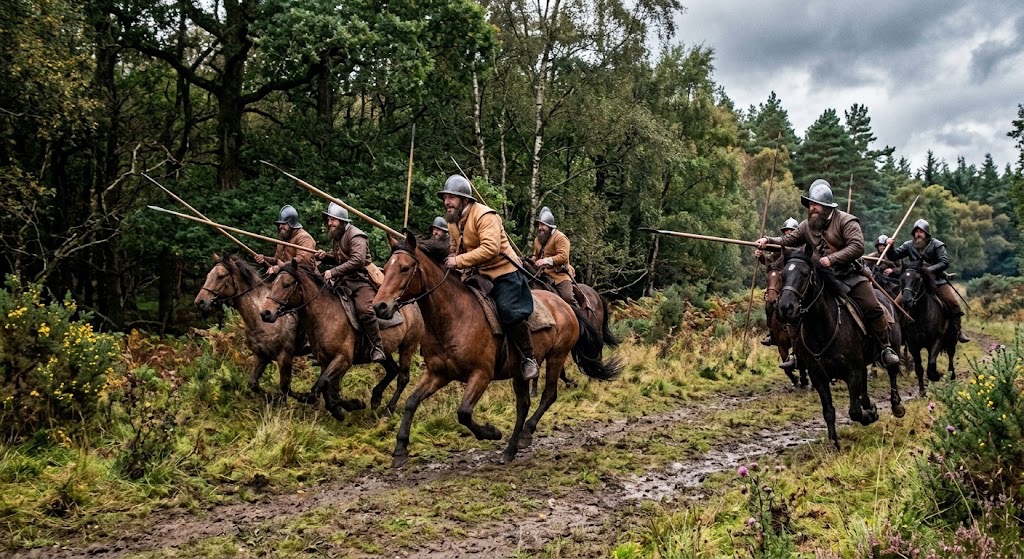
Well, memories of the destruction from Henry VIII of England’s “Rough Wooing” remained vivid. And the estate was located in the area impacted by this conflict. Additionally, Reivers, influential riding families, continued to raid and feud across the borders.
Therefore, defending property was crucial, requiring a fortified residence as much as a simple dwelling.
It also signified the new order following the Reformation. A former monastic holding became the fortified seat of a lay family, and the tower served as both a residence and a physical assertion of Douglas control over the land.
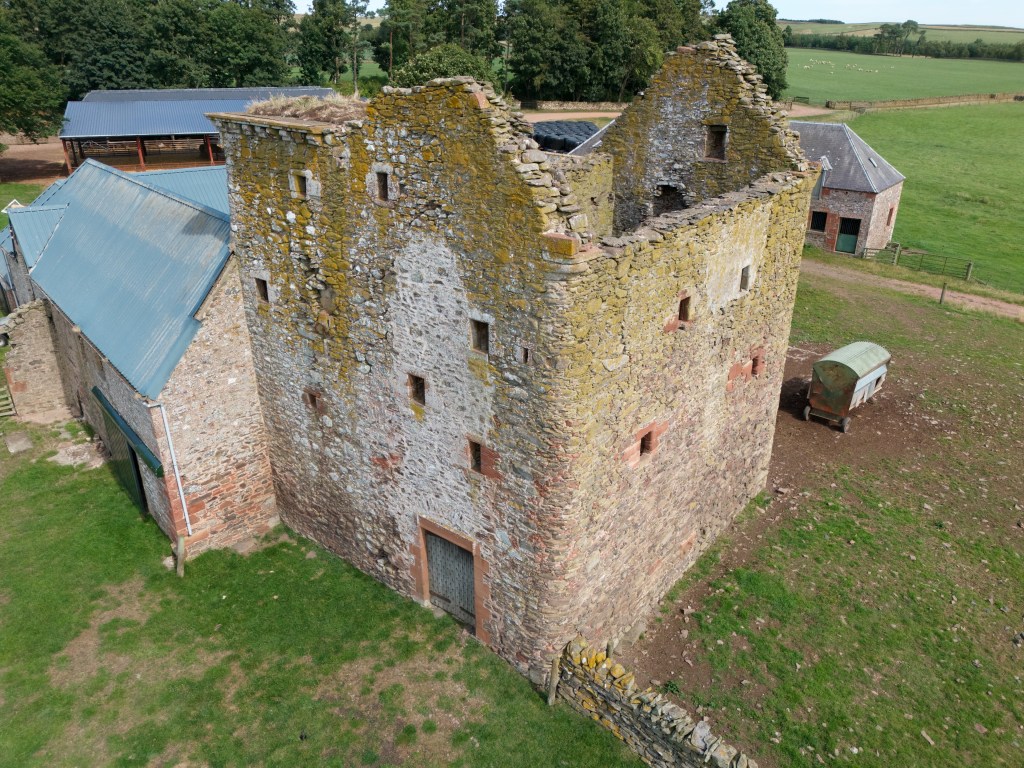
The tower itself was a relatively small but strongly constructed residence. It consisted of a main rectangular block (10.9 by 6.6 metres) with a projecting stair-wing (4.4 by 3.2 metres), forming an L-plan. It had three storeys and a garret, with:
• A vaulted basement and kitchen.
• A first-floor hall.
• Private chambers on the upper floors.
• A stair entered through the re-entrant angle.
• Barred windows and gun-loops.
• Rounded angles corbelled out to square at eaves level.
• A vaulted upper floor in the projecting wing.
This arrangement combined domestic and defensive purposes. It was not a major castle intended to withstand a prolonged siege, but a fortified residence and refuge for a landed family, servants and dependants. The gun-loops and restricted openings were particularly appropriate to the sixteenth-century Borders, where a sudden raid, cattle-lifting expedition or local feud was a more immediate danger than a formal campaign.
However, Alastair Maxwell-Irving explains that the wing’s vaulted top floor played an essential role in supporting a fireproof beacon platform. One of a network of border beacons, this would have been lit to warn of English raids.
The Douglases appear to have remained in possession of Evelaw Tower for at least the first half-century. By 1630 the estate was sufficiently substantial to be recorded as a distinct landed possession. They were assessed as having an annual free rent of £300 and were taxed at £7 19s 4d. By 1634, the property was associated with Robert Douglas, or possibly his heirs.
The Douglas tenure eventually ended through marriage. Evelaw passed to the Sinclairs of Longformacus, an established Berwickshire family. It therefore became associated with a Berwickshire branch of the Sinclair family, distinct from the better-known Sinclair lines of Caithness, Rosslyn and Orkney.
The Sinclairs were notable landowners in the eastern Borders, with their main residence at Longformacus situated just a few miles from Evelaw. The leading figure in the seventeenth century was Sir Robert Sinclair of Longformacus, who inherited his father’s lands there in 1647. In 1664, Charles II appointed him a baronet of Nova Scotia. He was a strong supporter of the royalist cause during the civil wars, and in 1650, Covenanter forces reportedly plundered his house, though this was unlikely to have been the tower at Evelaw.
Nonetheless, the family connection between Evelaw and Longformacus places the tower within the royalist and anti-Covenanter political circles of Border gentry. However, there are no records directly connecting the tower to the tumultuous events of the mid to late 1600s.
The Evelaw estate remained with the Sinclairs for a considerable period. By the early eighteenth century, the owner was Sir John Sinclair of Longformacus. On 18 May 1731, Sir John sold the lands to Archibald Smith, a tenant at Collilaw. Evelaw later passed to the Sommerville family before Andrew Sommerville sold it in 1836 to James Curie of Melrose.
But what actually happened to the tower?
The precise date when Evelaw ceased to be occupied as a residence is uncertain (estate ownership does not always imply residence). But that is actually one of the more interesting aspects of the site. Unlike some Border towers, there is no famous siege or dramatic destruction which explains the ruin. Instead, the likely story is one of gradual obsolescence.
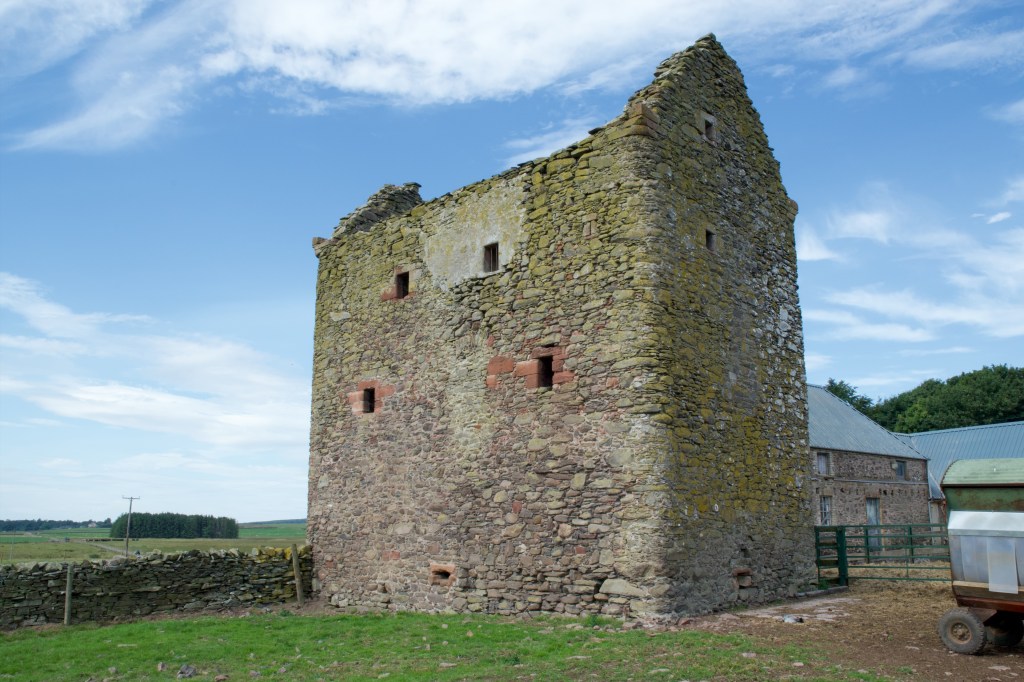
By the eighteenth and nineteenth centuries, landowners increasingly preferred substantial unfortified houses. A dark, defensive tower with thick walls, small windows and cramped accommodation was no longer an attractive principal residence.
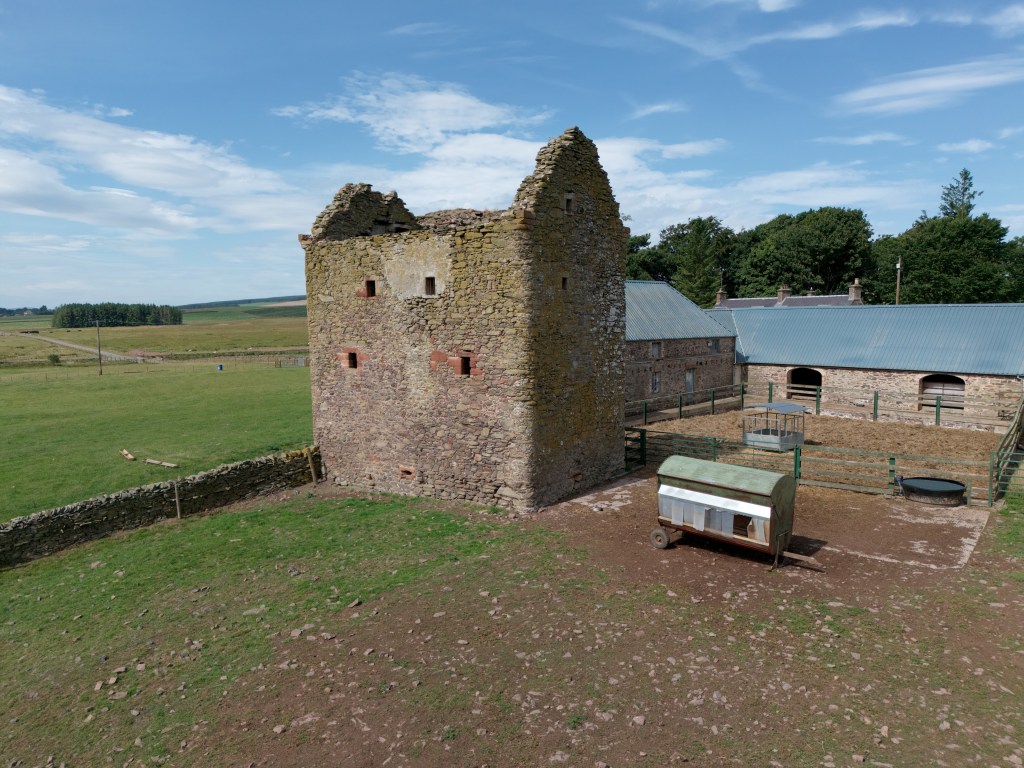
The tower subsequently became incorporated into the agricultural landscape. Farm buildings were constructed against its north side, partly concealing the original L-shaped arrangement.
By today’s standards, Evelaw Tower is remotely located. From Westruther, take the B6456 west, then turn onto the first minor road heading north, passing Wedderlie House. The tarmac road ends here, and you can continue by car or on foot along unmade farm tracks heading east for about 2 kilometres. Since it’s located on an active farm, please explain your purpose for visiting. Be cautious of nearby sheep or other animals—keep dogs on a lead and ensure all gates are closed.
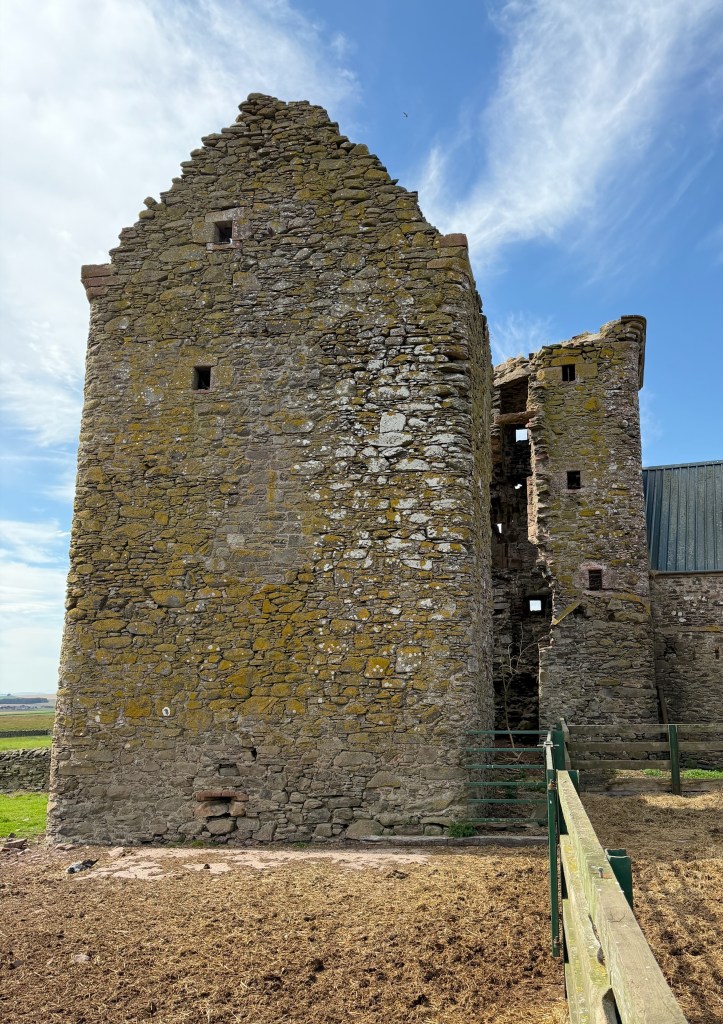
Evelaw Tower is valuable precisely because its history is comparatively quiet. Unlike Hermitage, Fast Castle or Cessford, it is not famous for royal visits, dramatic sieges or a single celebrated family. Instead, it preserves the history of a smaller Border estate that passed through three prominent families, from monastic possession before the Reformation to defensive residence, a link in the Borders beacon network, and eventually reduced to a farm-associated ruin.
In that sense, Evelaw Tower connects architectural survival with the transformation of the Scottish Borders from a militarised frontier into an agricultural and increasingly pacified region. Its occupants show the movement of property from church to noble family, then through marriage and sale into the hands of local landholders and farmers.
Evelaw Tower: OS National Grid Reference NT 66116 52565
Further Reading
Alistair Maxwell-Irving, 2014, The Border Towers of Scotland 2 (Maxwell-Irving)
Ordnance Gazetteer Of Scotland (1883)
History of the Berwickshire Naturalists Club




Leave a Reply