
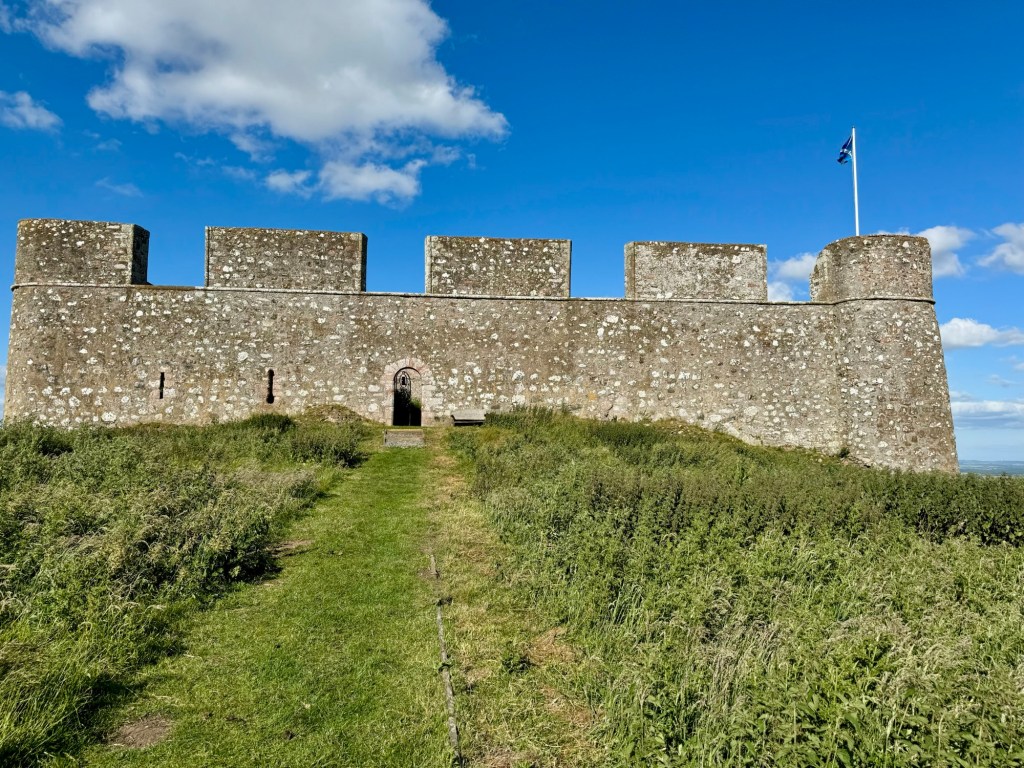
High on a rocky outcrop north of Kelso stands one of the most recognisable landmarks of the Scottish Borders. At first sight, Hume Castle looks like a remarkably well-preserved medieval fortress, complete with massive walls and exaggerated battlements.
But appearances are deceptive.
The castle we see today is largely an eighteenth-century reconstruction or picturesque folly, built on the site of a much older and far more formidable stronghold. Beneath its battlements lie the remains of the castle that once belonged to the powerful Home family, whose members became Lords Home, Wardens of the Eastern March, and later Earls of Home. For centuries, Hume was one of the principal strongholds of the eastern Borders, and its history is inseparable from the recurring conflicts between Scotland and England.
It was a place where medieval lordship, Border warfare, dynastic politics and the Wars of the Three Kingdoms all came together.
Hume Castle occupies an extraordinary natural defensive position. The rocky hill rises above the surrounding countryside, with steep slopes on most sides and particularly difficult ground to the north-west. The only relatively easy approach is from the south-west. From the summit there are extensive views across the Merse and towards the River Tweed, the Cheviots, the Eildon Hills and the Lammermuirs.

The location was important for another reason.
Hume was only about 6 miles (10 kilometres) from the Anglo-Scottish border, and from its summit a warning of an approaching English army could be transmitted across the Border by a chain of beacons. In an age when armies could cross the frontier with relatively little warning, the ability to see for miles across the landscape was a considerable military advantage.
The history of Hume Castle is closely tied to the origins of one of the most important families of the eastern Borders: the Home or Hume family.
The story begins in the early thirteenth century with Ada, daughter of Patrick, Earl of Dunbar. Through marriage, she acquired the lands of Hume, and her 3rd husband, William, took the territorial name de Home from the estate. As was common in medieval Scotland, the name of the family’s principal landholding eventually became the family’s surname.
The original structure of the first castle on the site may have been wooden. According to Historic Environment Scotland, the site might date back to the twelfth century, although the exact timeline of the earliest defences remains unclear. An aerial survey, referenced by the Hume Castle Preservation Trust, revealed a rampart east of the current walls, which is thought to be the remains of an earlier timber-and-earthwork castle, along with additional outworks at the western end of the platform. The same survey also identified a round tower before the current entrance and another on the north wall, indicating a stone courtyard castle that may have replaced the timber structure during the 13th or 14th century.
Interestingly, the modern village of Hume is only a fraction of what once existed. Archaeological surveys have identified the remains of numerous buildings, terraces and other features around the castle. By the late seventeenth century, the village contained 86 houses, while evidence suggests that settlement in the area may go back to the period when the castle itself was established. Hume was therefore not simply an isolated fortress, but the centre of a substantial settlement.

The precise role of Hume Castle during the Wars of Independence is difficult to establish because the surviving documentary evidence is comparatively thin. It is possible that the castle was attacked, given its valuable position, but we have no record.
But Hume Castle’s strategic importance and status was confirmed when Scotland’s James II stayed there during the siege of the nearby Roxburgh Castle (which at the time was held by the English) in 1460. During this period of Anglo-Scottish wars, Hume Castle was a target for both Scottish and English forces. Its strategic location made it valuable for controlling the eastern Scottish Borders.
By the beginning of the sixteenth century the Home family had become deeply involved in national politics as well as Border affairs.
Hume Castle was the principal seat of Alexander Home, 3rd Lord Home, who was one of the most powerful nobles in the eastern Borders.
In 1513, Scotland was drawn into the wider European conflict between England and France. James IV invaded England in support of his French allies, and the resulting campaign culminated in the disastrous Battle of Flodden.
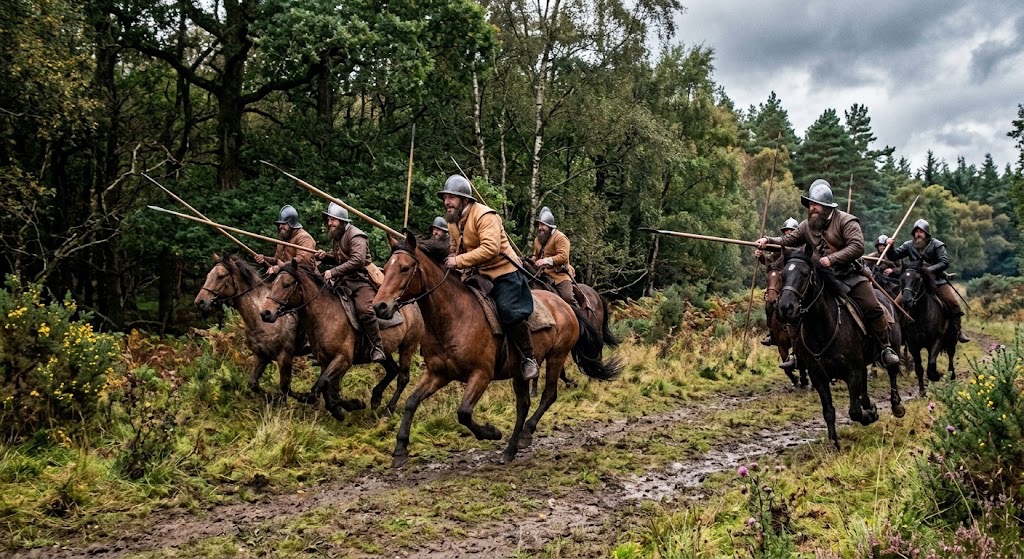
The Home family played an important part in the Scottish army. At Flodden on 9 September 1513, Home and the Earl of Huntly commanded the Scottish vanguard. Their cavalry defeated or dispersed the English right wing, and Home’s contingent appears to have achieved one of the clearest Scottish successes of the battle. The wider Scottish army, however, was destroyed, and James IV was killed along with many leading nobles and members of the Home affinity.
Legend has it that after the battle of Flodden, the 3rd Lord Home took possession of King James IV body and hid it in a cave adjoining the well at Hume Castle. During the 19th century, a skeleton was found in the medieval well with a chain around his waist. Sadly, it disappeared, so we’ll never know whether this was the king.
In the political turmoil following Flodden, accusations were made against some of the Scottish commanders.

Lord Home was accused of having failed to perform his duty properly during the battle and eventually, would be branded a traitor. The charges have to be treated cautiously, because they emerged from the bitter political struggles of the period, but the consequences were very real.
Indeed, after James IV’s death, the crown passed to his infant son James V. The king’s widow, Margaret Tudor, initially acted as regent, and Home became one of her principal councillors, appointed to important judicial and administrative responsibilities south of the Forth.
But when Margaret married the Archibald Douglas, Earl of Angus, her position weakened, and she was replaced as regent by John Stewart, the Duke of Albany. Although he had initially supported Albany’s appointment, Home later aligned himself with Margaret and Angus when Albany took control. This put him in conflict with Albany who moved against the Home family and their Border power base. Hume Castle itself became part of the struggle.
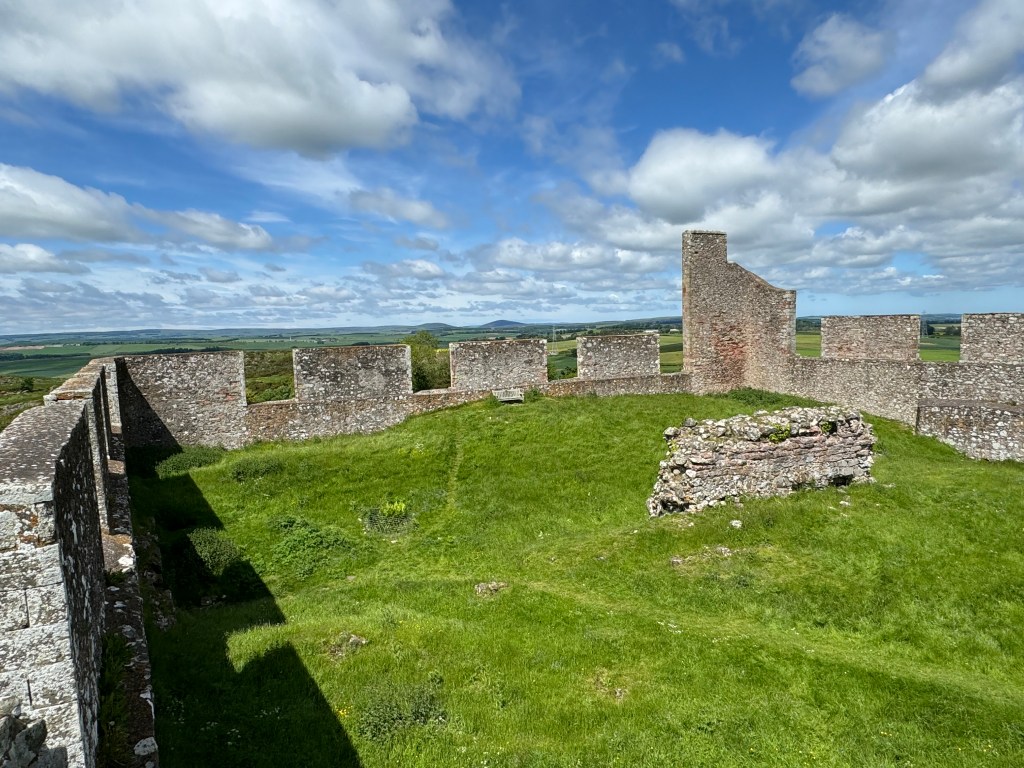
In 1515, the castle was seized during a campaign against the Homes. It was subsequently recovered by Lord Home, and contemporary reports indicate that he deliberately damaged the castle’s defences rather than allow them to fall intact into the hands of his enemies.
In 1516, after a failed attempt to settle their dispute, Regent Albany arrested Alexander Home, and he was subsequently executed, along with his brother William.
The episode illustrates a recurring feature of Border politics. The greatest danger to a Border lord did not necessarily come from England. It could come from the Scottish Crown itself.
And the Borders in the 16th century was rarely peaceful.
The Home lands lay in a region where livestock, labour, and portable wealth were constantly vulnerable to theft. Reiving involved cattle theft, retaliation, ransom, hostage-taking, and the pursuit of long-running feuds. The Homes, as Wardens of the March, were responsible for keeping order and suppressing reiving. But this position was one they could easily exploit to their advantage. They could shelter, employ, protect, or punish the men involved, and conduct their own raids on other families in Scotland or across the border. The Homes were part of the Border Reiver culture, and Hume Castle provided a defensible headquarters from which the family could project power across the Merse.
In other words, the Home lords were aristocratic wardens and political actors whose activities included normal diplomacy, military command, administration, and factional politics, as well as raiding. Nevertheless, the distinction between legitimate enforcement and private violence was often unstable on the frontier.

Of course, the 16th century was marked by a particularly violent period known as the Rough Wooing.
By 1547 the castle had evidently been strengthened to withstand artillery. Its natural position was already formidable, but the development of gunpowder weapons was changing the nature of siege warfare.
The English commander Edward Seymour, Duke of Somerset, invaded Scotland in 1547 and defeated the Scots at the Battle of Pinkie.
The Home family suffered badly. George Home, 4th Lord Home, was mortally wounded, while his son and heir Alexander was captured. The English army then turned towards Hume. And this is where one of the castle’s most remarkable stories begins.
With Lord Home dead and his heir a prisoner, the defence of the castle fell to Mariota or Marion Haliburton, Lady Home. The English army therefore surrounded the castle and threatened to execute Lady Home’s captured son if the garrison refused to surrender.
Lady Home eventually agreed and on 22 September 1547, Hume Castle surrendered to the English. The English then strengthened the fortress and installed a garrison.
But their occupation did not last.
Alexander Home was eventually released, and in 1548, he returned to the Borders and recovered Hume Castle. The Scottish force captured the English garrison and, according to contemporary accounts, put most of the defenders to death. The English commander, Edward Sutton, was captured and imprisoned.
The Homes were also caught up in the extraordinary political crisis surrounding Mary, Queen of Scots. Alexander Home initially supported the political forces that opposed Mary, but his position subsequently changed. He eventually became one of her supporters during the crisis that followed her forced abdication in 1567.
During the Marian Civil War, Hume Castle was again attacked. This time by an English force, led by the Earl of Sussex, that had intervened in support of the anti-Marian faction. The castle’s defenders faced a formidable force equipped with artillery. Sussex brought guns from Wark Castle, including heavier pieces capable of battering the fortifications. After a relatively short siege, the garrison surrendered.
Hume’s natural position still made it difficult to attack, but artillery was steadily undermining the defensive advantages of traditional medieval castles. The same walls which might once have been extremely difficult to storm could now be breached by concentrated gunfire.
Hume Castle’s days as a stronghold finally ended in the seventeenth century. In 1651, during Cromwell’s invasion of Scotland, the English forces, led by Colonel George Fenwick, besieged the castle. The Governor of the castle, Colonel John Cockburn refused at first to surrender, but when the castle walls were breached, Cockburn arranged a parley. This resulted in him and 78 others being allowed to go free; and Fenwick took control of Hume Castle. Later, Cromwell destroyed the castle to prevent its further use as a military stronghold.

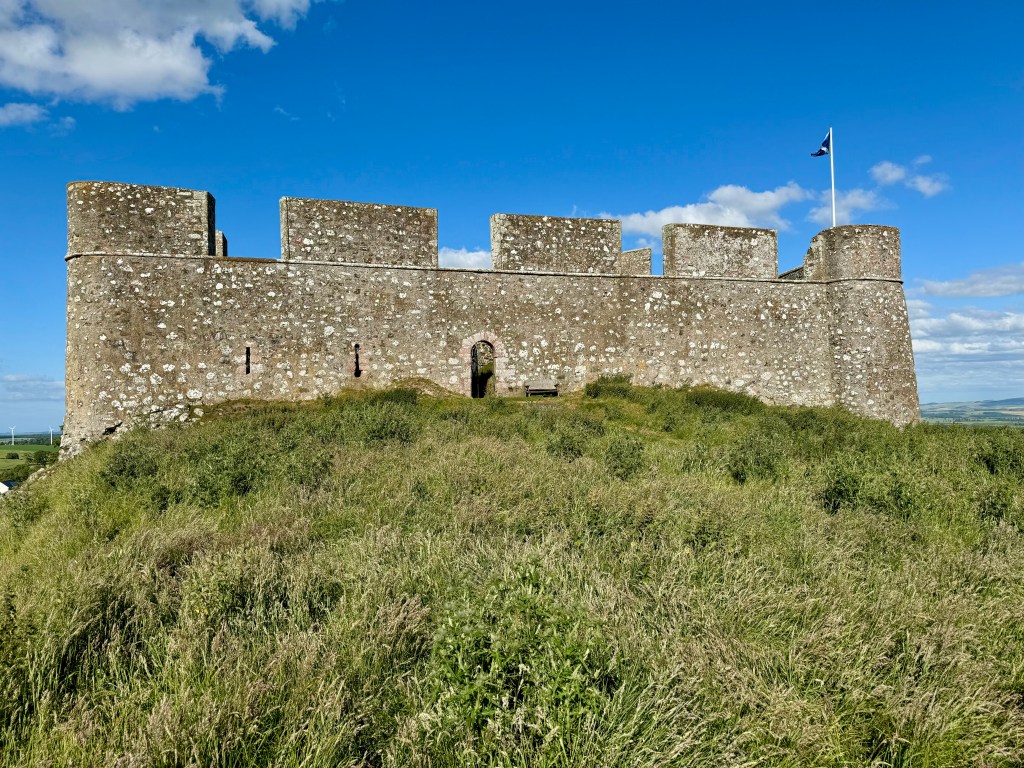
By the 18th century, the lands of Hume had passed to a cadet branch of the family, the Earls of Marchmont. It was Sir Hugh-Hume Campbell, the 3rd Earl of Marchmont who bulit the folly, the ruins of which stand today.
But the story doesn’t quite end there. The folly was used as a signal station during the Napoleonic wars. In 1804 it was the cause of the “Great Alarm” when a sergeant mistook charcoal fires on possibly the Cheviots, or perhaps Dirrington Law, a hill 12 miles (19 km) to the north, as a warning of imminent attack. He fired his own beacon at Hume, setting in train the lighting of all Borders’ beacons to the west.
The transformation of Hume Castle to a folly is particularly interesting because it reflects the changing eighteenth-century attitude towards medieval ruins. What had once been an instrument of war could now be appreciated for its romantic appearance and its contribution to the landscape. Historic Environment Scotland specifically identifies Hume as an important example of this changing appreciation of the medieval past and the development of the picturesque landscape aesthetic.
Visiting Hume Castle is simple. It’s a short drive from Kelso, with a small car park just past a row of houses. Some steep steps lead up partway, but the terrain is quite uneven, so sturdy footwear is advised. The area is regularly grazed by sheep, so keep dogs on a lead if you’re bringing them along.
The site is free to access, throughout the year. There are no internal structures to explore; the area within the walls is covered with grass, save for the remaining part of the old castle.
As there are no facilities on site or in Hume itself, you are recommended to visit Kelso for pubs, cafes and public toilets.
Further reading:
Hume Castle Preservation Trust


 Thistle & Time
Leave a comment