
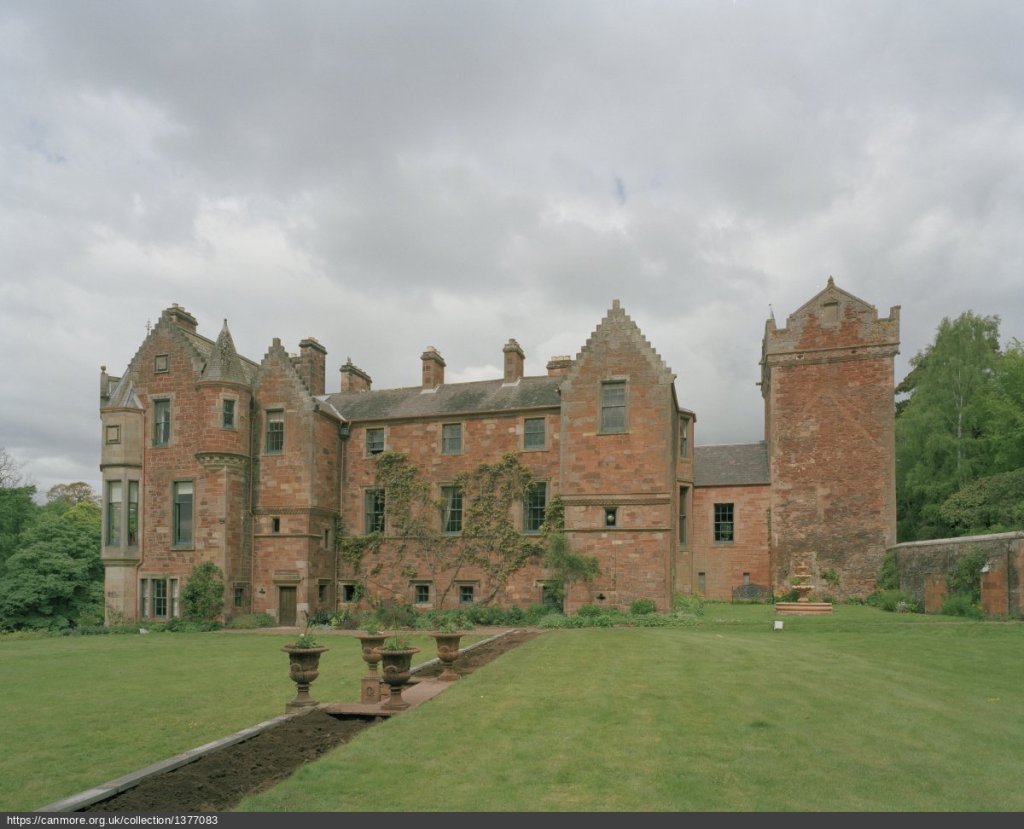
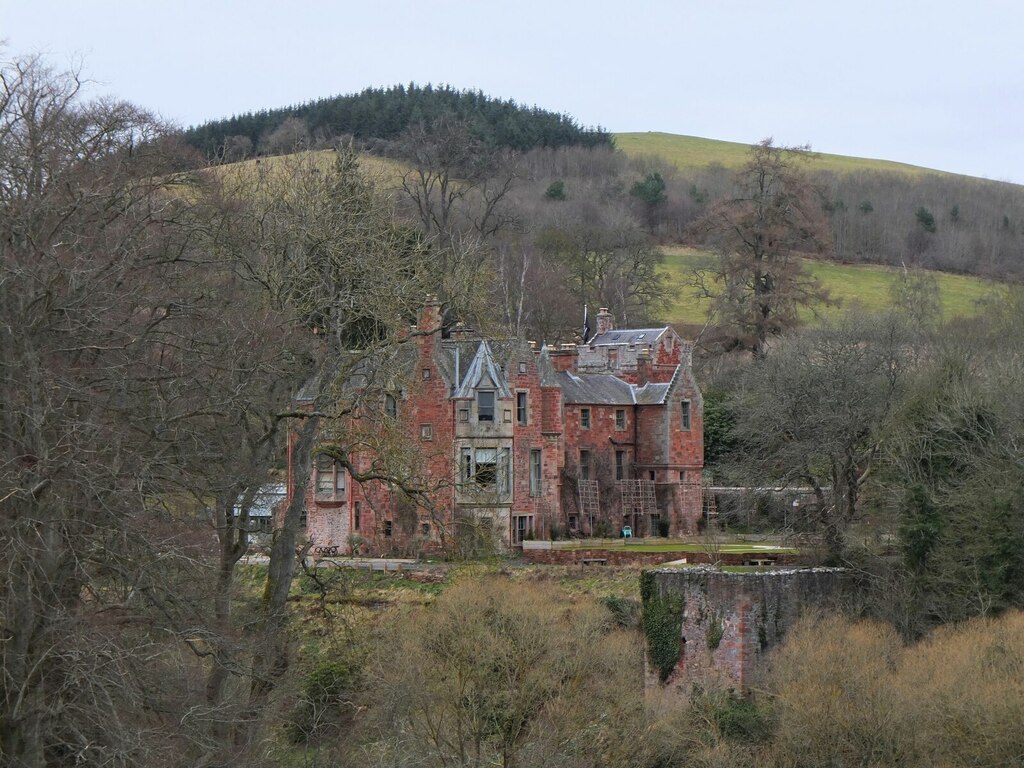
Cowdenknowes, just south of Earlston on the eastern bank of the Leader Water, is an intriguing historic house.
Two generations of the powerful Home family lived here and became embroiled in the dramatic events of 16th-century Scotland. Their achievements are reflected in the buildings they left behind: a formidable 16th-century tower and a remarkably sophisticated Renaissance mansion, both incorporated into the Cowdenknowes House we see today.
But Cowdenknowes may have origins dating back to the Middle Ages. Later estate histories say the site was occupied by a Douglas stronghold as early as the 12th century. This is an appealing possibility, but firm contemporary evidence has yet to confirm it. We can say with much greater confidence that Cowdenknowes was an established fortified residence by the late 15th or early 16th century.
Cowdenknowes is marked on Blaeu’s mid-17th century map as “Coldunknow Castle”.
A brief history
In 1484, the Earl of Angus ordered the lands of Earlston and Cowdenknowes transferred to Alexander Home, grandson and heir of the 1st Lord Home. Nine months later, Angus revoked the order in favour of Alexander’s younger brother, John Home of Whitrig, who acquired Cowdenknowes in 1489. Later royal charters confirmed the family’s ownership, establishing the Homes of Cowdenknowes as a cadet branch of one of the eastern Borders’ most powerful riding families.
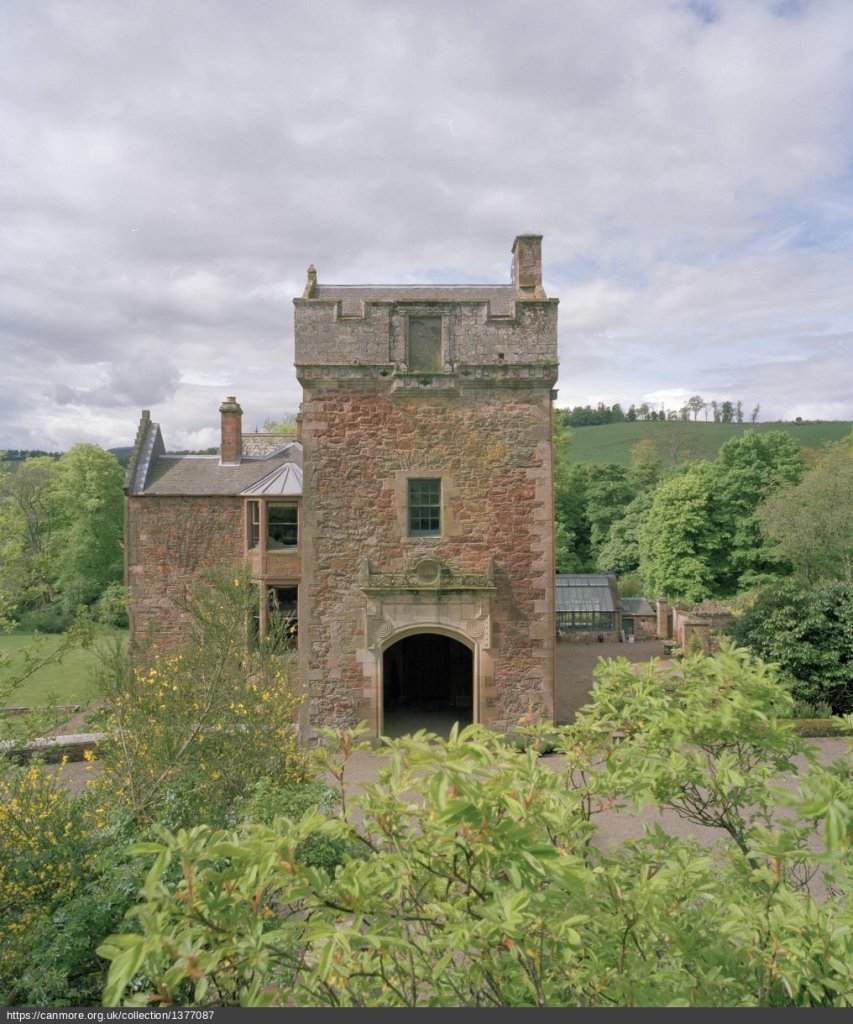
The north tower is generally dated to around 1554, when Sir John Home owned it. It was therefore built, or substantially rebuilt, soon after the Rough Wooing, during which English invasions devastated much of the eastern Borders.
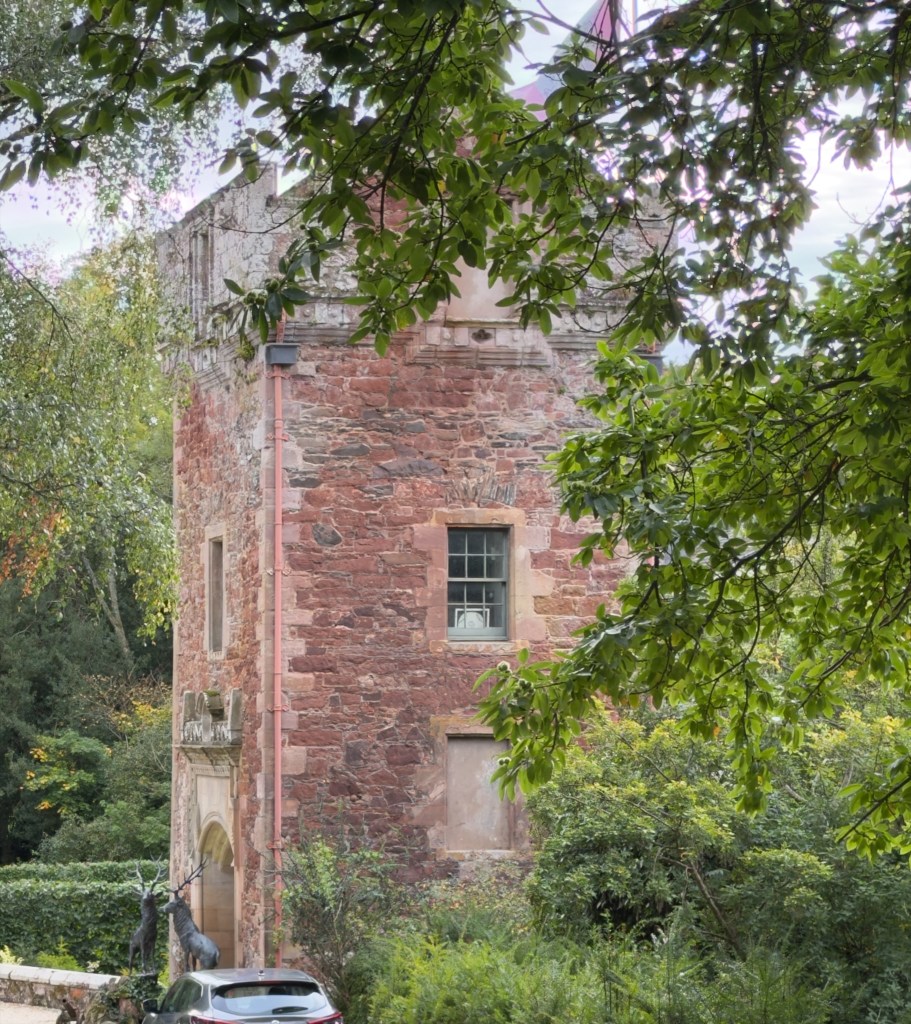
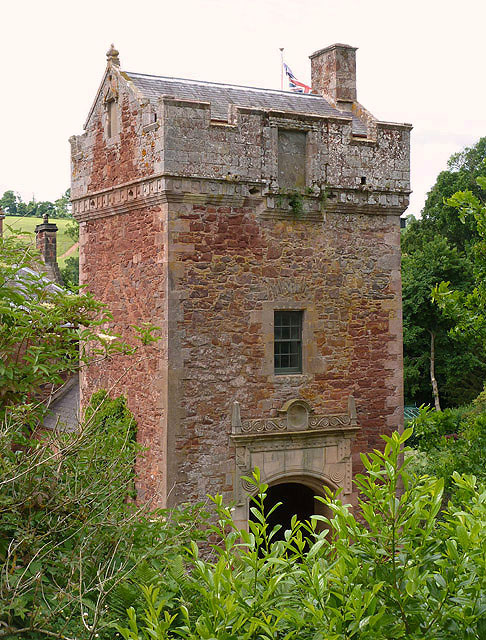
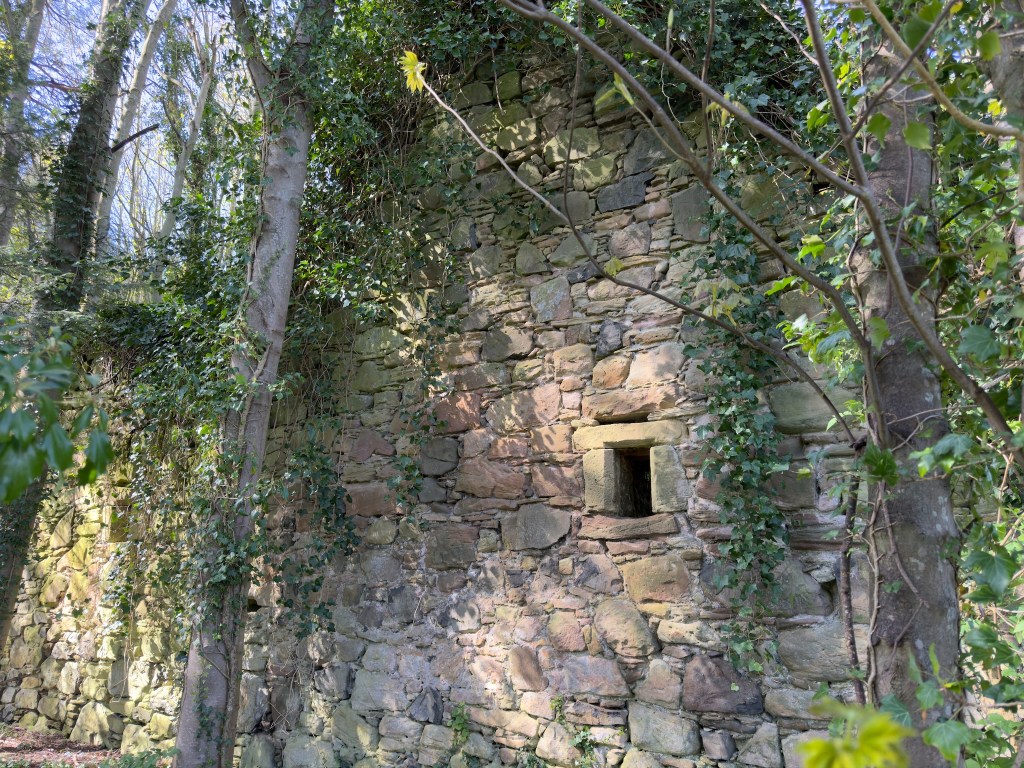
The original complex was more extensive than a single tower. Historic Environment Scotland identifies three main components: the north tower, a smaller tower now ruined, and the later mansion. These were originally connected by defensive walls enclosing a courtyard or barmkin.
The north tower offered defensible accommodation and showcased its owners’ status. Built from local red sandstone, it had three storeys and a garret, and measured 6.5 by 5.5 metres, with walls more than a metre thick. It likely included a vaulted basement from the outset. However, later alterations make its original appearance difficult to reconstruct.
There is no firm evidence that Cowdenknowes was burnt during the Rough Wooing or that the tower was built specifically to replace a destroyed building. Its construction date nevertheless places it firmly within the period of renewed concern about Border security.
Sir John Home, who married Margaret Ker of Cessford, was an active participant in the turbulent politics of the mid-16th century.
During the Rough Wooing, he travelled to France in June 1547, apparently seeking military assistance for the Scots against the English. After Scotland’s defeat at Pinkie and the English occupation of Hume Castle, he took part in the castle’s daring recapture in December 1548. Contemporary correspondence names John alongside Andrew Home and John Haitlie of Mellerstain. Regent Arran recognised his contribution, and records from Mary of Guise’s French-backed administration also link him to financial support from France.
But John Home was among those accused of killing Sir Walter Scott of Buccleuch on 4 October 1552. An indictment from the time names Home, members of the Ker family, and others. The killing took place in Edinburgh amid the bitter Scott-Ker feud and was seen as revenge for the 1526 death of Andrew Ker, the father of Home’s wife.
John died in 1573 and his son James, initially known as James Home of Syndlaws, became one of the most politically influential members of the family. Knighted in 1565 during celebrations at Mary, Queen of Scots’ court, he subsequently joined the nobles opposing Mary and the Earl of Bothwell.
Historical accounts place him with the Confederate Lords at Carberry Hill in June 1567, where Mary’s surrender led to her imprisonment and eventual abdication. It isn’t known if he was at also at the later Battle of Langside, but his allegiance brought substantial rewards. Following the government’s victory, Regent Morton appointed him Warden of the East March in November 1573 and granted him control of the forfeited Hume Castle.
In 1574, Sir James Home and his wife Katherine constructed an impressive new mansion alongside the older north tower. This was a very different kind of building. Its carefully arranged principal chambers, vaulted service rooms and Renaissance architectural details reflected a growing emphasis on comfort, sophistication and social status.
But Sir James’s political adventures were to continue. In August 1582, a group of Protestant nobles led by William Ruthven, Earl of Gowrie, seized the young James VI at Ruthven Castle near Perth, seeking to curb the influence of his powerful favourites.
Sir James was among the Border lairds associated with what became known as the Ruthven faction, though there is no firm evidence that he took part in the King’s initial capture. When James VI escaped the faction’s control in 1583, Sir James became politically vulnerable. During the Earl of Arran’s ascendancy, he was imprisoned at Blackness Castle in 1584, and his possession of Cowdenknowes was threatened.
His fortunes improved after Arran’s downfall in 1585. He later became Captain of Edinburgh Castle, demonstrating his remarkable ability to survive the shifting politics of James VI’s reign.
Sir James was succeeded by his son, another Sir John Home, whose career continued into the reign of James VI and I after the Union of the Crowns. In 1608, he married Beatrice Ruthven, daughter of the Earl of Gowrie, who had led the Raid of Ruthven in 1582. The marriage created a direct family connection to the household behind the earlier conspiracy.
Despite their prominence, the Homes gradually lost Cowdenknowes through financial difficulties and land transfers.
In 1634, King Charles I granted a charter making Cowdenknowes a separate barony in favour of James Livingston of Biel and Skirling, a royal courtier.
The estate later passed through other families, including those connected with the Hamilton Earls of Haddington. By the 19th century, Cowdenknowes belonged first to James Gilfillan and later to William Cotesworth. Under successive owners, it developed into the country house whose appearance survives today.
Tradition and folklore
A longstanding account says that Mary, Queen of Scots stayed at Cowdenknowes while travelling to Jedburgh in 1566. The story appears in later estate descriptions, but no contemporary record confirming her presence has been found.
Nineteenth-century descriptions mention a dungeon in the old tower and a tree said to have been used by the Homes to hang offenders. These stories reflect the harsh reputation of Border justice, but while they may well have occurred, no specific executions at Cowdenknowes have been reliably documented. They remain part of the property’s folklore rather than established history.
Cowdenknowes also has a gentler claim to fame in the traditional Scottish ballad The Broom o’ the Cowdenknowes. Its verses celebrate the broom-covered hillsides of the Leader valley and tell of love and separation. The song carried Cowdenknowes’s name far beyond the Borders.
Cowdenknowes today
Today Cowdenknowes is recognised as a Category A listed building, reflecting the exceptional historical and architectural interest of the surviving complex. It remains privately owned and is not open to the public. However, the north tower is advertised as being available for holiday rentals.
Cowdenknowes offers an unusually complete picture of how life changed for the great Border families during the 16th century.
The older north tower reflects an age of insecurity, invasion and fortified residences. The mansion of 1574 represents a different world, in which royal office, political influence and architectural sophistication were becoming increasingly important.
Few surviving Borders residences bring together so many strands of Scottish history.
And while some of the colourful stories associated with Cowdenknowes belong to folklore, the documented history is remarkable enough: a family that fought the English, opposed a Scottish queen, helped sustain a royal government, supported a plot to seize a king and repeatedly recovered from the political consequences.
Cowdenknowes House: OS National Grid Reference NT 57728 37038
(Note: Featured image, top of page, from Historic Environment Scotland Crown Copyright: HES)
Further Reading
Alistair Maxwell-Irving (2014) The Border Towers of Scotland 2 (Maxwell-Irving)
Maureen Meikle (1988) Lairds and Gentlemen: A Study of the Landed Families of the Eastern Anglo-Scottish Borders University of Edinburgh (download)
James Home of Cowdenknowes Wikipedia
A History of the Barony of Cowdenknowes electricscotland.com
Cowdenknowes (Estate Agent particulars) On the Market
William Fraser, 1878, The Scotts of Buccleuch Vol II deriv.nls.uk




Leave a Reply