
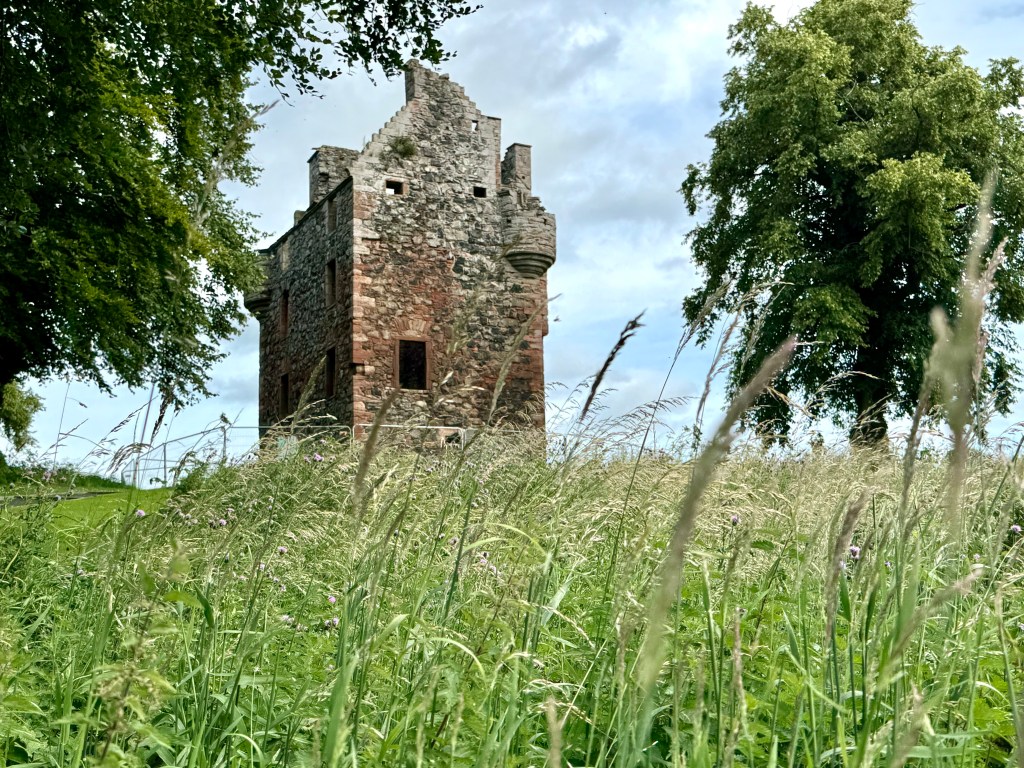
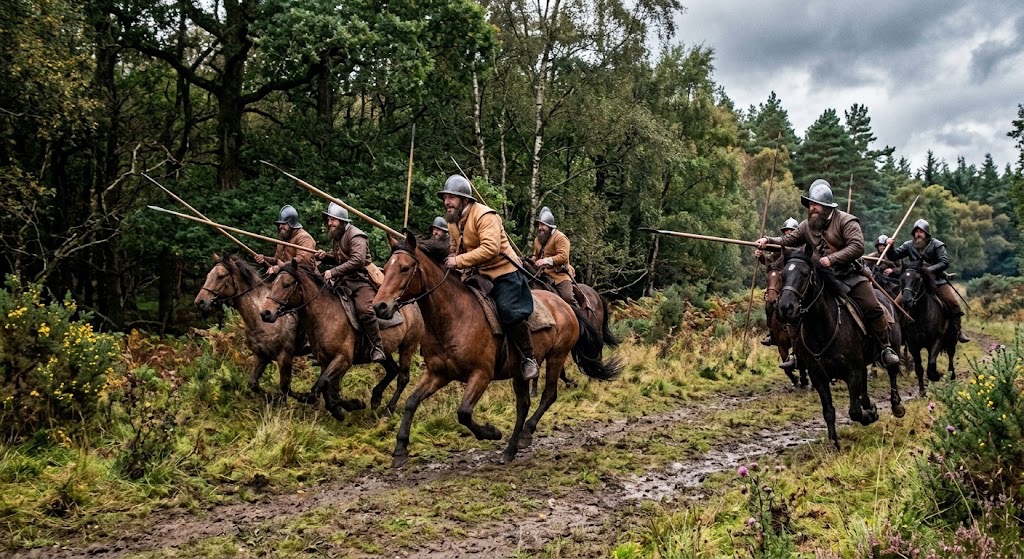
The Scottish Borders has a turbulent history. As well as being the frontline for wars with England, it was home to a number of notorious families known as Border Reivers. So perhaps not surprisingly, fortified tower houses were built to deter and defend against attack.

Greenknowe Tower, located near Gordon in the Scottish Borders, is an interesting 16th-century example of a tower house. It was built in 1581 by Sir James Seton of Touch, with the construction date and the initials of Seton and his wife, Janet Edmonstone, inscribed above the entrance. The Seton family had owned land in Gordon since marrying into the Gordon family: who in turn had been granted the estate by Malcolm II in 1018.

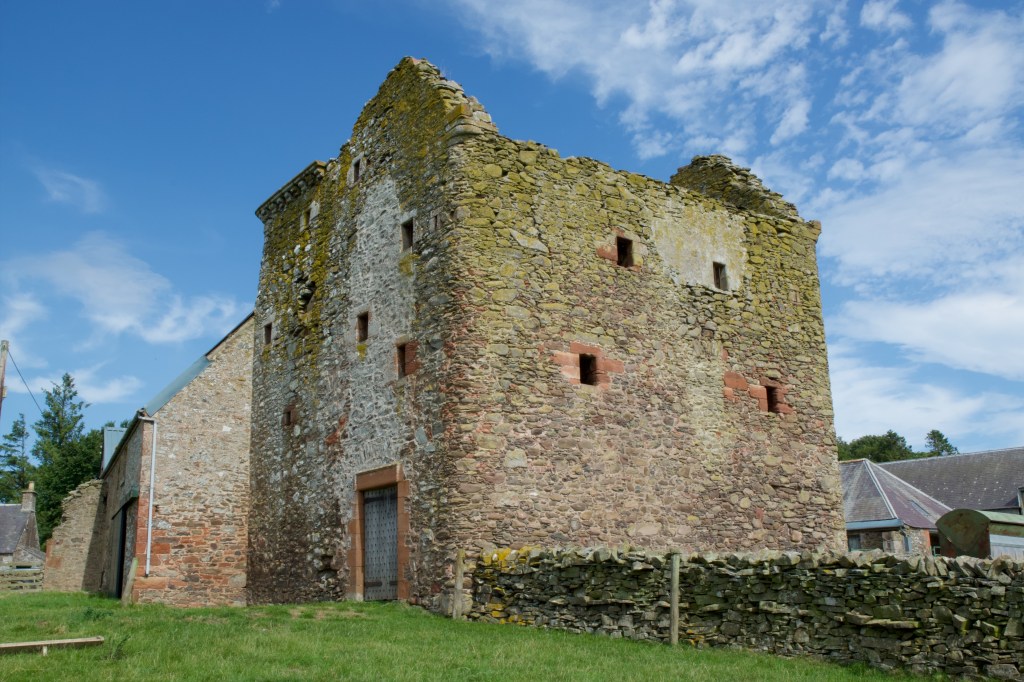
The tower rises impressively to four stories, with a distinctive L-plan design. It is adorned with multi-corbelled angle turrets and crow-stepped gables. Its defensive features include gun loops, a single entrance door, and an iron yett (a type of gate) that is still in place today. However, there is no parapet.
Built of local Silurian rubble and sandstone, the main block measures 10.7 by 7 metres, with walls of over 1 metre thick. The wing measures 4.7 by 3.2 metres. From the entrance hallway, there are three steps down to a vaulted basement with a kitchen at its north end. The spiral staircase in the wing only rises as far as the first floor, after which there is a smaller turret stair. The main hall is on the first floor, while the second floor is divided into two rooms. The third floor, now ruinous, was similarly arranged.
While today Greenknowe Tower stands in relative isolation on its knoll, historically it was the centrepiece of a more extensive complex. Originally, the tower was surrounded by a stone wall enclosing a large courtyard area that would have contained various outbuildings. This arrangement is typical of Scottish tower houses, which often formed the secure core of a localised settlement.

The Setons themselves were a notable royalist family. The main Seton line was strongly associated with the Catholic and royal cause during the Reformation era, and cadet branches often shared similar loyalties. The tower’s construction during the era of the Border Reivers, and shortly after the instability of the Marian Civil Wars, suggests lingering concern about border security.
That said, Historic Environment Scotland suggests that Seton didn’t anticipate a great deal of trouble at his new home. The impressive turrets were possibly more for show than for defence, while the pistol holes in the walls were better suited for deterring intruders than defending against armies. That said, it was strategically positioned to provide protection and demonstrate the family’s social standing.

Greenknowe Tower passed to the Pringles in the early 1600s. Noted Covenanter and author Walter Pringle of Stichel lived there in the mid-1600s. He may have refurbished the tower, enlarging windows and adding an extension on the north side. His memoirs describe the upheavals of the period and the sufferings endured by supporters of the Covenant.
In these memoirs, Walter mentions the time he fought against Cromwell’s English Army at Dunbar in 1650, and then, when back in the Borders, killed an English soldier. A decade later in September 1660, following the restoration of the Monarchy, Walter, was imprisoned for 15 days in Edinburgh Castle, presumably for his religious beliefs.
The tower later passed to the Dalrymple family and then eventually to the Fairholmes. But in or around 1850, it was abandoned. It was given into state care in 1937. Today, it is a scheduled ancient monument and is managed by Historic Environment Scotland.

Although Greenknowe Tower was not a fortress in the military sense, over the years it appears to have served as a relatively secure lairdly residence during a time when trouble repeatedly visited southern Scotland.
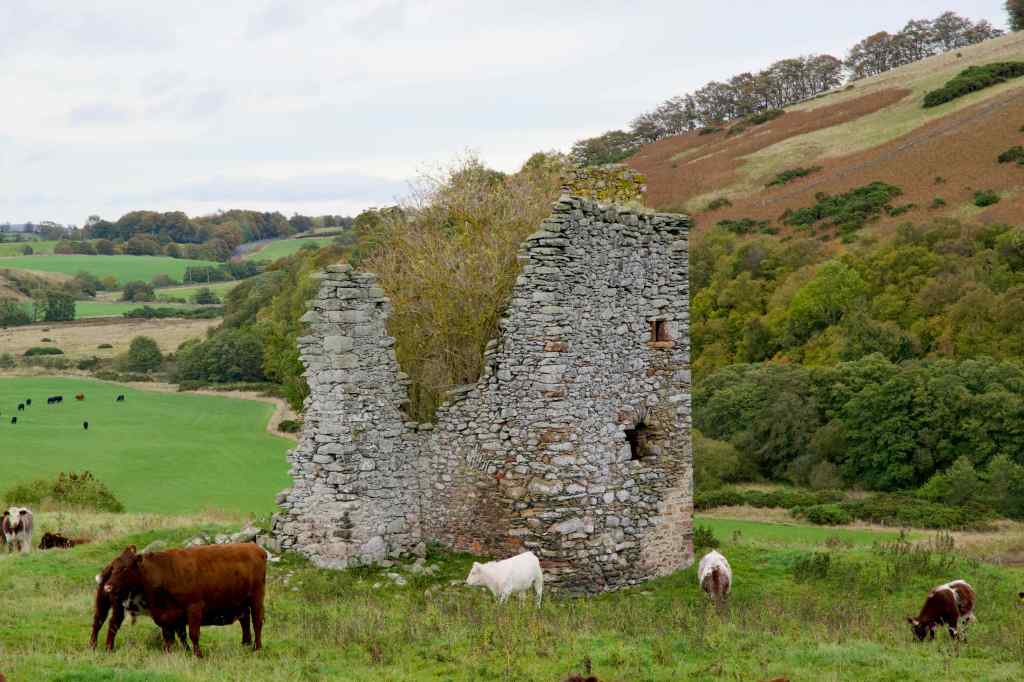
Today, Greenknowe Tower can be accessed from a layby on the A6105, just west of Gordon. There is a short path up to the ruin which is set in the beautiful Scottish Borders countryside. At the time of my visit, there was no access inside the building due to necessary masonry inspections.

Greenknowe Tower may not be as impressive as some of Scotland’s many other castles, but it doesn’t disappoint. It is a strong reminder of the troubled and interesting history of the Scottish Borders.
Further reading
Internet Archive: The Memoirs of Walter Pringle


 Thistle & Time
Leave a comment