
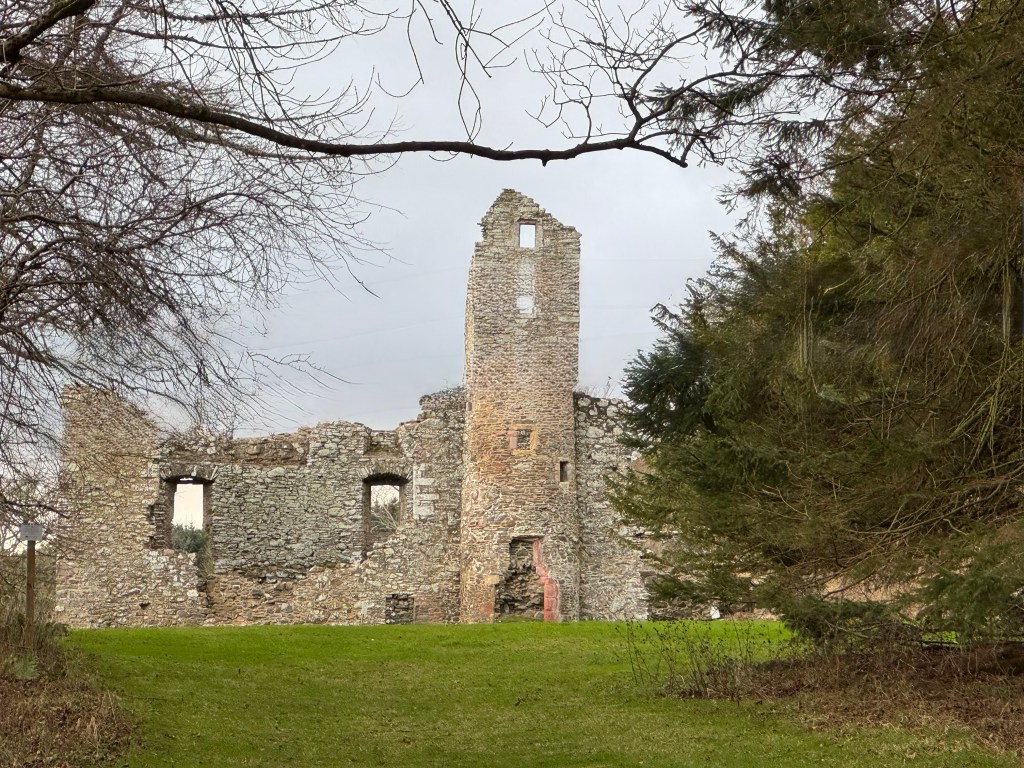
A few kilometres to the west of Galashiels in the picturesque Scottish Borders stands Torwoodlee Tower. Perched on an elevated terrace overlooking what is now the A72 road to Peebles, it must have looked quite striking in its day.
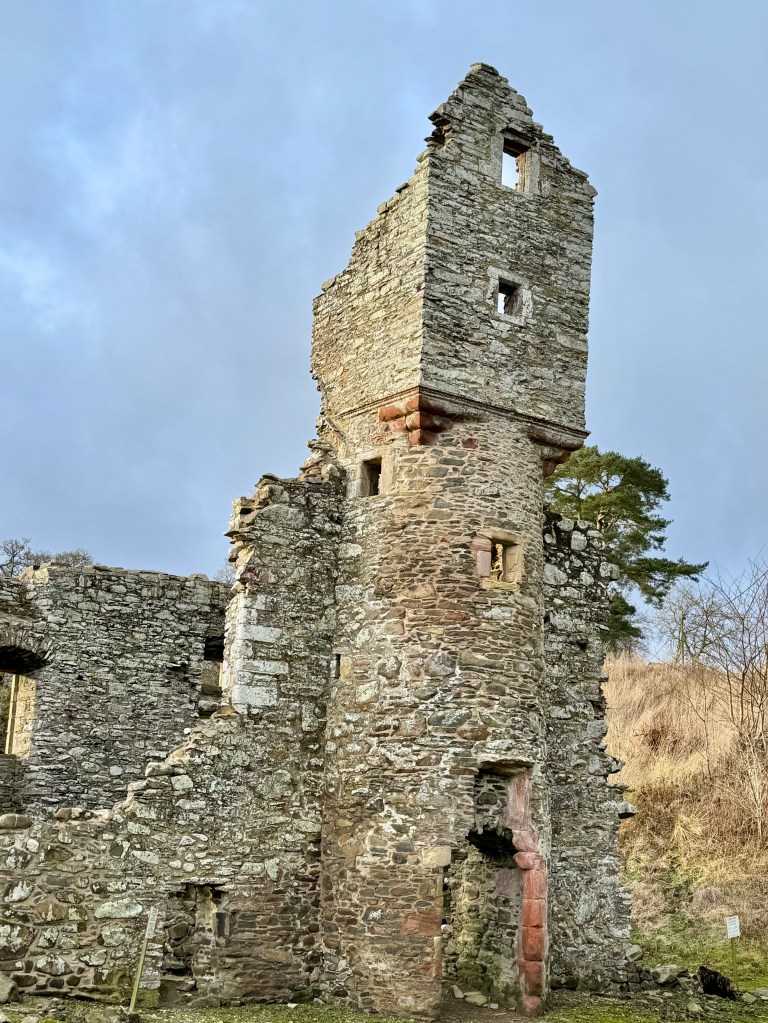
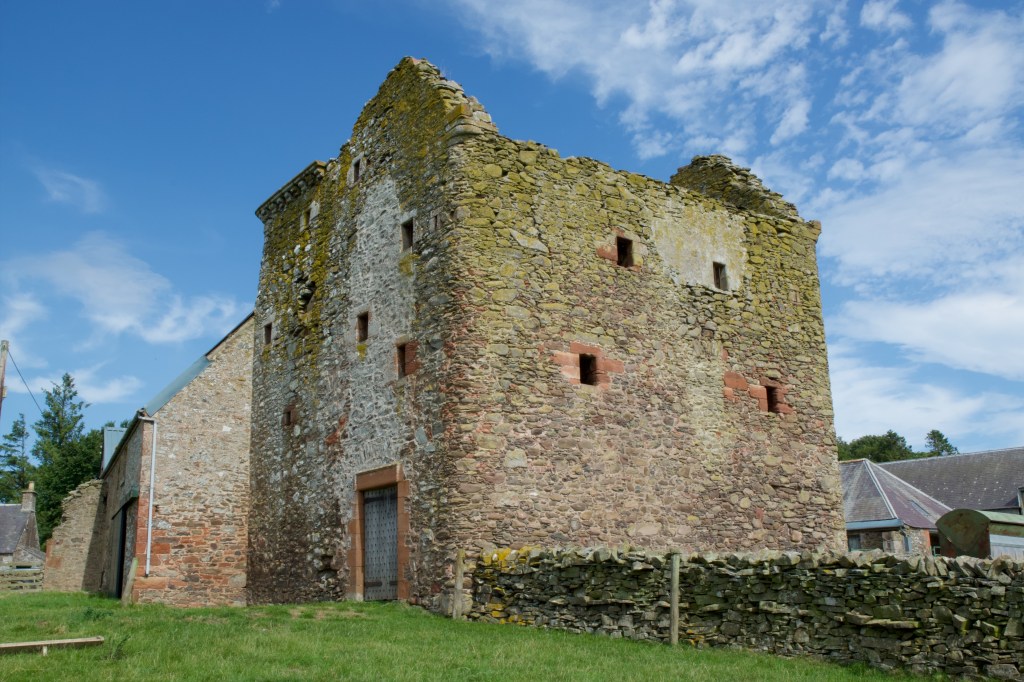
Visitors today will see a ruin which has three partly complete sides, with only the northern end entirely missing. Measuring some 8 metres by 23 metres, it is made from local whinstone rubble, and features thick walls. Of particular interest is the distinctive turret that adds to its stature and charm.
It is believed that the ground floor was divided into three vaulted chambers, one of which would have been the kitchen. On the first floor would have been the main hall and living space, together with some additional rooms. The second floor housed the bedrooms, while the turret housed the stairwell and main entrance to the tower.

Torwoodlee Tower was built by the Pringle family. This was at a time when the Scottish Borders was still characterised by clan conflicts and Border Reivers. The site occupied an important position in the turbulent Middle Marches of the Scottish Borders.
Specifically, the valleys around Galashiels and Selkirk lay between the great riding territories of the Elliots, Armstrongs, Scotts and Kerrs, all notorious reiver families. In the sixteenth century, the region was deeply affected by feuding, reiving and the political instability caused by the Anglo-Scottish wars and the Scottish Reformation. Torwoodlee’s history reflects all of these wider upheavals. And the Pringles? While they are not so well documented in Reiver history, they were active during the period leading up to the tower’s construction.
Originally called “Hoppringill” or “Hoppringle”, the Pringles were already established in the Borders by the thirteenth century. They were closely connected with the powerful Douglas family and held lands around Smailholm, Gala Water and Lauderdale.
It was William Pringle who in 1501 took a lease on the land of Torwoodlee, later buying it in 1510. He fell at the fateful Battle of Flodden in 1513 and was succeeded by his son George, the 2nd Laird of Torwoodlee.
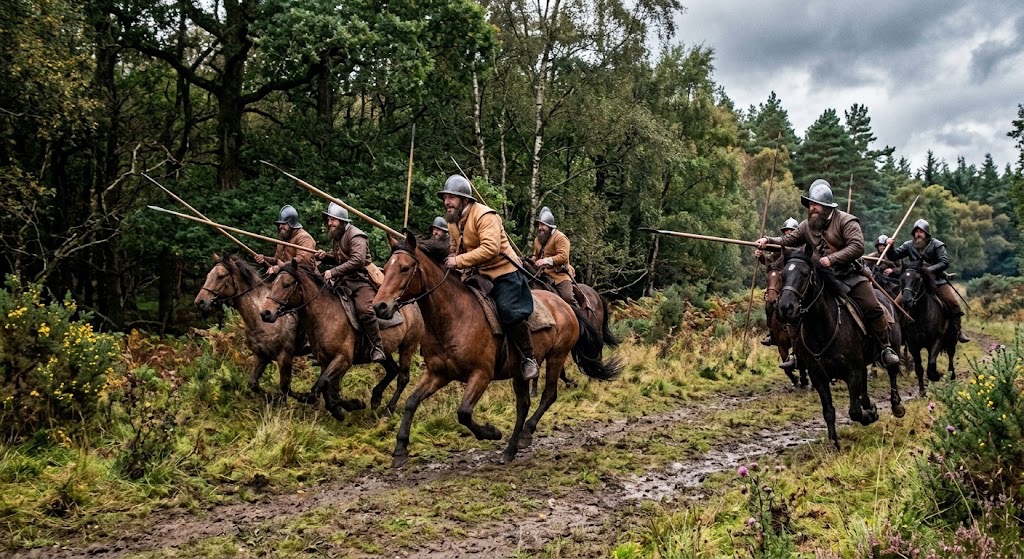
George died violently in 1568, the victim of bitter feuding. A mixed band of Elliots and Armstrongs, numbering some 300 men, sacked an older Tower at Torwoodlee, took George away and murdered him.
After this tragic event, it was some three decades before rebuilding took place. The new Torwoodlee Tower, the ruins of which we see today, was built in 1601 by the 4th Laird of Torwoodlee, also called George.
But despite the need for security, the tower was built in expectation of better family fortunes and more settled times to come. This is seen by the building’s large footprint, and the number of windows in the structure. Terraced gardens also flanked the tower, which was accessed via a tree-lined avenue from the east.

The 4th Laird at the time the tower was built, died in 1637. His successor, James (5th Laird) went on to be a member of parliament.
But seventeenth-century Scotland was dominated by conflict over church government and royal authority. The core dispute was between supporters of episcopacy (government of the church by bishops, favoured by the Stuart monarchy) and the Covenanters. These were Presbyterians who believed the church should be governed by ministers and elders, and that Christ, not the King, was head of the church.
When King Charles II was restored as monarch, the 6th Laird, yet another George, found himself on the wrong side of the King’s religious policies. The most significant event involved the 9th Earl of Argyll, Archibald Campbell and the “Test Act”. This was a law designed to enforce loyalty to the crown. Anyone holding public office had to swear an oath to the crown that accepted, in particular, the king’s supremacy in civil matters and the existing church settlement.
Argyll attempted to take the oath with reservations, saying he accepted it only “in so far as it was consistent with itself and the Protestant religion”. The government treated this as disloyalty, and he was arrested and condemned for treason in 1681.

But Argyll escaped from prison and during his flight to England, was helped by George Pringle. Yet by providing Argyll with food, money and a guide, George became a wanted man. He may also have been implicated in the 1683 Rye House plot.
So with the authorities searching for him, he fled to Holland in 1684 and had his lands confiscated. He died shortly afterwards. Meanwhile, his teenage son James was imprisoned for months, and only released upon bail of £5000.
However, the arrival of a protestant monarchy in 1689 (William III and Mary II) made way for the return of the Pringle estate to the family.
Torwoodlee Tower remained in use until 1783 when a new mansion house was built. Since then it has stood empty. Not surprisingly, a combination of time and the Scottish climate have taken their toll.

However, in 2015 a two year project began to preserve what remained of the tower and prevent it from falling down. It was achieved through generous support from the local community, and funding from the Fallago Environment Fund, Historic Environment Scotland, and Pringles from around the world.

Today, Torwoodlee Tower is a scheduled ancient monument. It is a reminder of our once turbulent past here in the Borders, and of our historical heritage. It can be reached by walking the short downhill distance from the small parking area overlooking the tower (follow the trail above the tower through to the wooded area, then turn back on yourself). Continue through the avenue of trees and Torwoodlee Tower will be in front of you.
The ground is uneven in places so suitable footwear is advised. Also, there are no facilities at the site.

Further information
Alistair Maxwell-Irving, 2014, The Border Towers of Scotland 2 (Maxwell-Irving)




Leave a Reply