
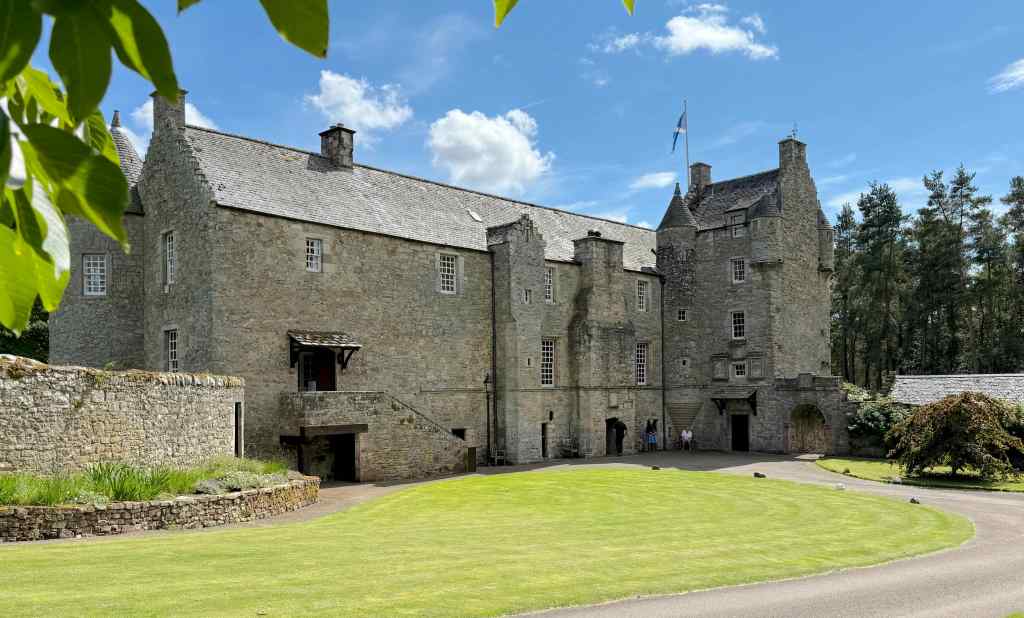
Ferniehirst Castle stands two miles (3.2 km) south of Jedburgh, set among trees and lush lawns and overlooking the River Jed. Its dramatic story includes raids, sieges, royal intrigue and religious struggles. For over five centuries, it has remained in the Kerr family’s continuous possession, serving as a strategic stronghold through every major conflict in Border history.
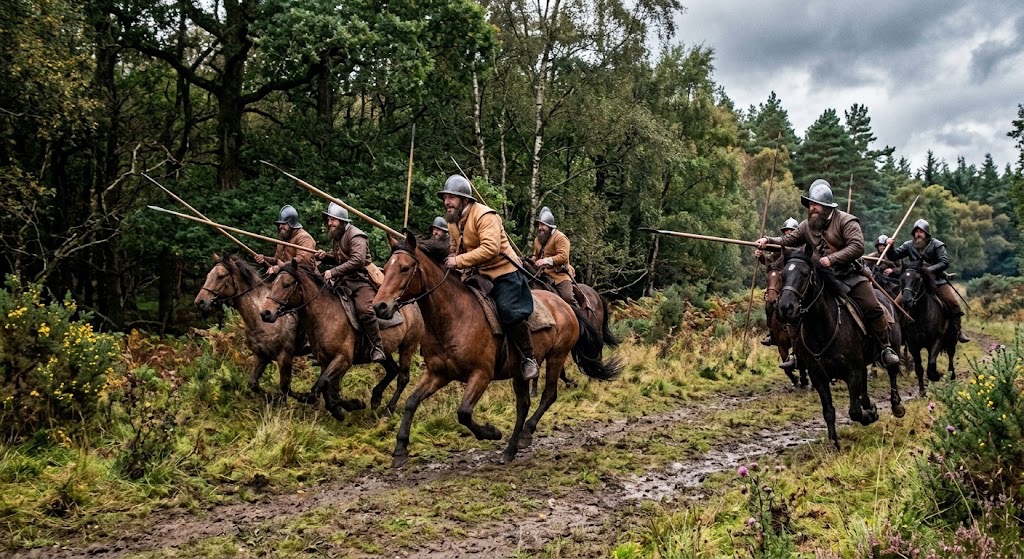
The castle was born into the world of the Border Reivers. The riding families who conducted cross-border raids, stole cattle, took hostages, burned steadings and pursued feuds that could last generations. The Kerrs, as prominent reivers, were never far from the troubles that characterised the 15th and 16th centuries.
The present castle can be traced back to 1598, but before then, there were several rebuilds of an earlier structure first built in 1470 by Thomas Kerr, son of Andrew Kerr of Cessford.
Built from cream sandstone rubble with finely crafted dressed margins and mouldings, Ferniehirst Castle features a long main block measuring about 32 metres east to west and 7.8 metres across, with walls up to 1.3 metres thick.

A round tower, 4.9 metres in diameter, is attached to the southeast corner. On the north side, wings were added at each end, intended to form part of an enclosed courtyard; however, this plan was never completed, and the wing at the east end has since been demolished
Viewed from above, the castle is a T-shape. The northwest wing, measuring 6 by 5.5 metres, is a tall tower featuring the main castle entrance in its re-entrant angle. Above the entrance, there are three floors of private chambers. Inside the entrance, a staircase leads to the first floor, with the upper floors accessed via a turret spiral staircase in the re-entrant angle. The southwest wing, which is two storeys high, contained the original vaulted kitchen. It has since been altered.
The basements of the main block and the southeast round tower are survivors of an earlier phase than 1598 and may even predate an earlier 1570 renovation. The former comprises six vaulted cellars, with the vault of the east one being at right angles to the others. The southeast tower was provided with two gun-loops of the dumb-bell variety, each made from two stones, whose crudeness and style would suggest a date considerably earlier than 1570.
The main block’s first floor was part of the 1598 renovation. It is not clear how many rooms it originally had, as it has undergone several transformations since, but it now has four chambers. These are the great hall, an ante-room to the west of it, and outer and inner chambers to the east. The great hall has a large fireplace, 3.35m wide, in the middle of the north wall, though the present chimneypiece is a modern replacement.

The second floor of the main block was originally a garret with dormer windows, but late in the 17th century, the wallhead was raised and new windows fitted to make a full storey, with an attic above. The last restoration of the castle took place in 1984-7.
A number of the castle’s restorations were caused by conflict, as reflected in its fascinating history.
In 1490, Ferniehirst Castle was inherited by Andrew Kerr (circa 1471–1545). Known as Dand Kerr, he was a leading figure of his time. He was chief of over 2,000 “Men of Jedhart” (the old name for Jedburgh), and the English feared him, believing the Devil rode alongside him in battle. A highly clever commander, he left a notable physical legacy at the castle: a spiral staircase that winds counter-clockwise, called the “left-handed staircase,” which disadvantages right-handed attackers. The legend states that after returning from the Battle of Flodden in 1513, Dand trained his men to use their left hands in swordsmanship (hence the term “Kerr-handed” for left-handedness in Scotland).
Andrew Kerr of Ferniehirst was made Warden of the Middle Marches in 1502. It was a position of immense local power, and one the family unquestionably abused at the expense of other Border families.
At Flodden, both the Ferniehirst and Cessford Kerr branches fought under James IV. Following the battle, Dand Kerr seized Kelso Abbey and installed his brother Thomas as its Commendator. While this could be seen as nepotism, his action likely prevented it from being seized by the English.
Then in 1523, Ferniehirst Castle was taken by the English. Lord Dacre attacked with 700 men and artillery during a raid in which Jedburgh was burnt. After fierce hand-to-hand fighting, the castle fell, but that evening Dand’s men stampeded over 200 English horses, many plunging over the cliff at Lintalee.

During this period, the Ferniehirst Kerrs were engaged in an intermittent feud with the Cessford Kerrs, whilst both branches simultaneously feuded with the Scotts of Buccleuch. Meanwhile, reiving, including cross-border raids into England, continued.
But when Scotland rejected a marriage proposal between the infant Mary, Queen of Scots, and Henry VIII of England’s heir, the violence escalated further. This period, now called the Rough Wooing (1542 – 1551), saw Henry lay waste to the borders. His armies burnt towns, destroyed crops, sacked abbeys, and garrisoned strategic castles. They carried out their orders with enthusiasm, to put “man woman and child to sword, without exception’…”
The chaos enabled rivalry between the border families to be exploited, and many were brought into English service through threats and bribes. The Ferniehirst Kerrs were burned out in 1543 by the Liddesdale Armstrongs working for their English paymasters. Dand Kerr was captured and imprisoned along with his son John. But in order to protect his family interests, he did what many others had done and became an “Assured Scot”.
As such, the Ferniehirst Kerrs and other assured Scots rode with the English at Ancrum Moor in February 1545. However, it is said that in the battle, assured Scots in the English ranks tore the cross of St. George from their person and turned on their former allies. The Scottish victory at Ancrum Moor was much needed and served to rally flagging Scottish spirits.

During the Rough Wooing, Ferniehirst Castle’s position, commanding the road north to Edinburgh, was of strategic importance and so it had been occupied by English forces and held as a forward garrison. But it was recaptured in February 1549, a few years after Dand Kerr’s death, by his son Sir John Kerr with help from the French. The French were in Scotland as the allies of the Queen Regent, Mary of Guise. Emphasising the brutality of this war, the English prisoners were executed on the spot and a game of handball was played with their severed heads. This is commemorated today by the annual “Ba Game”, played in the streets of Jedburgh with a leather ball instead of an English soldier’s head.
But the English were not done. An English army led by the Duke of Rutland recaptured the castle in June 1549. However, the war was nearly over. The Treaty of Boulogne, which ended Anglo-French hostilities, also brought the Rough Wooing to a close, and English forces eventually withdrew.
Sir John Kerr’s son, Thomas Kerr of Ferniehirst, was noted for his loyalty to Mary Queen of Scots. In 1565, he raised the Royal Standard for Mary, helping to quell an insurrection led by her half-brother, James Stewart, Earl of Moray. Ferniehirst Castle therefore became a centre of Marian loyalty in the years of civil war that followed her deposition in 1567.
Thomas also joined Mary at Hamilton after her escape from Loch Leven Castle in 1568, later fighting for Mary at the Battle of Langside that same year.
Not surprisingly, the castle served as a refuge for those on the losing side of the Marian conflict. In January 1570, the exiled Countess of Northumberland was housed in the tower at Ferniehirst Castle, with the Earl of Westmorland staying in the room above. Both were English Catholic nobles who had backed the unsuccessful Northern Rising of 1569, aiming to place Mary on the English throne, and were now fleeing Queen Elizabeth I’s considerable anger.

Later, to intimidate Mary’s supporters, Ferniehirst was damaged during an English raid on 18 April 1570. It followed raids by Thomas Kerr into northern England designed to foment trouble for Elizabeth I.
In 1573, another English force damaged the castle en route to Edinburgh Castle. This was a punishment for Thomas Kerr’s support for the Marian garrison there, the last stronghold of the queen’s party in Scotland, which surrendered in May 1573.
After this, Thomas went into self-exile in France. However, in 1581 his lands were restored by James VI and in 1584 he was able to return to Scotland. He was appointed Warden of the Middle March later that year.
Thomas Kerr died two years later in Aberdeen after being falsely accused of murdering Sir Francis Russell on a truce day. He was succeeded by his son Andrew.
In 1591 Sir Andrew Kerr was appointed Gentleman of the Bedchamber to James VI. This extremely important office gave him regular access to the king. However, this royal favour didn’t last. The summary justice he oversaw in Jedburgh and his capacity to raise a small army aroused suspicion at court. This was highlighted when Francis Stewart, the 5th Earl of Bothwell, and a number of followers in 1591 were accused of practising witchcraft to murder the King. Those implicated in the plot included Sir Andrew Kerr, who was summoned to court to answer the charges. Andrew refused to attend, and Ferniehirst Castle was rendered uninhabitable by the Crown as punishment.

In 1597 Ferniehirst Castle was returned to Sir Andrew Kerr, who was forgiven his past misdemeanours after taking his seat in Parliament and supporting the King’s request for revenues. The rebuilt castle, designed by Sir Andrew and completed in 1598, is essentially the structure that survives today.
By the 17th century, the Kerrs of Ferniehirst had risen far beyond their origins as Border reivers. Through inheritance, marriage, and political acumen, the family had accumulated a web of titles and estates, including that of Lothian, that made them one of the great noble houses of Scotland. In 1624, the 2nd Earl of Lothian died without a male heir, and his daughter, Anne, Countess of Lothian, married Sir William Kerr, also of the Ferniehirst branch. In 1633 he was created Earl of Ancram. Until the 20th century, the last Kerr to live at Ferniehirst was William, the 6th Marquis of Lothian, who died in 1767.

After serving as an estate house and subsequently being rented to tenants, alterations were made between 1880 and 1900, but remained unfinished. By 1935, the castle had become a youth hostel. It wasn’t until 1985 that Peter Kerr, the 12th Marquis of Lothian, fully restored it, returning it to a family residence.
Today, Ferniehirst Castle stands as one of the best-preserved Border fortresses, its stones bearing witness to five centuries of raids, sieges, royal intrigue, and family loyalty that defined the Kerr name. It is open by appointment for tours during July each year, with contact details available on the castle’s website (see below).
Further reading
Anthony Kerr, 1985, Ferniehirst Castle, Scotland’s Frontier Stronghold (A Kerr, Lothian Estates)
Bob Lawson, 2014 The Kerrs of Ferniehirst (Lawson)
Alistair Maxwell-Irving, 2014, The Border Towers of Scotland 2 (Maxwell-Irving)




Leave a Reply