
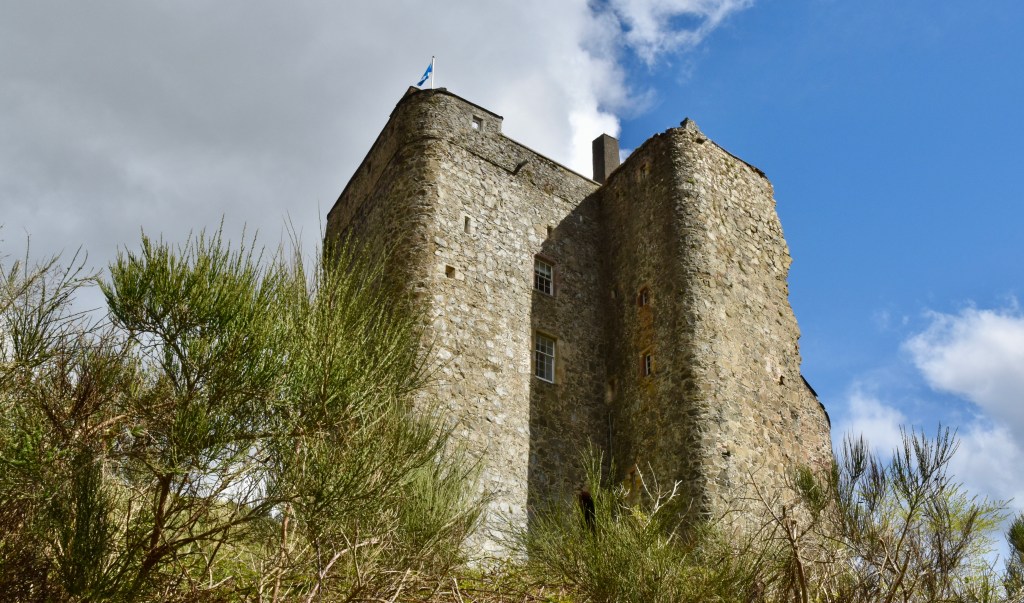
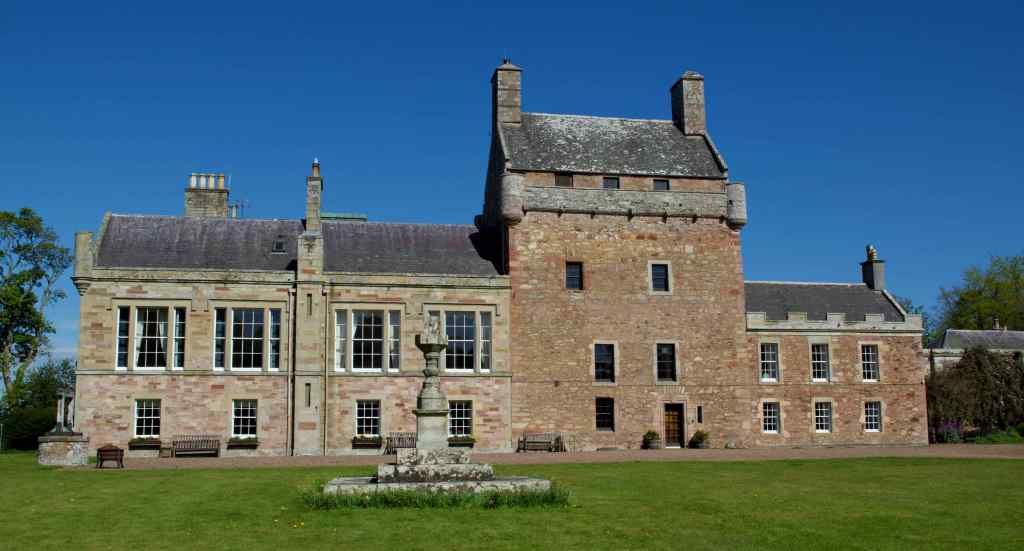
Neidpath Castle is an impressive medieval L-plan tower house, dramatically positioned on a cliff overlooking the River Tweed, about a mile (1.6 km) west of Peebles. It has witnessed some 800 years of Scottish history, having hosted royalty, withstood sieges, and remained a privately owned residence to this day.
Records aren’t clear on when a fortification at Neidpath was first established. Some sources say a wooden castle was standing by 1190. But more likely it was Bernard Fraser or his son, Gilbert, who began the site’s long history in the 1200s. It was strategically chosen for its commanding position overlooking the River Tweed, providing excellent defensive advantages.
The Frasers had the full confidence of Alexander II, King of Scots, and were part of the political inner circle. Both Bernard, and then his son Gilbert, held the post of Sheriff of Peebles.
The next generation of Frasers continued the royal association with William Fraser, becoming Bishop of St. Andrews and Alexander III’s chancellor. However, it is Gilbert’s grandson, Simon, the last of the Frasers at Neidpath, who was to become the most acclaimed.
Sir Simon gained his fame for his remarkable military achievement of defeating the English three times in a single day at Roslyn Glen, despite commanding only 8,000 men against an English force that some say was three times that size.
But Simon Fraser didn’t start out as a Scottish freedom fighter. When Edward I of England sent his army into Scotland, Simon joined fellow Scottish nobles to fight at the Battle of Dunbar in 1296. But the battle was lost, and he was captured and imprisoned in England.
However, he eventually secured his freedom by promising to serve Edward in his war against France. So Simon fought in Flanders for the English in 1297, serving with distinction. He was then reported to have fought against William Wallace at the Battle of Falkirk in 1298, and fought for Edward at the siege of Caerlaverock Castle near Dumfries in 1300.
But by September 1301, Simon Fraser had changed sides. Exact reasons are unknown, but it has been suggested that he viewed his oath to King Edward as being made under duress. What’s more, the Pope declared that Edward had no authority in Scotland, and perhaps Simon considered this to invalidate his oath to serve the English king.
In 1302, Simon Fraser, with William Wallace, was carrying out guerrilla raids against English garrisons in south-east Scotland. But it was at Roslyn in 1303 that Simon led his army to defeat an English force that had separated into three distinct units. It was a tremendous morale boost for the Scots and made Simon a hero.
He continued to fight against Edward’s army, joining up with Robert the Bruce. Tradition says that when Bruce was ambushed while encamped at Methven, it was Fraser who saved his life.
But despite his military prowess, Sir Simon’s story ended tragically when he was captured near Stirling. He was executed in London shortly afterwards.

During this period, the castle also suffered, being burnt to the ground by the English, leaving Simon’s daughter Mary to inherit a ruin.
The castle passed to the Hay family through marriage in the early 14th century when the heiress Margaret, daughter of Simon Fraser’s son, married into the Hay family. This marriage alliance transferred the barony of Neidpath to the Hays, who would maintain ownership for the next three centuries.
It is thought that Sir William Hay, who served as Sheriff of Peebles and died around 1390, built the present castle in the late 14th century. This marks the beginning of the structure that forms the core of what visitors see today.
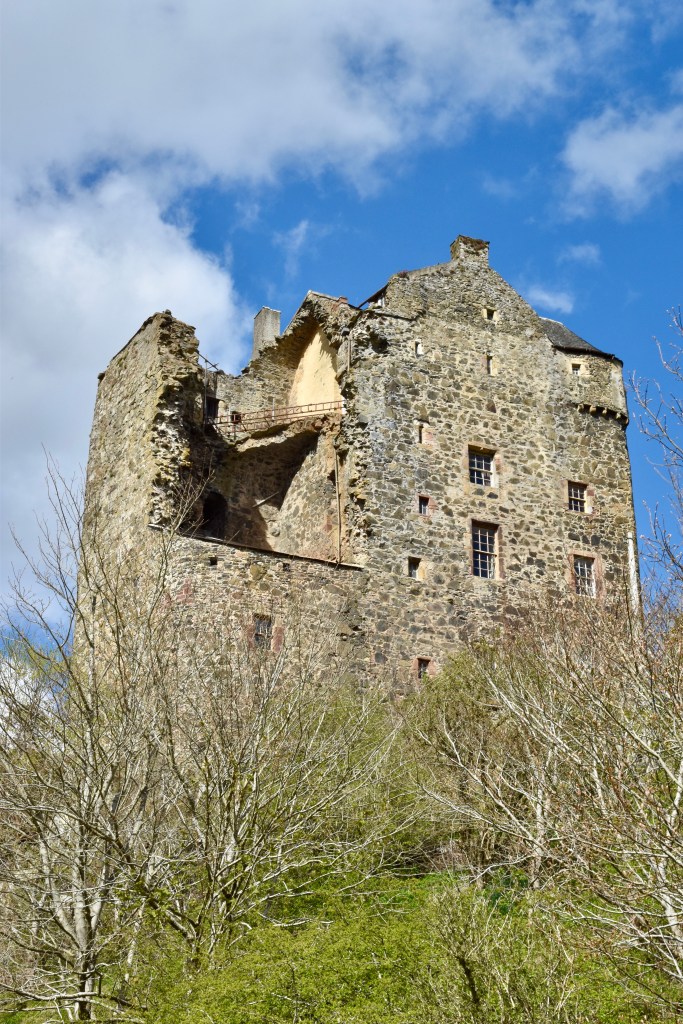
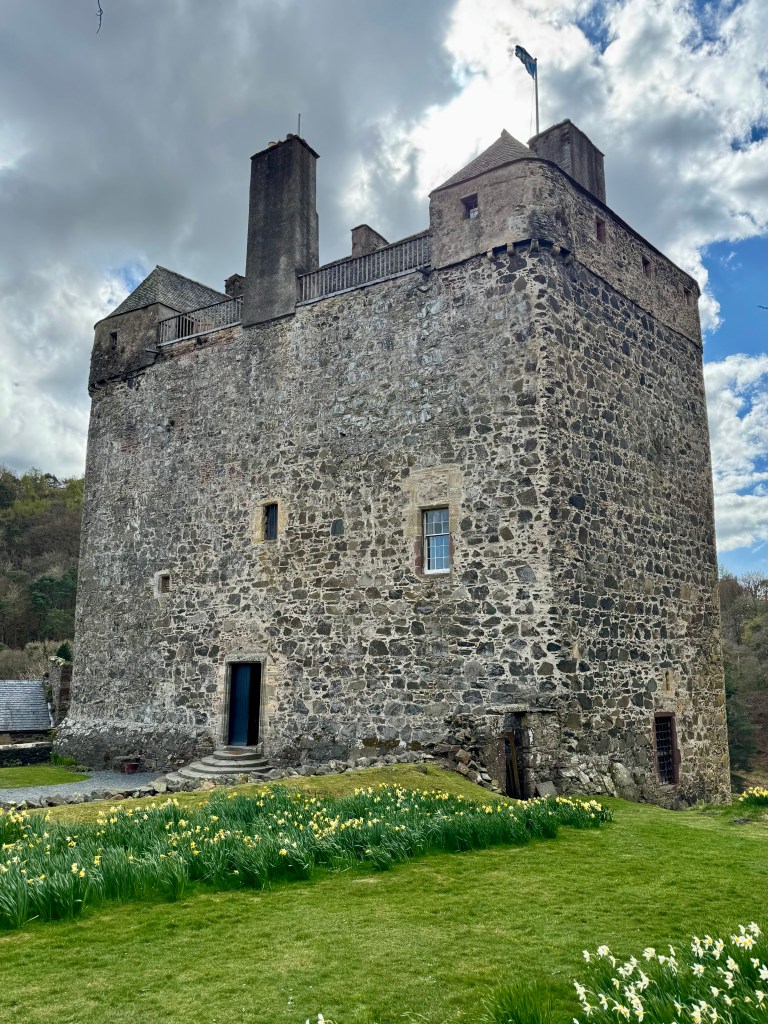
The castle was built as an L-plan tower house with distinctive rounded corners, demonstrating the architectural preferences of the period. The design is partly determined by its surroundings. Built on a rocky crag overlooking the River Tweed, the main block is not perfectly rectangular but takes the shape of a parallelogram to suit the natural contours of the rock.
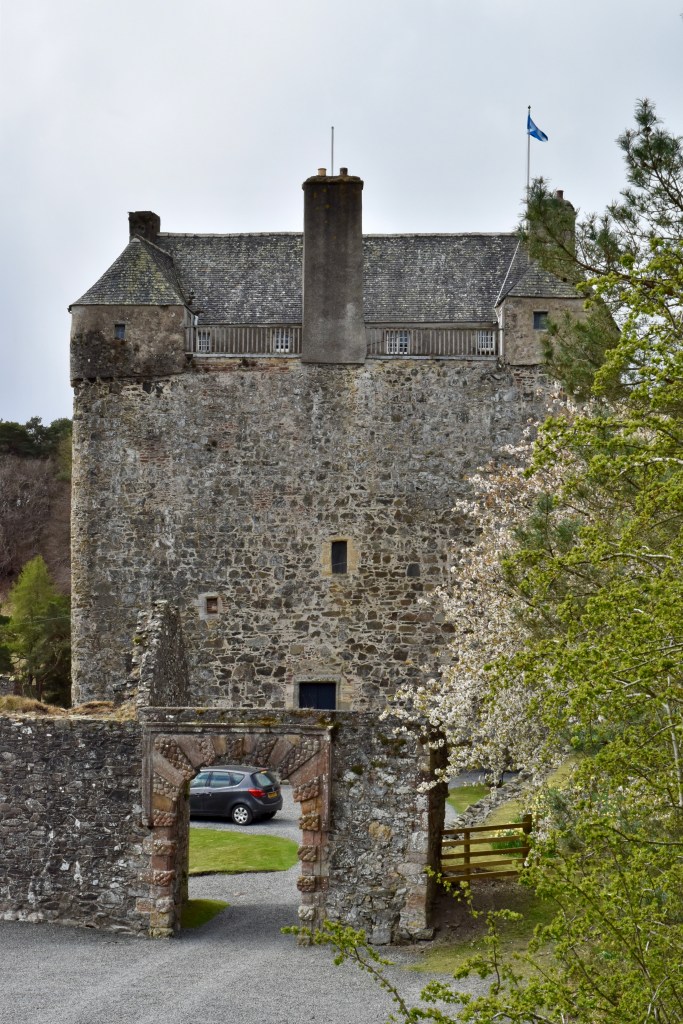
The original entrance was positioned at ground level on the south side of the castle, on the edge of a cliff. Both the main block and the wing featured vaulted basements, creating secure storage areas and foundations for the floor above. There was also a pit-prison in the basement, reached from the guard room above; a sobering reminder of the castle’s role as a centre of power and justice.
Although subdivided overall into five storeys, the tower was structurally divided into just three high compartments, each barrel-vaulted in stone. The great hall occupied the entire second floor, while its kitchen and services filled the wing. Smaller rooms were built ingeniously into the thickness of the walls, which in places reach an incredible 3 metres.
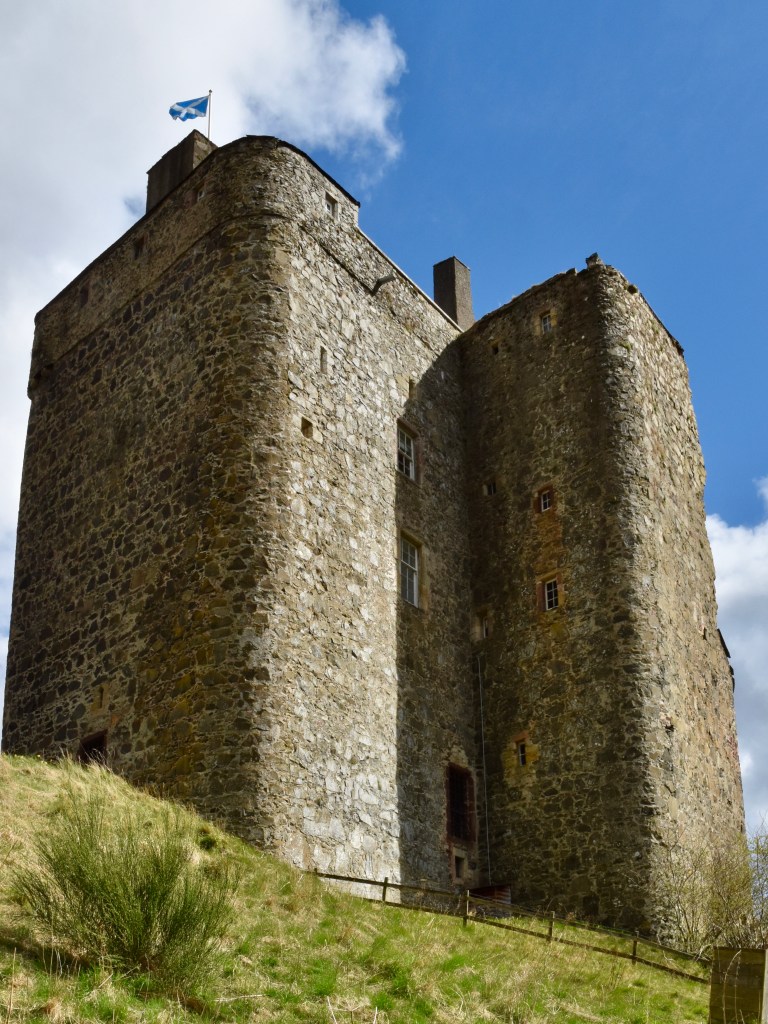
Overall, it’s an immense structure, measuring 19 metres by 12 metres, with a wing projecting 5.8 metres. It reaches a height of 19.2 metres at parapet level.
Through influential marriages, the Hay family of Neidpath gained land and status, and eventually inherited the Yester estate. It is as the Lords of Yester that the Hays’ family story develops.
The 2nd Lord Yester, John Hay, was killed at the Battle of Flodden in 1513, along with about 87 others from the extended Hay family. The 4th Lord Yester had more luck fighting the English at the Battle of Ancrum Moor in 1545, during the War of the Rough Wooing. However, two years later, at Pinkie Cleugh, he was captured and remained a prisoner until his release in 1550.
Interestingly, there are no accounts of direct attacks on Neidpath Castle during this brutal war. Yet English forces completely razed nearby Peebles, and many other towns and villages in the Borders. Could an assualt on such a stong castle have been a step too far for the invading English army?
In more peaceful times, Neidpath Castle hosted several royal visitors over its long history. Mary, Queen of Scots, stayed at the castle in 1563 during her personal rule of Scotland. This visit came during a relatively stable period in Mary’s tumultuous reign, before the series of crises that would eventually lead to her forced abdication and exile in England.
The Hays were considered friends of Mary, and the 5th Lord Yester, William Hay, was initially a key supporter of hers. He fought for her at Carberry Hill in 1567 and then again at Langside in 1568. However, at Langside he left the battlefield when he realised Mary would lose. He eventually went on to join the King’s Party during the Marian Civil War and become a Presbyterian.
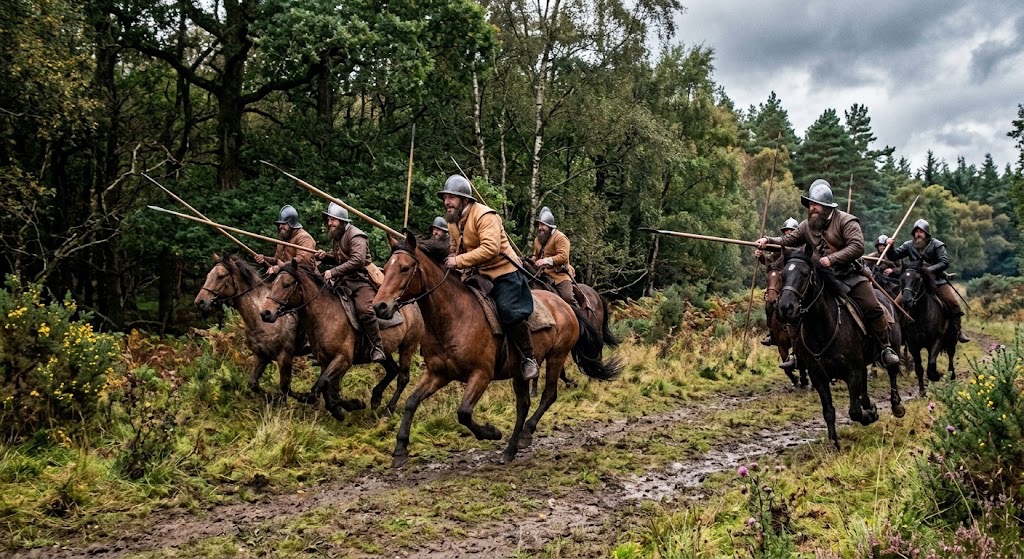
As we know, the 1500s were not just blighted by war. This was also the era of the Border Reivers. Although there is no surviving evidence of raids on Neidpath Castle, some of its occupants were caught up in the violence of that time.
The 5th Lord Yester was himself no stranger to border feuding, despite being a member of the Privy Council in the 1570s and Sheriff of Tweeddale. Through his wife, Margaret, he was associated with the Kers of Ferniehirst, a well-known family of Reivers. This likely embroiled him in the Ker feud with the Scotts of Buccleuch.
But his son, also called William, was particularly involved in the Reiver culture. While Master of Yester, living at Neidpath Castle, William was proclaimed at the Peebles Mercat Cross for killing a servant of another laird based in South Lanarkshire. What’s more, he earned a reputation as the leader of an unruly band of men, based at Neidpath, who would hang without trial anyone William considered a miscreant.
But in 1582 matters turned particularly difficult when the 5th Lord Yester and son William, although not as leading conspirators, were implicated in the Raid of Ruthven. This saw the young James VI held captive for nearly a year while the leading conspirator, the 1st Earl of Gowrie, led a Presbyterian government ruling in the king’s name. Once the young King regained control of his government, Lord Yester and his son William were exiled to the Low Countries until pardoned in 1583.
William became the 6th Lord Yester upon the death of his father in 1586.
In 1587, Mary’s son James VI visited Neidpath Castle. By this time, James had assumed personal rule of Scotland and was navigating the complex political landscape of his kingdom before also inheriting the English throne in 1603.
The mid-17th century brought significant challenges to Neidpath Castle during the Wars of the Three Kingdoms. In 1645, the castle was garrisoned against the Royalist forces of James Graham, 1st Marquess of Montrose. Interestingly, following Montrose’s defeat at Philiphaugh, he reportedly attempted to seek shelter at Traquair House, approximately 8 miles (13 km) to the east, but was denied entry. Some accounts suggest he may have stayed at Neidpath, although others consider this highly doubtful.
The castle was garrisoned again five years later, this time against Cromwell’s army. However, accounts differ as to what happened. Some say Neidpath Castle surrendered without a fight, although other sources suggest that it required the longest assault on any stronghold south of the River Forth to force it to surrender. On the other hand, local sources say that the castle sustained some limited artillery fire, with sections of the south wall being damaged.
We do know that the castle, held by the royalist Hays, was attacked by Cromwell’s forces under Lambert in 1650 as part of the south‑to‑north advance. Quite how long it held out is clearly a matter for discussion but once Cromwell’s army had dug placements for its cannons, a warning shot or two may have been enough for the castle’s occupants to seek surrender terms.
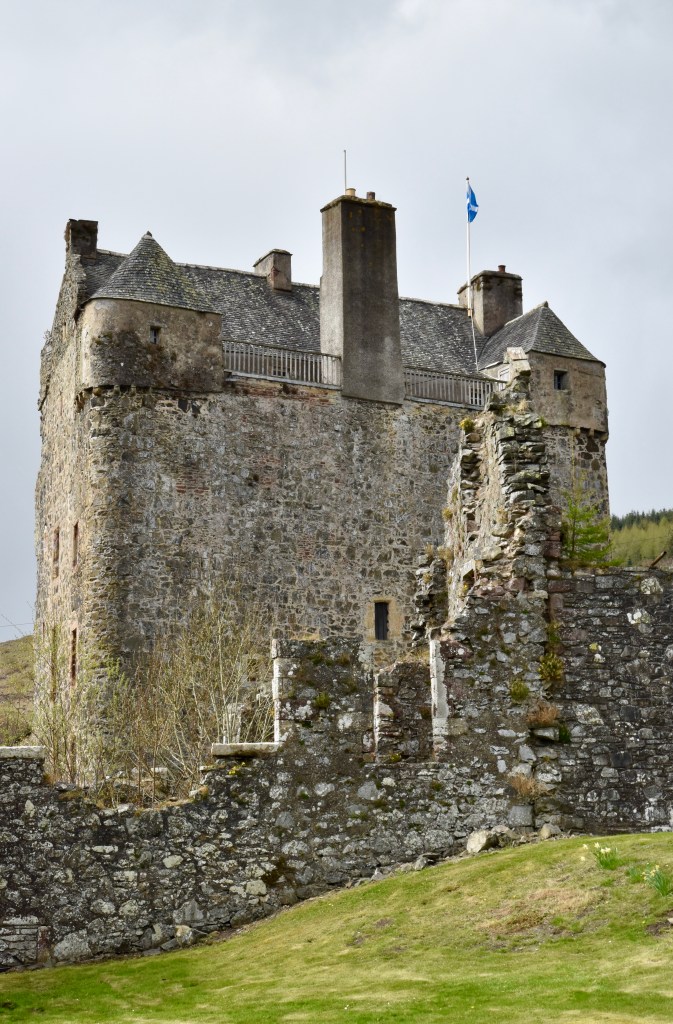
Few alterations were made to Neidpath Castle until the 1590s, when the two upper floors were remodelled. Further alterations took place shortly after Cromwell’s invasion of Scotland. A new entrance was created in the east wall, and a wide staircase was installed in the southeast corner up to the second floor. The great hall was divided into two panelled rooms. Other changes included the addition of outbuildings and the planting of an avenue of Yew trees, of which one side remains today.
In 1686, John Hay, the 1st Marquis of Tweeddale, was declared bankrupt, and he sold Neidpath to William Douglas, the 1st Duke of Queensberry. In 1693, William gave the castle to his second son, who later became the 1st Earl of March, and married Lady Jean Hay, the daughter of the bankrupt Marquis of Tweeddale. In the first half of the 18th century, Neidpath Castle became the summer home of the Earls of March.
Neidpath Castle stayed with the Douglas family and was let to tenants by the 3rd Earl of March (who was also 4th Duke of Queensferry). Despite his wealth, the castle suffered neglect, and by 1790 the upper storeys of the wing had collapsed (and to this day they have never been restored).
William Wordsworth and Walter Scott both visited the castle in 1803. Wordsworth was appalled at the felling of “a brotherhood of venerable Trees” by Douglas and wrote a sonnet beginning “Degenerate Douglas! oh, the unworthy Lord.” On the death of the Duke in 1810, the castle, along with the earldom of March, was inherited by the Earl of Wemyss, although the dukedom went to the Scotts of Buccleuch.
This transfer marked the beginning of the Wemyss family’s association with Neidpath, a relationship that continues to this day, spanning over 200 years of uninterrupted ownership. The Wemyss family have taken great care to protect Neidpath, and it retains much of its original medieval character. This includes the Great Hall with its panelled walls and fabulous artworks portraying the life of Mary Queen of Scots.
Today, Neidpath Castle serves as a function venue while remaining a privately owned property of the Earl of Wemyss and March.
Neidpath Castle is not without its own ghost story. This is the legend of Jean Douglas, the “Maid of Neidpath.” Forbidden by her father, the Earl of March, to wed the Laird of Tushielaw, Jean pined by a window until illness consumed her. When her lover finally returned, he failed to recognise her frailty and rode on—breaking her heart. She died soon after, and her ghost, clad in a long brown dress with a large white collar, is said to wander the ramparts still waiting for him. Sir Walter Scott immortalised her in the poem The Maid of Neidpath, weaving the poignant tale into Scotland’s literary heritage.
Getting to Neidpath Castle is simple. It is just off the A72 west of Peebles, and is well signposted. However, it is not generally open to the public. Guided tours are available on select dates, typically from May to October and are well worth your time. Alternatively, private tours can be arranged by appointment throughout the year. See the castle’s website (below) for more details.
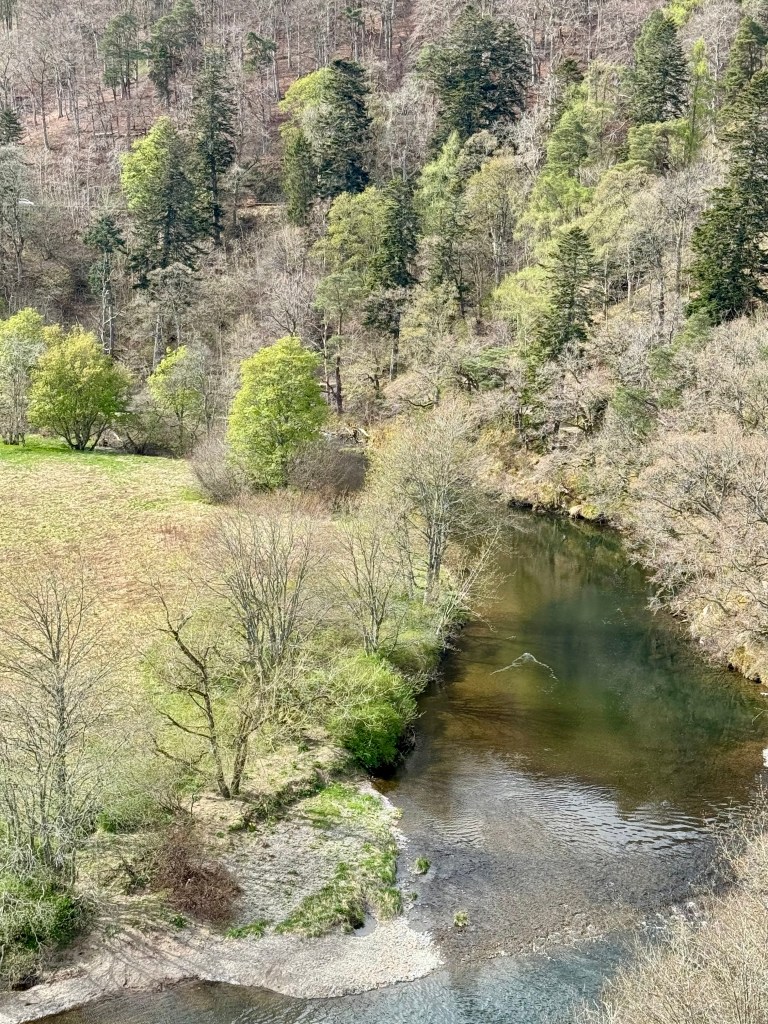
You can view the exterior of the castle from the footpath along the banks of the River Tweed, with perhaps the best views being from the south bank, just west of the castle.
Further reading
Steve Dubé, 2020, Neidpath Castle and its Lairds (Kirklands Press)
Martin Coventry, 2025, The Castles of Scotland (sixth edition), Goblinshead
Alastair Maxwell-Irving, 2014, The Border Towers of Scotland Vol. 2 Maxwell-Irving
Adrian Pettifer, 2024, Scottish Castles, The Boydell Press
Mike Salter, 1994, The Castles of Lothian and the Borders, Folly Publications




Leave a comment