
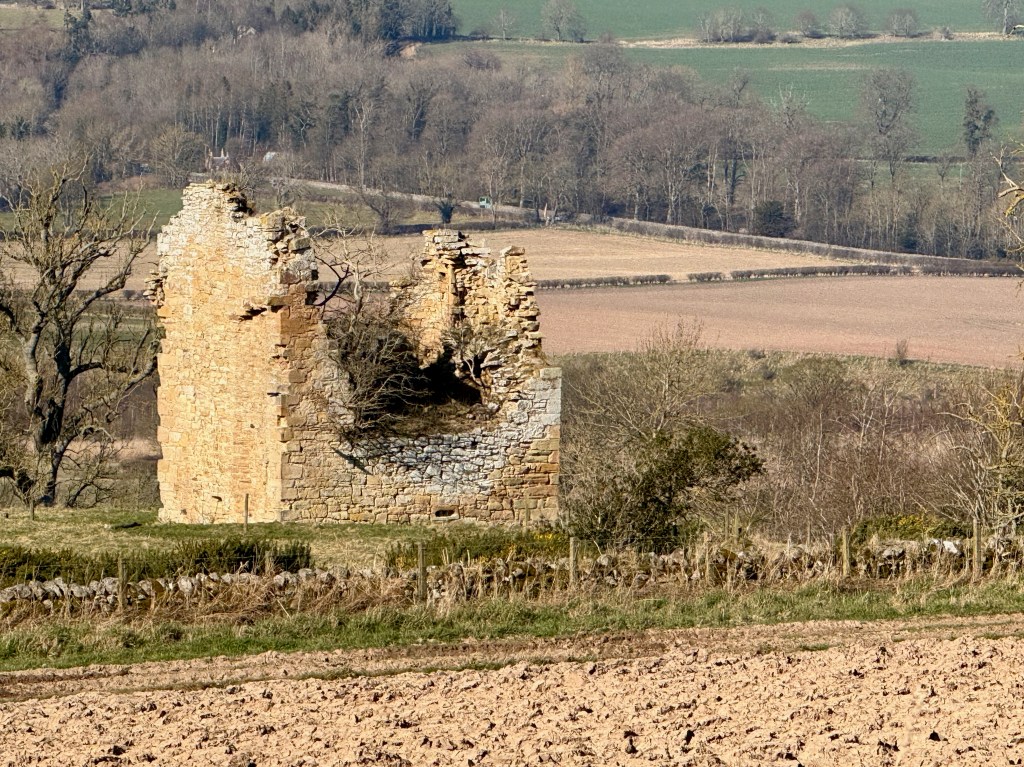
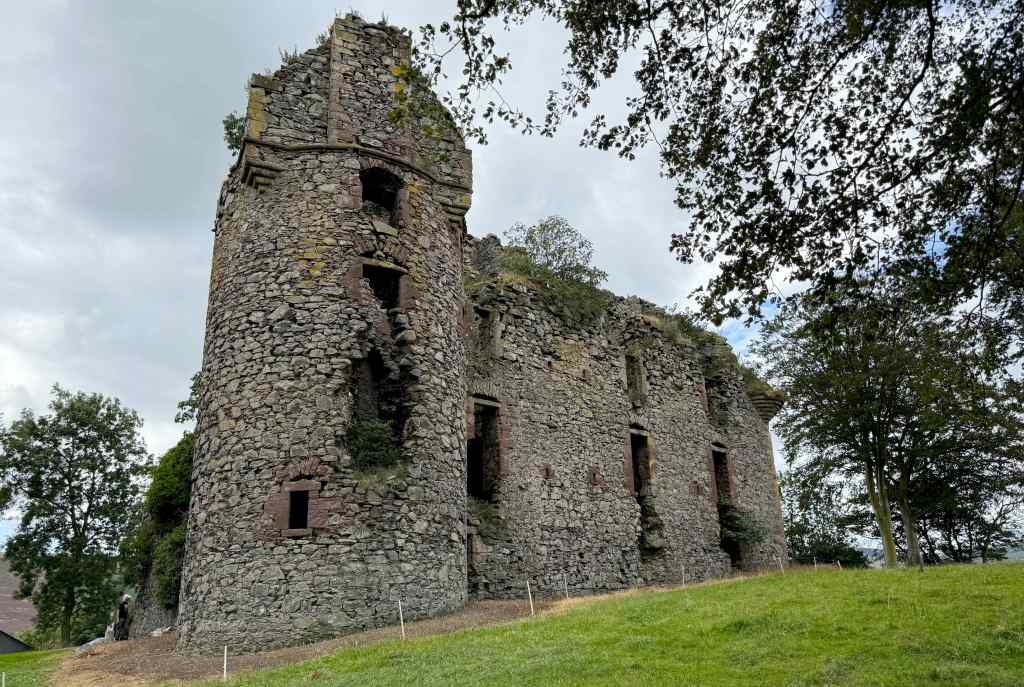
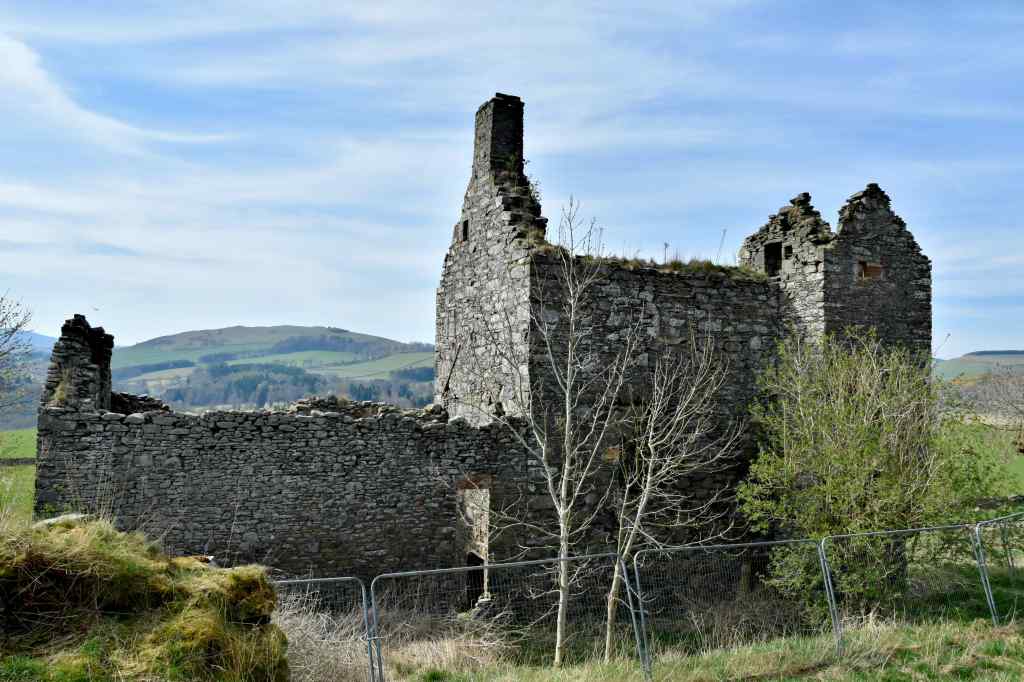
This ruined 16th-century Tower House occupies a lonely spot on the western slope of Lanton Moor, approximately 1.5 miles (2.4 km) north west of Jedburgh. The tower, which is surrounded by older earthworks, originally reached a height of four storeys. Its position had some natural defensive advantages, being on rising ground between the River Teviot and Jed Water.
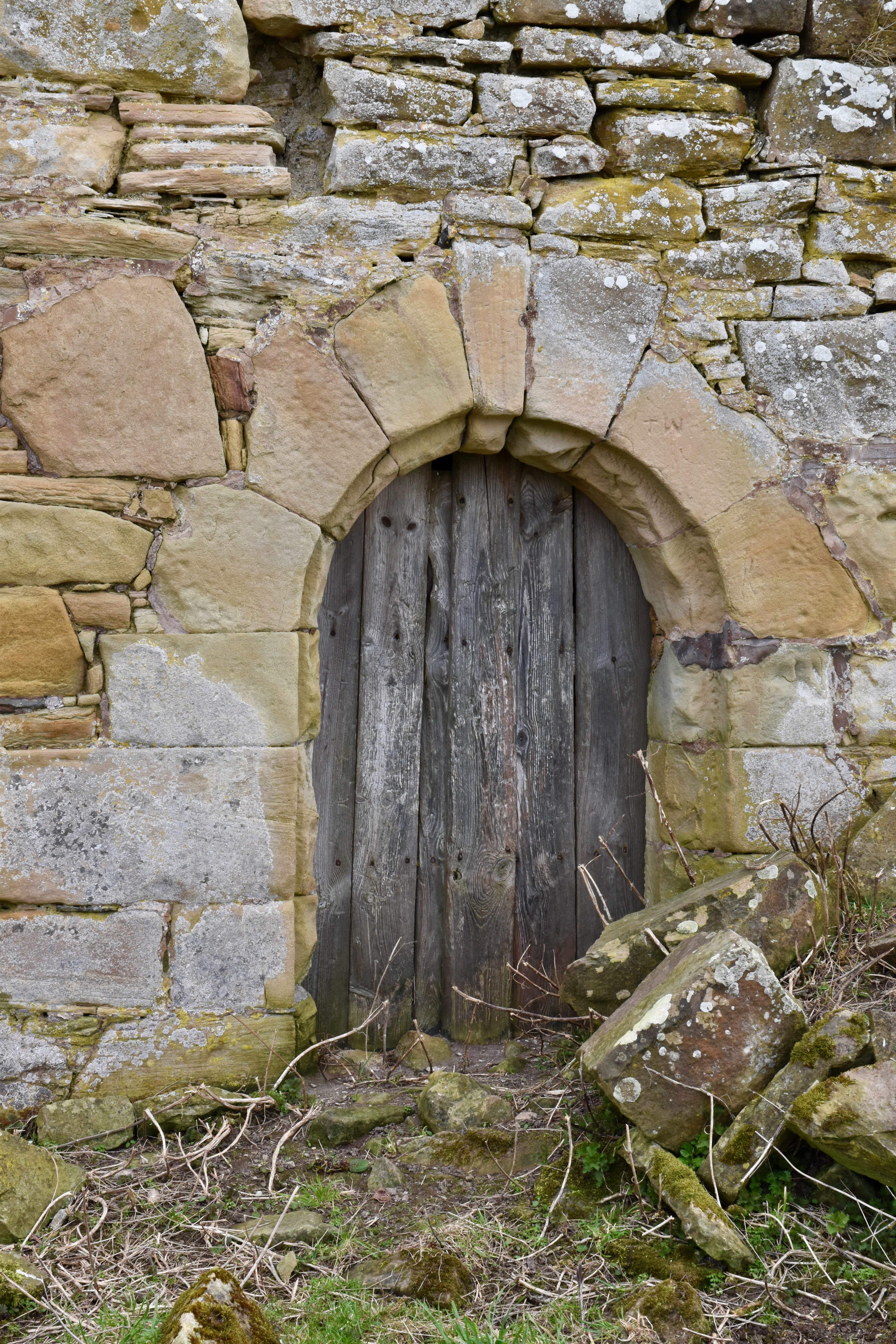
The original entrance, which features a semicircular arch with an outer door, faces northwest, but another entrance was broken through the northeast gable in the 17th century. Two gun-loops survive on the lower floor, while a third was enlarged to form a window in the 17th century.

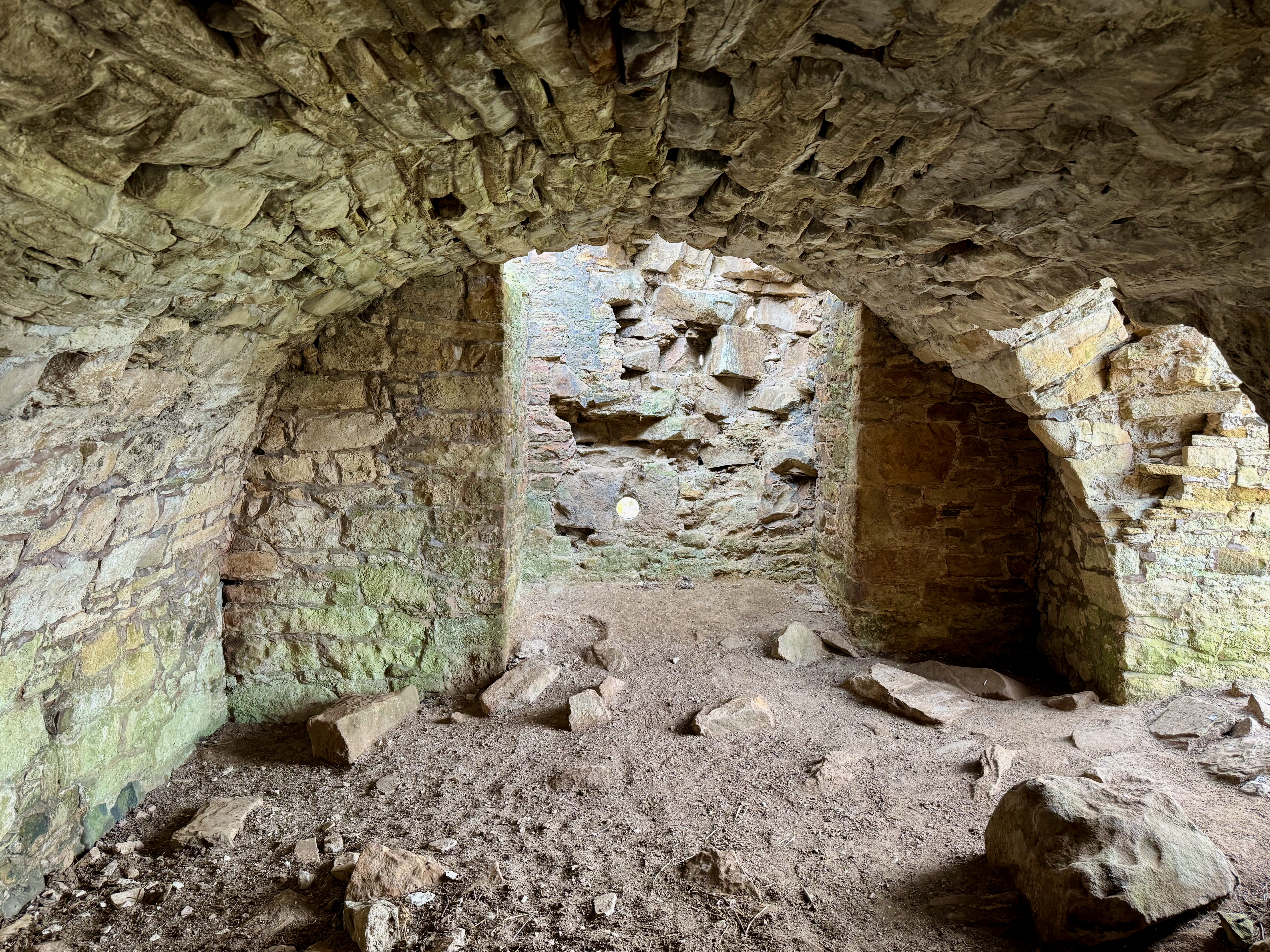
The original entrance opens into a vaulted cellar, on one side of which is access to the stairwell. This chamber was originally a storehouse but later became a kitchen. The hall, located on the first floor, features a fireplace remnant on the west wall. The upper floors would have been the sleeping quarters.
One of the most intriguing aspects of Timpendean Tower is its proximity to much older earthworks. These are thought to be from the early Middle Ages. The surviving defences comprise various configurations of ramparts and ditches on different sides of the perimeter. Adding to the tower’s defensive capabilities, one of these ditches would have been filled with water.

Timpendean Tower is associated with the Douglas Lairds of Bonjedward. In 1479, George Douglas, 4th of Bonjedward, passed Timpendean over to his younger son, Andrew. Then in 1540, William Douglas, heir of the late George Douglas, received a charter from James V, which included the lands of Timpendean. But what of its association with historical events?
We know that towers such as Timpendean were common throughout the Borders because of the prevailing lawlessness and the need for protection against raiding parties, particularly Border Reivers. The Douglas family’s power may have made them targets for reiving (raiding), necessitating the defensive tower, but potentially, it could also have positioned them as participants in the border power dynamics.
But the best documented historical event occurred at the hands of English invaders in 1545 as a result of Henry VIII’s “rough wooing”. This was a violent attempt to force a marriage agreement between the infant Mary Queen of Scots and Henry’s 6-year-old heir, Edward. Timpendean Tower was one of many attacked and burnt by Edward Seymour, Earl of Hertford, as part of a “scorched earth’ policy. Despite being seriously damaged, Timpendean Tower was eventually rebuilt by the Douglas family. It remained their seat until it was later sold to William Kerr, Marquis of Lothian, in 1843.

Timpendean Tower is just about visible from the main A698 road, It can be reached on foot by walking about 1 km up a farm track from the road. It is uphill on an uneven surface, and on the approach to the tower, there is a stile giving access over a fence into the earthworks. If it has been raining, the ground will be muddy and the uphill walk hard-going.
Timpendean Tower is an interesting ruin, offering a valuable insight into border life and architecture. Despite the obvious damage, it is certainly worth a visit.
Further reading:
Mike Salter, 1994 The Castles of Lothian and The Borders (Folly Publications)
Ancrum & District Heritage Society


 Thistle & Time
Leave a comment