
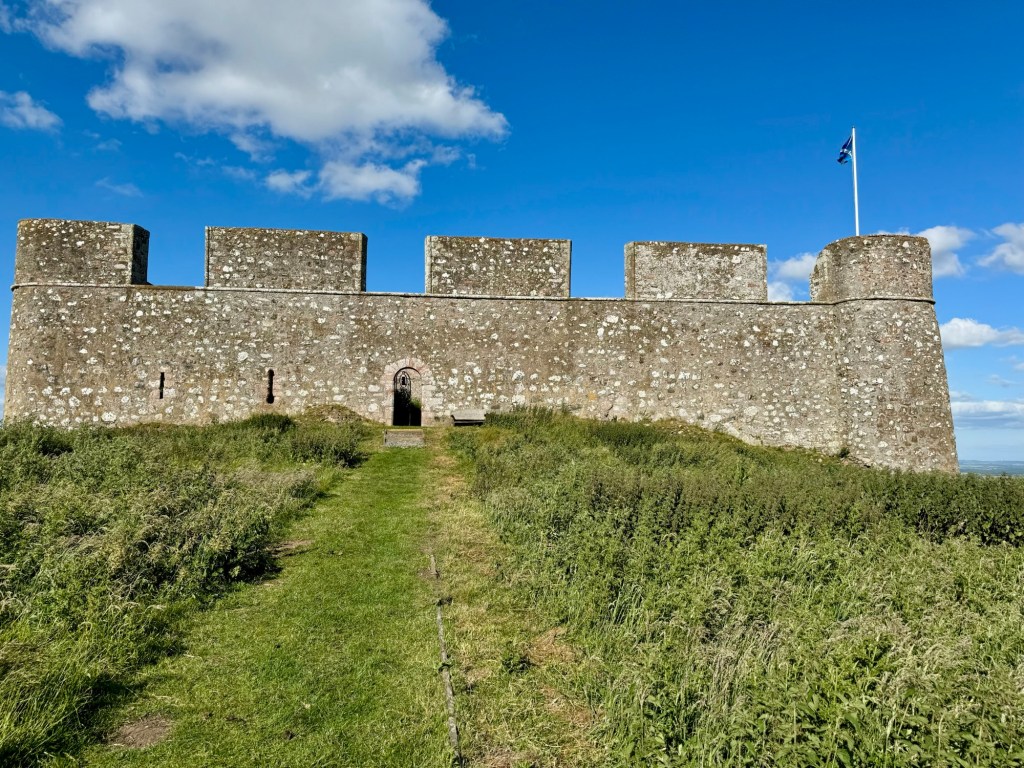
Perched atop a rocky outcrop in the Scottish Borders, almost 230 metres above sea level, Hume Castle occupied a crucial site for controlling what is known as the Merse. This is the land situated between the River Tweed in the south, and the Lammermuir Hills in the north. The views, in all directions, are spectacular.
Originally built in the 13th century, Hume Castle played a significant role in border warfare between Scotland and England. Unsurprisinglyy, its strategic location made it a key stronghold.

The ruins that remain today are in fact those of an 18th century folly that sits on top of the footprint of the original medieval castle. The latter served as the seat of the powerful Home family until the early 1600s. Successive Lords Home, seated at Hume Castle, were Wardens of the Eastern Marches, policing the Scottish side of the Border, which was less than five miles away.

Hume Castle’s strategic importance and status was confirmed when Scotland’s James II stayed there during the siege of the nearby Roxburgh Castle (which at the time was held by the English) in 1460. During this period of Anglo-Scottish wars, Hume Castle was a target for both Scottish and English forces. Its strategic location made it valuable for controlling the eastern Scottish Borders.

Legend has it that after the battle of Flodden in 1513, the 3rd Lord Hume took possession of King James IV body and hid it in a cave adjoining the well at Hume Castle. During the 19th century a skeleton was found in the medieval well with a chain around his waist. Sadly it disappeared, so we’ll never know whether this was the king.
The castle is particularly well documented during the 16th century, when it played an important role in the ‘Rough Wooing‘ changing hands on a number of occasion.
In 1651, during Cromwell’s invasion of Scotland, the English forces, led by Colonel George Fenwick, besieged the castle. The Governor of the castle, Colonel John Cockburn refused at first to surrender, but when the castle walls were breached, Cockburn arranged a parley. This resulted in him and 78 others being allowed to go free; and Fenwick took control of Hume Castle.
Later, Cromwell destroyed the castle to prevent its further use as a military stronghold. However, when rebuilt as a folly by Lord Marchmont, a member of the Home family, it was used as a signal station during the Napoleonic wars. In 1804 the castle was the cause of the “Great Alarm” when a sergeant mistook charcoal fires on possibly the Cheviots, or perhaps Dirrington Law, a hill 12 miles (19 km) to the north, as a warning of imminent attack. He fired his own beacon at Hume, setting in train the lighting of all Borders’ beacons to the west.

Being just a 20 minute drive from home, we eventually made a visit, together with grandchildren and dogs, after passing through the small village of Hume on a number of previous occasions. Not being a particularly well-known castle, we had the place to ourselves. There are no internal structure to explore, the area within the walls being covered with grass, save for a remaining part of the old castle. But the younger family members really enjoyed climbing the rampart to look out over the Borders countryside; and to be fair, so did we!
Hume Castle is just a short drive from Kelso and there is a small car park located just after a row of houses. There are some steep steps part-way up to the castle but the terrain is fairly rough, so appropriate footwear is recommended. Also, the area is regularly grazed by sheep so keep dogs on a lead if they are accompanying you. The site is free to access, throughout the year.
As there are no facilities on site or in Hume itself, you are recommended to visit Kelso for pubs, cafes and public toilets.

Sources:
Hume Castle Preservation Trust


 Thistle & Time
Leave a comment