
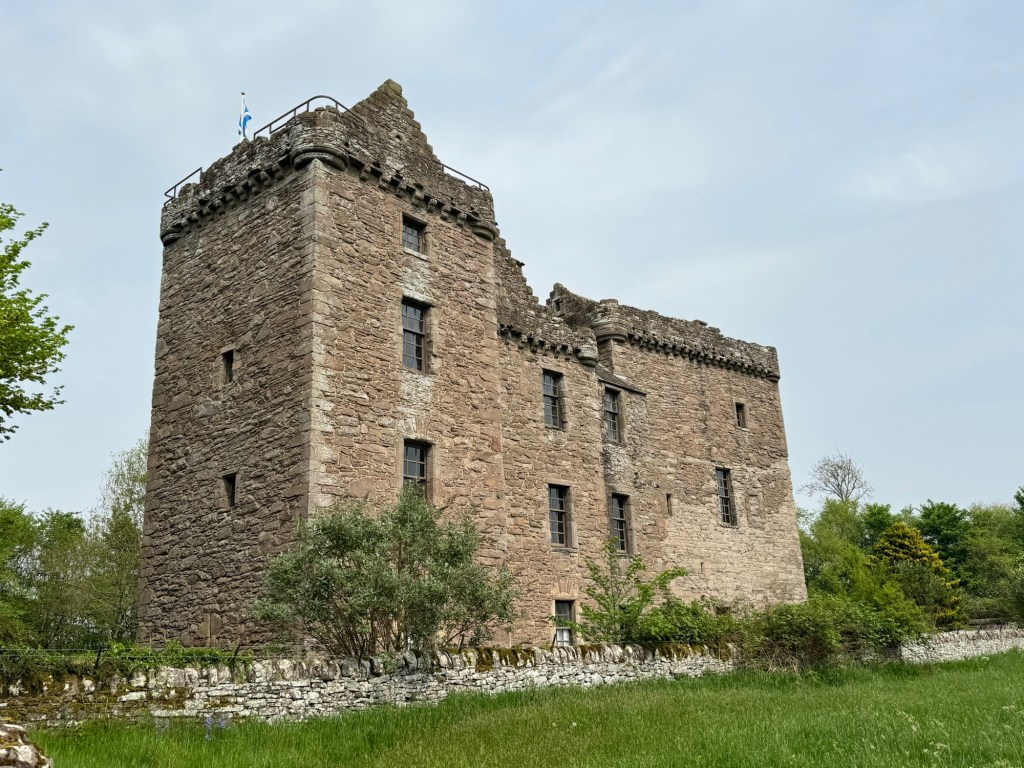
Close to the city of Perth, located just a short distance west of the busy A9, is Huntingtower Castle. Despite its proximity to traffic and houses, the setting is such that visitors are immediately transported back to the Middle Ages. In fact, for nearly three centuries this well-preserved building was home to some of Scotland’s most powerful people.

The castle originally comprised of two tower houses, built remarkably close together. However, the gap between them was eventually enclosed in the late 17th century. The east tower is typical of medieval Scottish tower houses, with kitchen and services on the ground floor, the hall on the first floor and private apartments on the upper floors.
An interesting interior feature is the painted ceiling which is believed to date back to 1540. Not discovered until 1913 when some pine panelling was removed, it is one of the oldest tempera-painted ceilings in existence.

The west tower is L-shaped, with the main block rising to three stories and the south-west projecting block rising a storey higher.
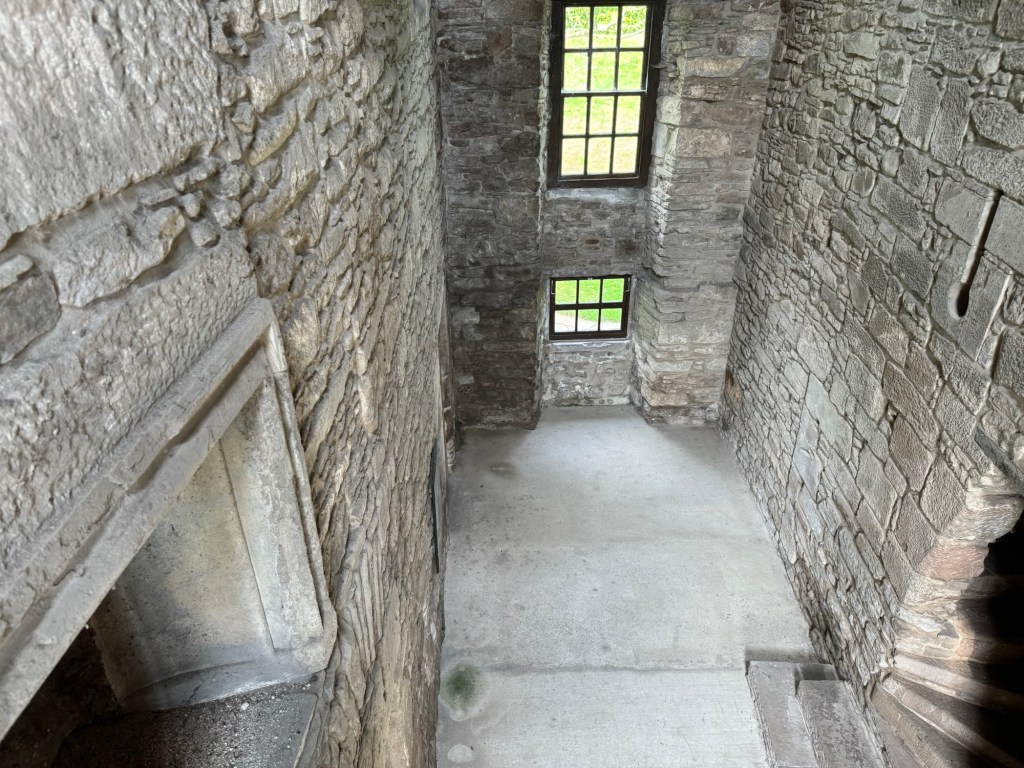
Walking through the various rooms and climbing the staircases, I imagined what it must have been like to call this place home. It felt massive and empty, but of course in its hey day, it would have been a colourful hive of activity. Where I saw stone there would have been plastered walls and all manner of furnishings applicable to the era; and castle servants going about their respective duties.
However, for me the most intriguing part of my visit was learning the building’s history. In the 1400s the castle was the home to the Ruthven family, who later became the successive earls of Gowrie. They certainly attracted some important visitors. In 1565, Mary Queen of Scots visited with her husband Lord Darnley, shortly after they were married. It is said that Mary didn’t care much for her host, Patrick, the 3rd Lord Ruthven. She was wise to be suspicious, since in March 1956, Patrick was one of the ring leaders in the murder of David Riccio, Mary’s personal secretary. Patrick fled to Newcastle and died there three months later.
Patrick’s son, although also implicated in the murder, went on to become treasurer of Scotland and was made the 1st Earl of Gowrie in 1581 by James VI, who by then had become the young new king of Scotland.
But the 1st Earl and some others, eager to protect the young king from the influence of pro-Catholic noblemen, took things into their own hands in what became known as the “Ruthven Raid”. This resulted in James VI being held against his will by Gowrie for some 10 months. However, following his escape in 1583, James had Gowrie executed.
Later, in 1600, the 3rd Earl of Gowrie and his brother were slain in Gowrie House in Perth, allegedly because of a plot to kill the same King James VI (known as the Gowrie conspiracy). The true facts of what happened and why will probably remain a mystery. One theory is that the James VI orchestrated events in order to avoid paying the substantial debt he owed the family.
After their deaths the two Ruthvens were indicted for high treason and an Act of Parliament extinguished their name, and forfeited their estates. Their mutilated bodies were displayed in Scotland’s primary burghs.

The castle then became crown property and it became known as Huntingtower Castle, (rather than the Place or Home of Ruthven as it was previously known). Keepers of the castle were the Murray family, in whose possession it stayed until 1805. It was at the castle that Lord George Murray was born, who later became the military commander in Prince Charles Edward Stuart’s Jacobite army in 1745.
The castle changed hands a couple of times in the nineteenth century before being entrusted into state care in 1912.

There is an enduring legend associated with the castle, dating back to the time when the two towers were still separate. Dorothea, daughter of the Earl of Gowrie is said to have left her room in the west tower and crept upstairs into her lover’s room in the east tower. But becoming aware that her mother was trying to catch the lovers together, Dorothea made a daring leap across the gap between the two towers, a distance of around 2.7 meters, and landed safely. She returned to her room and avoided detection. The following day the lovers eloped. This tale, known as the Maiden’s Leap may be just a legend, but a real Dorothea, daughter of the Earl of Gowrie, did marry and live happily ever after!

Today the castle is managed by Historic Environment Scotland. There is a very small and narrow car park next to the small castle shop and ticket office. Entrance fees apply. There is also a picnic area immediately outside the castle. Like many castles in Scotland, dogs can be taken around the exterior but they are not allowed inside.
We’ve visited a number of different Scottish castles in the last few years and this is definitely a favourite of mine. Indeed, the painted ceiling was a highlight, although as someone who enjoys visiting castles, the whole experience was, in my view, superb (including sitting and eating lunch outside). It will certainly be of interest to anyone with a fondness for historical buildings or wanting to learn about this period of Scottish history.

Sources:
Historic Environment Scotland and official souvenir guide


 Thistle & Time
Leave a comment