

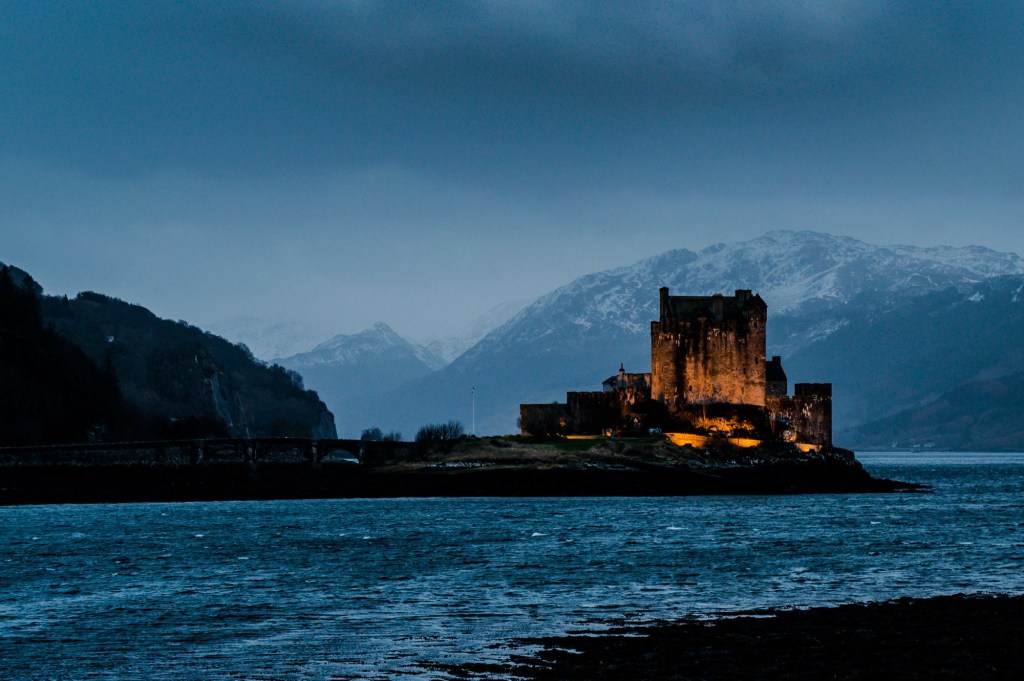
Situated near the village of Dornie, Eilean Donan Castle sits on a small tidal island where the lochs Duich, Long and Alsh all meet.
It is probably Scotland’s most photographed castle outside of Edinburgh, and rightly so. It really is stunning, set as it is in the beautiful western Highlands.

Finding Eilean Donan Castle is simple enough. Easily recognised, it is located on the A87 just south of Dornie and about 66 miles (106 km) from Fort William. There is a large pay and display car park which can get quite busy at peak season. The modern visitor centre at the mainland-end of the bridge is home to a gift shop, ticket office and café.

The island is perhaps bigger than it looks and it is possible to walk completely around the castle. It is certainly worth exploring the outside. However, inside, the meticulous restoration and recreation of the rooms brings the castle to life.
We made a stop at the castle on our way back from a trip to Skye. Sadly we couldn’t take the dogs inside, and leaving them in the car was not an option on a hot day. So we shall return some time in the near future for the full experience.
But what about Eilean Donan’s history? The first fortified structure was built in the early 13th century to defend against Viking raids. By 1274 the castle was in the hands of Kenneth MacKenzie and became a stronghold for the family and their allies, the MacRae clan.
The castle underwent several expansions and reductions over the centuries, with significant modifications in the 16th century, including the addition of a hornwork for cannon defence.
In 1715, the castle was a rallying point for Jacobites before the battle of Sheriffmuir. Later, during the 1719 Rising, Eilean Donan Castle served as a key Jacobite base supported by 46 Spanish marines.
They used the castle as a garrison and ammunition store while attempting to rally Highland clans to their cause. However, British government forces, alerted to the plan, dispatched three Royal Navy ships—HMS Worcester, Enterprise, and Flamborough—to the area. On May 10, the ships bombarded the castle after an initial attempt to negotiate was met with gunfire from the defenders. The bombardment continued for two days, and on May 11, a landing party stormed the castle with little resistance, capturing most of the Spanish marines and seizing large quantities of gunpowder and ammunition. To prevent further use by the Jacobites, government forces destroyed the castle with explosives on May 12. It remained in ruins until its restoration in the 20th century.

The castle was acquired in 19 11 by John McRae-Gilstrap, and in 1912 reconstruction began. Using stone rubble left when the castle was destroyed in 1719, it took shape over the next 20 years. In 1955 Eilean Donan Castle opened to the public. Today it is run by the Conchra Charitable Trust.

Sources:


 Thistle & Time
Leave a comment