

Melrose Abbey in the Scottish Borders is one of Scotland’s most significant and visually striking medieval ruins. Its history stretches back to 1136, when King David 1st founded the abbey for Cistercian monks, a religious order known for their austere way of life and dedication to manual labour. It was part of a broader programme of abbey foundations in the Borders, using monastic patronage to express both piety and royal authority in a contested frontier region.
King David’s initial choice of location was Old Melrose, where an early 7th-century monastery once stood. But the monks found a more suitable setting further west, known as Little Fordell, which eventually grew into the town of Melrose.

The new Melrose Abbey quickly became one of Scotland’s most important spiritual centres. In 1146, the east end of the abbey was completed and dedicated to St. Mary. Other buildings in the complex were added over the next 50 years.
The abbey’s Gothic architecture, with its intricately carved stonework, was renowned for its beauty and craftsmanship. A surprising amount of this still survives today, despite the passage of time and repeated attacks by invaders.

During the first centuries of the monastery’s life, the monks managed and worked an extensive collection of farms. However, by the 1400s the recruitment of lay-brothers had slowed, and so the monks rented out many of their farms. Their most important product was wool. Indeed, by the mid-1300s (when wool production in Scotland was at its peak) Melrose Abbey owned some 17000 sheep making it a major wool producer.

The relative peace of the Scottish Borders was broken in 1296 when Edward I of England invaded Scotland.
It is said that some twenty years later, the King of Scots, Robert the Bruce, who defeated Edward II at Bannockburn in 1314, based himself at Melrose and launched raids into English-held lands. However, in 1322, at the hands of Edward II’s English soldiers, the Abbey was sacked. Robert the Bruce helped to pay for the abbey’s rebuilding after its destruction.
When he died, Robert the Bruce’s heart was carried on a crusade by his friend, the Good Sir James of Douglas. It was returned to Scotland in 1331 and then buried at the abbey. A casket believed to contain his heart was discovered on-site in the 20th century, further cementing the abbey’s significance in Scottish history. It was reinterred with due ceremony.

The abbey is also the resting place of Alexander II, who died in 1249.
Further damage to the abbey occurred in 1385 at the hands of another English king, Richard II, when his soldiers burnt the monasteries at Melrose, Dryburgh and Newbattle.
After this destruction, rebuilding of the abbey continued over the next 100 or more years, creating much of the medieval architecture that we see today. Interestingly, the exterior of the abbey has been adorned with carved statues and although many are now missing, there are some fascinating survivors. These include flying dragons, demons and images of Christ, saints and martyrs. There is even a bagpipe-playing pig.

In the mid-1500s the abbey was again a victim of war during what became known as the “Rough Wooing”. Henry VIII of England tried to force a marriage between his son Edward and the young Mary Queen of Scots. The English set fire to Melrose Abbey’s church and desecrated its tombs. The abbey then fell into disrepair although parts continued to be used by monks until the early 1600s. Its eventual demise was underlined by the Protestant Reformation that officially abolished Catholic worship in Scotland.

However, despite being bombarded by Oliver Cromwell during the Civil War, part of its remains were later used as a parish church until 1810, when a new church was built.
Melrose Abbey is laid out on a traditional east-west axis and is built in the form of a St John’s Cross, with the east end forming the head of the cross. Only a small part of the first abbey church survives. The present building of rose-coloured stone dates almost entirely to the post-1385 rebuilding, and it is regarded as a fine example of medieval architecture. The great east window is one of the abbey’s best-known features, with elaborate tracery and a strongly Gothic character. Also still remarkably intact are the monks’ choir and transepts, and part of the nave.
Interestingly, the abbey’s cloister arrangements were unusual: there were cloisters north and west of the church, likely shaped by the river and site layout.
Perhaps it is no surprise to learn that this remarkable ruin has attracted some interesting folklore.

The abbey’s best-known tale tells of a corrupt monk, nicknamed the Hunderprest (or “dog-priest”), who lived a sinful life of violence and excess. After his death, he was said to rise from the grave as a monstrous, blood-drinking revenant—effectively a medieval vampire. He was eventually killed after being decapitated by an axe-wielding monk and then burnt.
Melrose is also linked to more traditional ghost lore: the wandering spirits of monks said to linger among the ruins and graveyard. These are often portrayed not as malevolent, but as unsettled souls tied to the abbey’s long religious past and violent history during border wars.
Today Melrose Abbey is managed by Historic Environment Scotland. It is open to visitors most of the year and an entrance fee applies. At the time of writing, access inside the abbey is restricted due to conservation work.
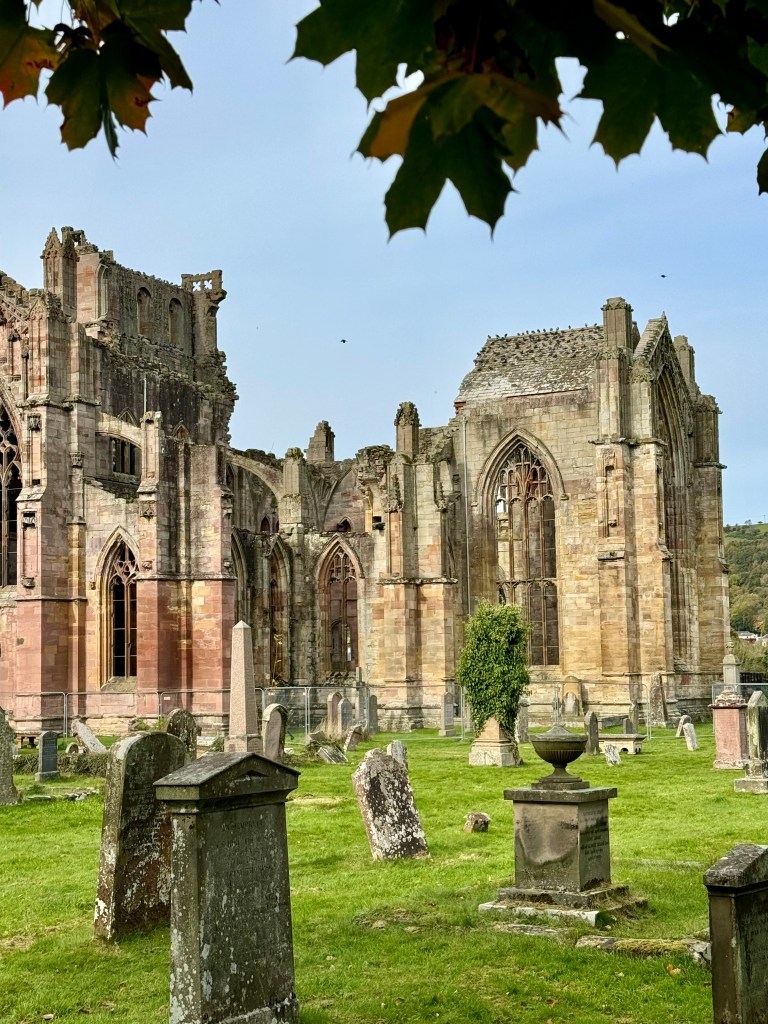
Living in the borders, we have visited the abbey more than once. Walking around the grounds you get a sense of how majestic it must have been in its time. You can also appreciate its beauty and the incredible skills of the masons who built it. What’s more, there is a museum, originally the Commendator’s House, that offers an interesting history of the local area. As for Melrose itself, it is one of our favourite towns and we visit quite often
Melrose Abbey is easily located on the north east of the town. There is a small “pay and display” car park nearby, or you can try your luck with on-road parking. In summer both the town and the abbey can be quite busy.
Further reading
Historic Environment Scotland, 2023, Melrose Abbey Official Souvenir Guide (HES)
Historic Environment Scotland website


 Thistle & Time
Leave a comment