

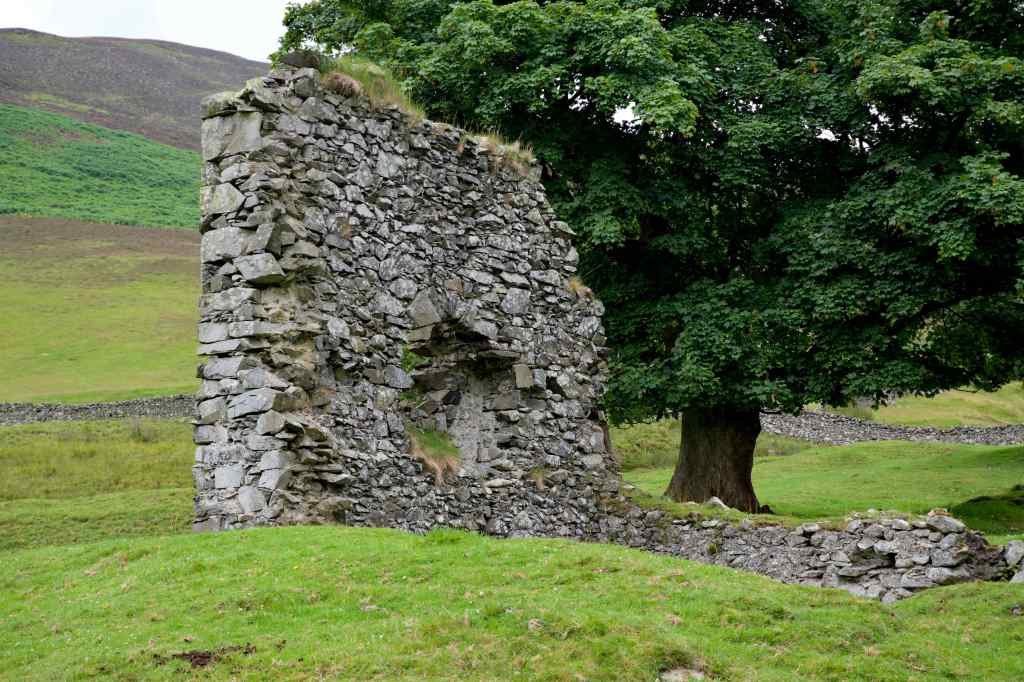
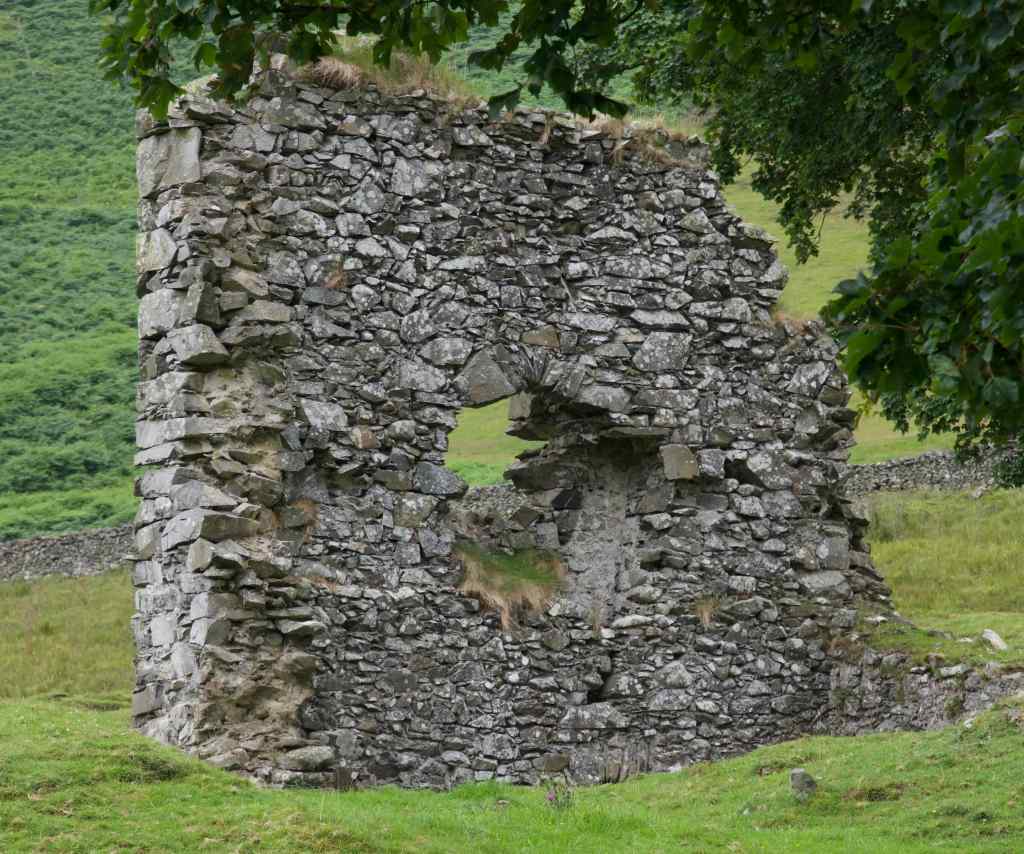
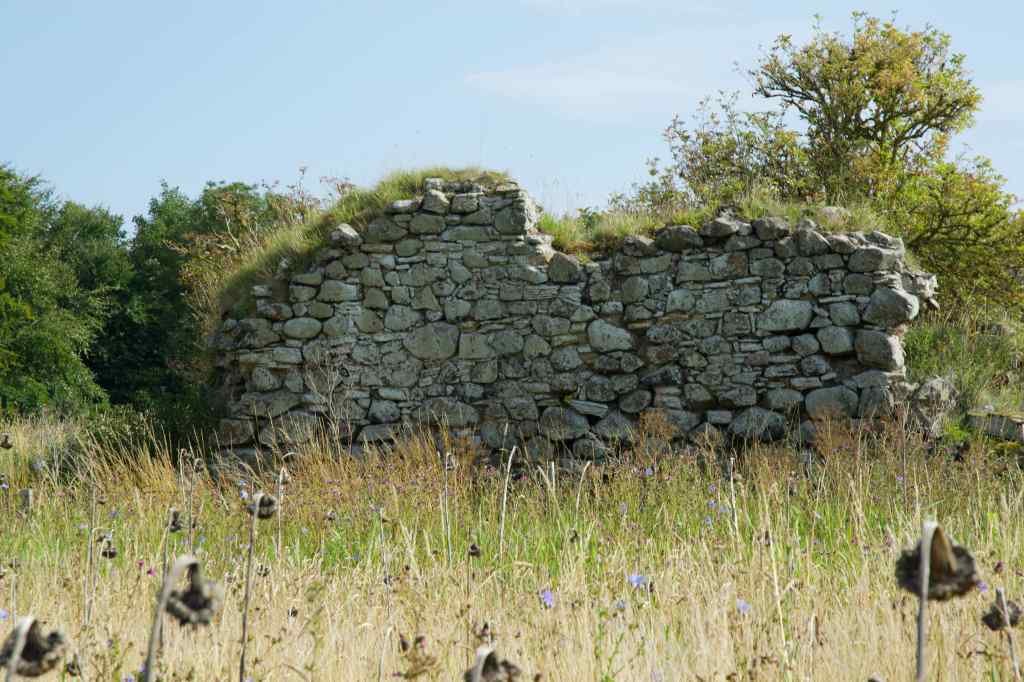
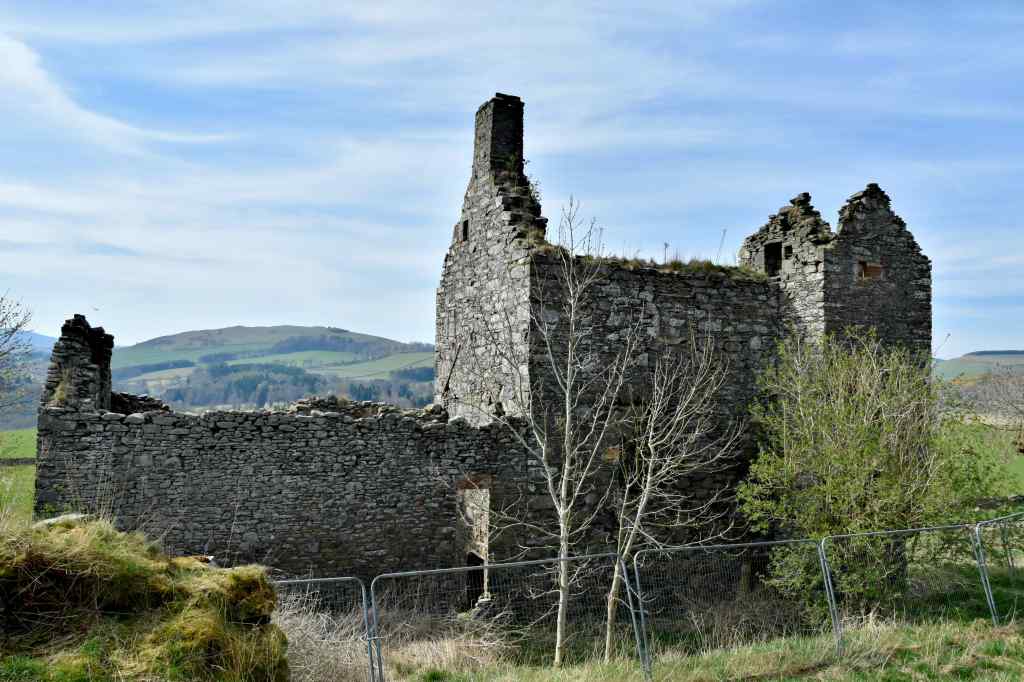
Posso Tower is a ruined 16th-century tower house in the parish of Manor, approximately six miles south-west of Peebles and just west of the Manor Water. Today, only low wall fragments remain. In its day, Posso Tower was part of the Posso estate owned by the Baird (also spelt Bard or Barde) family and was among a network of peel-towers and lairds’ houses that once defended the upper Tweed valley.
Likely constructed in the first half of the 1500s, Posso Tower had a rectangular footprint measuring 9.4 by 7.5 metres. It was a stone-built tower with at least two main storeys plus attic, featuring thick rubble walls of at least 1.22 metres, typical of 16th-century defensive houses in Tweeddale.

It had a vaulted basement that was lit by at least one slit window in the west wall. On the first floor was the main hall, which was also believed to be vaulted. There is no evidence of an extended barmkin, but to the south and east of the tower are the remains of outbuildings. There is also some evidence of terracing, possibly the remains of orchards and gardens.
Interestingly, the tower is situated within a landscape long inhabited, featuring prehistoric structures such as forts, stone circles, and cairns nearby.
The Bairds have an extensive family history in the area, with the earliest on record being Thomas de Bard, who served as Sheriff of Peebles in 1296. His descendant, also named Thomas, was granted a charter by Robert III, King of Scots, for the lands of Posso. In 1513, Sir Gilbert Baird of Posso is thought to have fallen at the Battle of Flodden.
John Bard was the Laird of Posso early in the 16th century. He and his wife, Jonete Scott, had three children: a son, Gilbert, who, it seems, was never married and was a minor at the time of his father’s death around 1525, and two daughters, Elizabeth and Jonete.
When Gilbert died, the estate was divided between the two daughters. Later, Elizabeth’s share of Posso was transferred through marriage to her husband, Sir Michael Naesmyth (also spelt Naismith). He served as Chamberlain to John Hamilton, Archbishop of St Andrews, and was a personal friend of Mary, Queen of Scots; he even hosted royal visits to the Posso Valley, where the Queen and her Court engaged in hunting and falconry.
During the Marian War, Naesmyth fought under Mary’s banner at Langside in 1568, which led to the confiscation of his estates by the Regent Moray. But he later regained them, and his family held their half of Posso and Glenrathnes for several generations.
By around 1775, a new residence had been built nearby, and contemporary accounts suggest that by this time, Posso Tower itself was already in a state of ruin. This reflected the broader decline in the military and practical significance of small tower houses following the Union of the Crowns and the pacification of the Borders.

As part of a network of watchtowers, Posso Tower was situated within the Border Reiving landscape. During times of danger, the beacon would be lit to signal a raid from across the border. However, there are no surviving records indicating that the tower was ever attacked, including during the Wars of the Rough Wooing (1543 – 1551).
The surviving evidence indicates that the Bairds and later the Naesmyths held a cautious middle position within 16th-century Border society, influenced by reiving conditions but not shaped solely by them. Posso Tower was situated in a landscape familiar with insecurity, livestock movement, and local feuding, yet neither the tower’s modest size nor the documentary record suggests that the Bairds or Naesmyths were active reivers.
They do not appear in Privy Council prosecutions for raiding, in bonds imposed on turbulent surnames, or in English and Scottish complaints that typically identify those most involved in organised reiving.
Instead, the Bairds match the profile of minor lairds whose main concern was defending Tweeddale rather than raiding or retaliation.
As for the Naesmyths, if anything, they signify a move further away from the reiving economy. Their course is that of an upwardly mobile, increasingly respectable landed family. Indeed, by the late 17th century, they had attained baronet status.
Equally notable is the absence of these two families from the records of the “Assured Scots” of the Rough Wooing. Formal assurance to England was a documented and politically sensitive status, typically reserved for lairds of strategic importance along the frontier. Systematic checks of known assurance lists and surname variations reveal no Baird or Naesmyth of Posso among them, nor any evidence of English protection or collaboration in related correspondence.
Taken together, this silence is significant. It indicates that the occupants of Posso Tower neither engaged in reiving nor crossed the perilous, yet often pragmatic, boundary into open alignment with English interests. Posso’s history is therefore not one of opportunistic reiving or political duplicity, but of two landed families manoeuvring through a violent Border landscape with discretion, localism, and quiet adaptation rather than through notoriety.
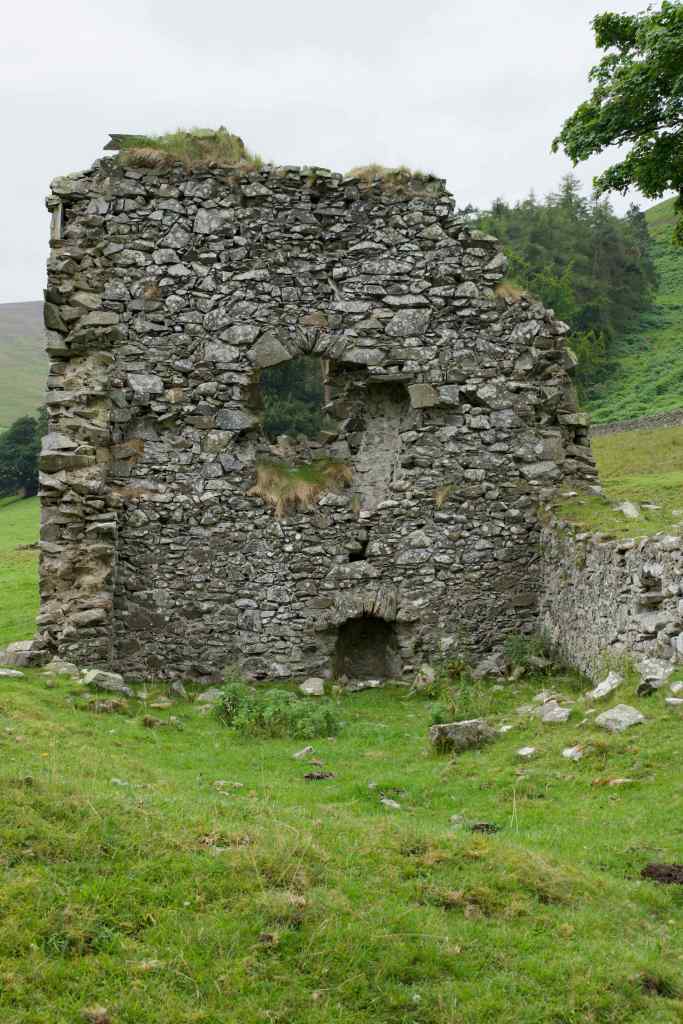
In summary, Posso Tower is a fairly typical small Borders tower-house: combining defensive and domestic features, situated in a cluster of homesteads and earthworks in the Manor valley. Its connections with the Baird family and later the Naesmyths are evident. Although it shares the context of the Border Reivers and the Rough Wooing — the wider area experienced raids and reprisals in the 16th century — no surviving primary source online explicitly records Posso as a targeted casualty of the raids during or outside the Rough Wooing.
You can see the remains of Posso Tower if you are willing to cross some fields (accessible under the Scottish Outdoor Access Code). For our trip, we took the minor road south through Kirkton Manor and then Castlehill. After about a mile (1.6 km), we parked off-road (it is narrow here, so leave space for farm vehicles to pass) and headed west on foot. The ground was muddy in places despite the recent good weather. The tower was in a second field occupied by some cows, which, fortunately, kept their distance from us.
Posso Tower: OS National Grid Reference NT 20014 33243
Further reading
Alastair MT Maxwell-Irving, 2014, The Border Towers of Scotland Volume II (Maxwell-Irving)
Mike Salter, 1994, The Castles of Lothian and the Borders (Folly Publications)


 Thistle & Time
Leave a comment