
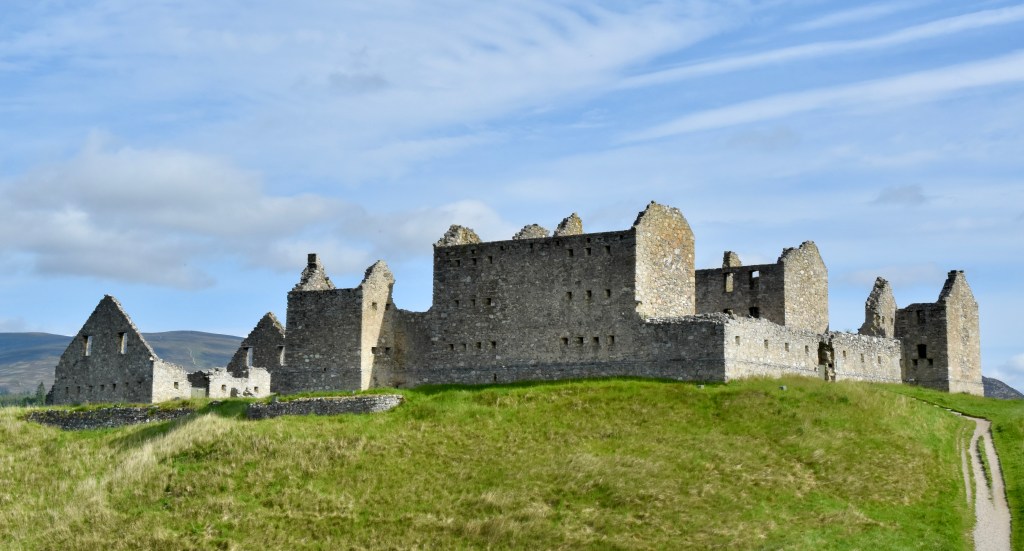
Ruthven Barracks (pronounced Riven), overlooking the small town of Kingussie in Badenoch, is a striking ruin with a rich history. It was one of four Highland barracks built by the British government following the Jacobite Rising of 1715.
Constructed between 1720 and 1724, the barracks overlooked the vital crossing of the River Spey and could house 120 troops and 30 horses for dragoons. The site was selected for its strategic advantages. The elevated mound on which the barracks stood provided extensive visibility across the Spey valley, making it easier to monitor movement and spot potential threats. In fact, the location had been fortified for centuries—at least since the 13th century—by a castle built by the Comyn family that later served as the stronghold of the infamous Wolf of Badenoch.
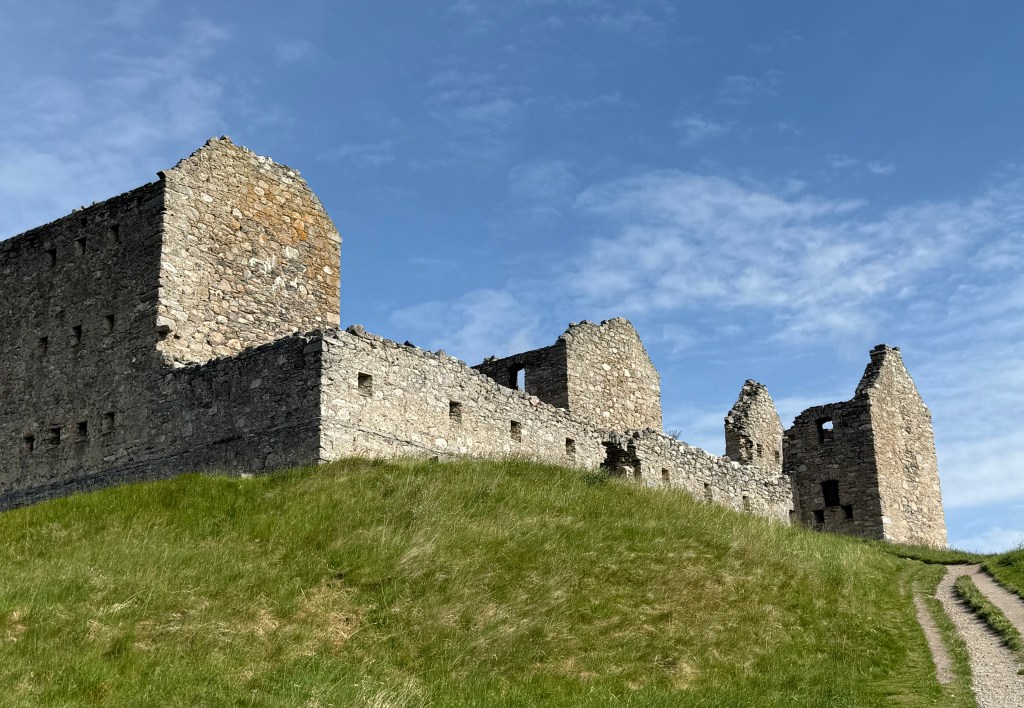
Then, in 1459, a larger castle was built and held by the Earls of Huntly. However, it was destroyed by Jacobite troops during the 1689 uprising. So it’s somewhat ironic that the new Ruthven Barracks, built solely to counter the Jacobite threat, were constructed on the very site where Jacobites had previously achieved a victory.
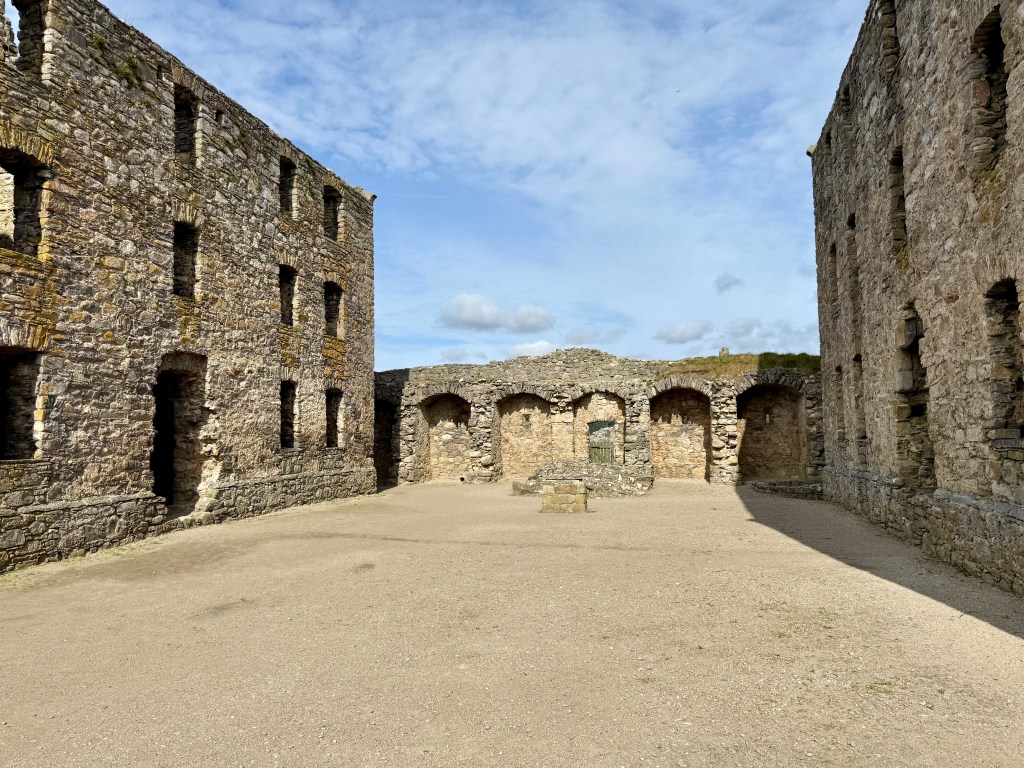
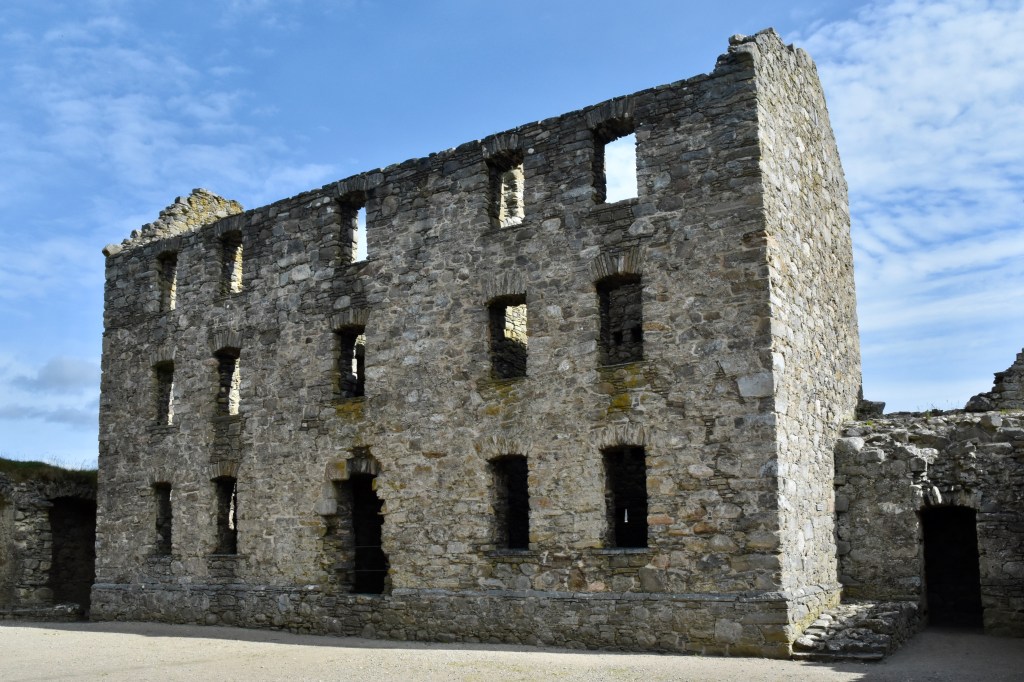
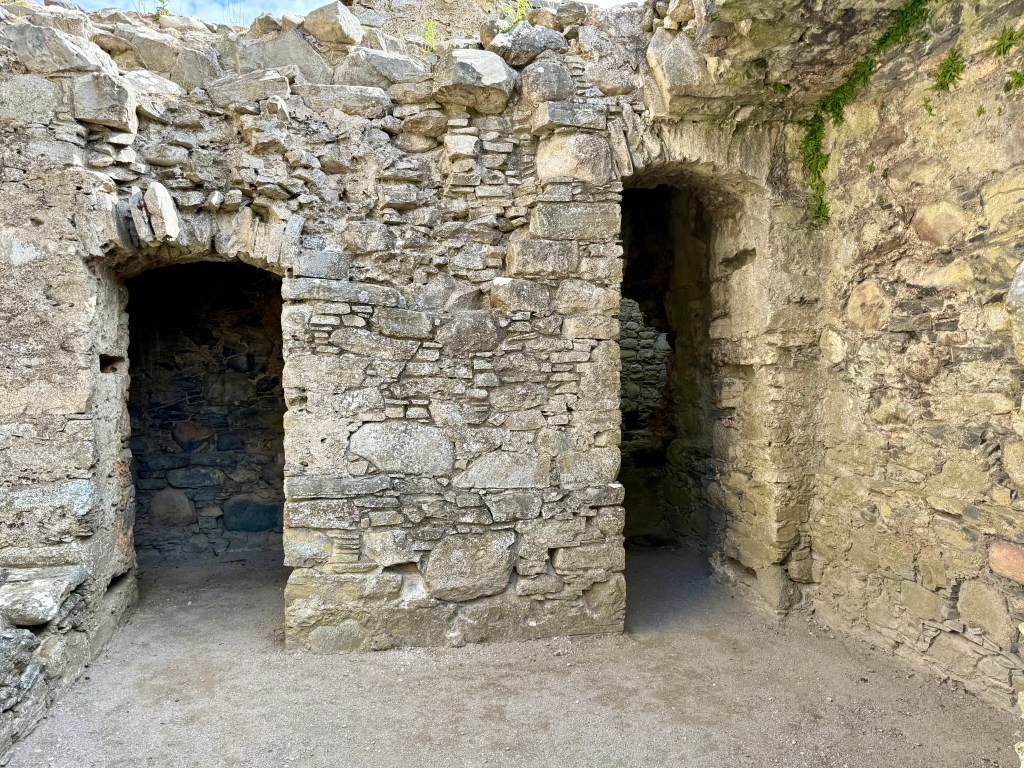
Ruthven Barracks featured a simple yet effective military layout designed for garrison life and defence, but not for prolonged siege warfare. There were two large, three-storey blocks on either side of a central courtyard or parade ground. Each barrack block contained six rooms, accommodating about 60 men per block, with soldiers sleeping ten to a room (and two to a bed). The rooms had windows facing the courtyard, while the outer wall contained gun loops.

Towers extending from opposite corners of the protective wall housed the officers’ quarters, along with a guardroom, prison, bakehouse, and brewhouse.
The enclosure walls around the parade ground had a wall-walk above a series of open-ended vaults, but each of these was provided only with one musket-loop. There was no provision for mortars or cannon. Entrance to the complex was through an archway in the south wall guarded by a strong iron gate and portcullis.
The stables beyond the barracks, added on orders of Major General Wade in 1734, could accommodate up to 30 horses. They were used by dragoons defending troops as they patrolled the military road.
The function of the barracks was not merely to serve as an operational outpost policing the highlands and enforcing the Disarming Acts of 1715 and 1725, but also to act as a physical symbol of state authority. The barracks were, therefore, a profoundly political instrument, embodying the British state’s determination to prevent another Jacobite uprising.
But it didn’t succeed. In 1745, Bonnie Prince Charlie raised his standard at Glenfinnan, and the “45 Jacobite Rising” was underway. Ruthven Barracks was set to play a prominent role…
Shortly after the rising began, some 1500 Government troops were led into the Highlands by Sir John Cope. He marched north towards Inverness on 28 August, leaving Ruthven Barracks with a garrison of just 14 men commanded by Irish sergeant Terrance Molloy.
Believing the barracks to be empty, a plan to capture them was devised by the Jacobite Major-General, John Gordon of Glenbucket. In total, 150 Cameron clansmen, led by Colonel John William O’Sullivan, were instructed to seize Ruthven Barracks.
However, upon realising the barracks were well fortified, the Jacobites offered those inside free passage if they surrendered. Molloy refused the terms, so the following morning, 30th August 1745, the Jacobite assault commenced.
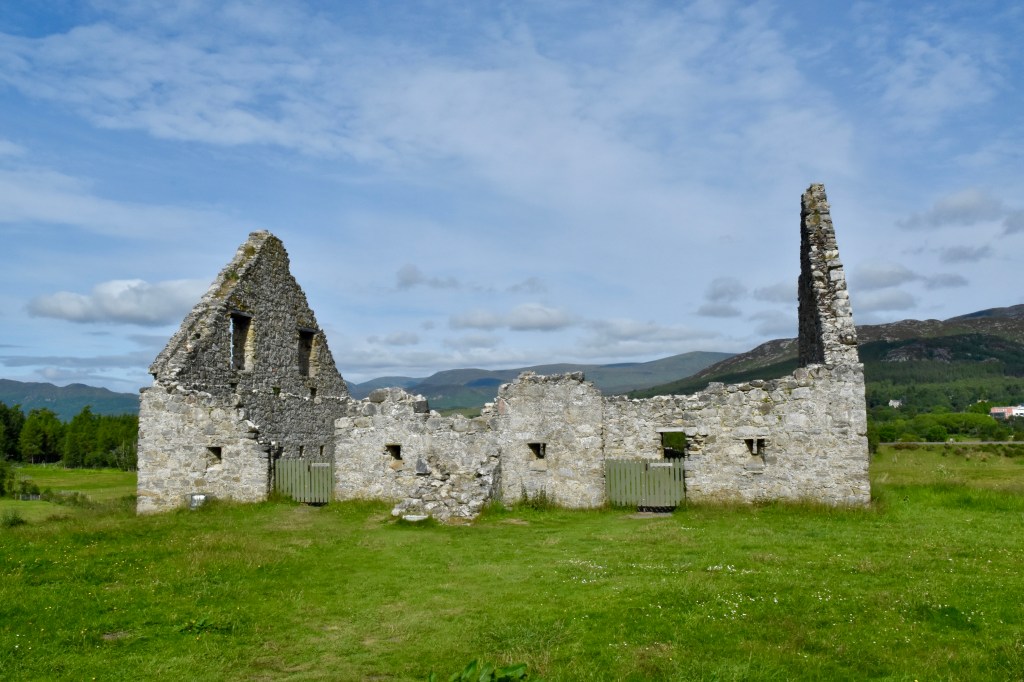
But a two-pronged attack failed when an attempt to burn down the door connecting the main block to the stables was thwarted. Meanwhile, under fire from the small garrison, the Jacobites failed to secure their ladders against the barracks walls. The Jacobite assault was effectively over. After nightfall, they were allowed by Molloy to recover their dead and wounded.
Following this heroic defence, Molloy was swiftly promoted to the rank of lieutenant. This episode proved that the barracks, as constructed, were a highly effective barrier against a lightly armed force.
But on 10th February 1746, a larger, more heavily armed Jacobite force, commanded this time by John Gordon himself, returned to the barracks. Crucially, the attackers were equipped with artillery, a game-changing factor that the barracks were not built to withstand. Still led by Molloy, the garrison initially refused to surrender, but, realising he was in no position to withstand a siege involving cannon, he agreed to terms and surrendered the following day. On 12th February, Molloy and his men were granted safe passage to Perth. The Jacobites then seized provisions from the barracks and set fire to the buildings.
As we know, two months later, on 16 April at Culloden, the Jacobites suffered a terrible defeat. Some 1250 of them were killed, and a similar number were wounded. After the battle, around 3000 Jacobite troops retreated to Ruthven Barracks under the leadership of Lord George Murray.
The gathering of so many at the barracks demonstrated their collective will to continue the fight. Believing that all was not lost, they awaited further orders from their leader, Prince Charles Edward Stuart. But any hope of fighting on ended on 20th April 1746. A messenger from the Prince arrived with a final message, “Let every man seek his own safety in the best way he can.”
This simple statement of capitulation, relayed to a still-willing army, caused profound despair. The words from the Prince effectively ended the Rising. The departing Jacobites destroyed the barracks, leaving the ruins we see today.
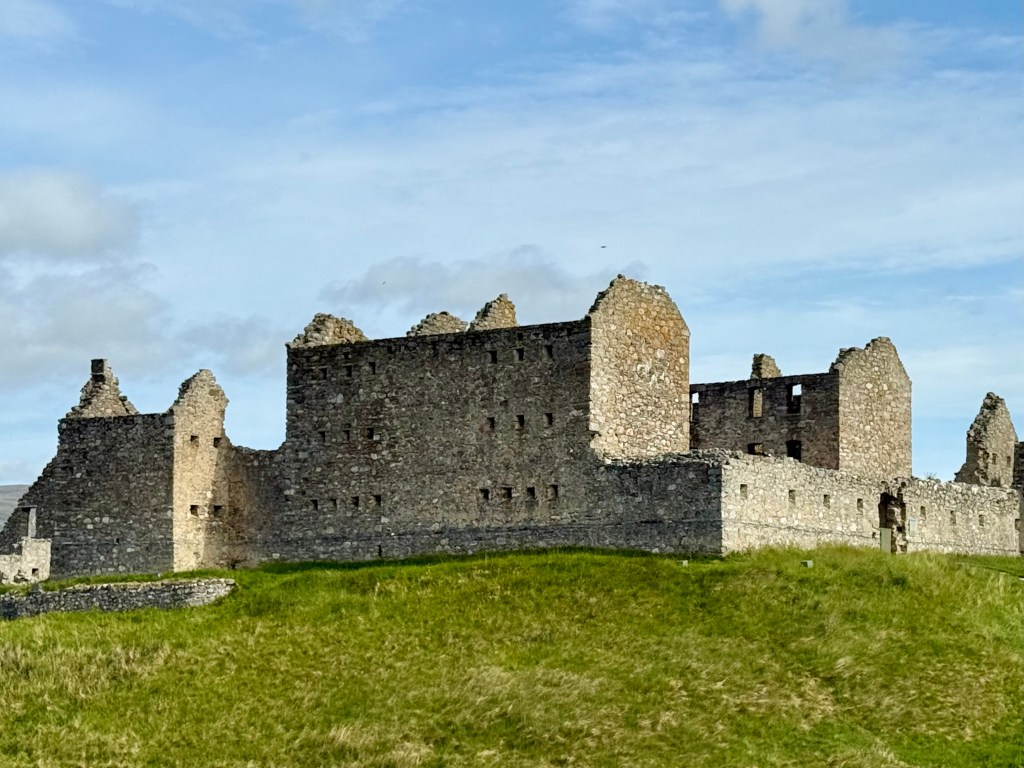
It’s nearly three centuries since the Jacobites’ received that message from Bonnie Prince Charlie. Since then Ruthven Barracks has remained a poignant feature in the Scottish landscape. It is a popular historic site, symbolising the struggle between the newly established British state (Scotland was independent until 1707) and supporters of the Jacobite cause. A visit is well worth it.
Today Ruthven Barracks is managed by Historic Environment Scotland and is free to visit. Although visible from the main A9 trunk road, access is made via Kingussie. Turn off the main street (A86) in the town centre of Kingussie towards the railway station. Continuing for about a mile (1.6 km) and the barracks will appear on your left. There is a small parking area; and you face a short but steep uphill walk to the entrance. The area outside the barracks may be grazed by sheep or hosres so please keep dogs on a lead.
Ruthven Barracks: OS National Grid Reference NN 764 997
Further reading



 Thistle & Time
Leave a comment