

We know that throughout its active lifetime, Dunnottar Castle was home to the Keith family, the hereditary Earls Marischal.
But the castle, and the rock on which it stands, were the scene of some very historic events, ranging from royal visits to serious conflicts. Here is a summary of the most interesting:
The First War of Independence Let’s start a hundred years before the stone castle was built. In 1296, King Edward I of England’s invasion of Scotland ignited the Wars of Independence. Legend says that William Wallace ambushed and attacked an English force that sought refuge, possibly in a chapel. No one survived.
This story comes from a poem about William Wallace, written about 200 years later by Blind Harry. Although the poem is not an accurate record of Wallace’s deeds, the main idea may hold some truth. We do know there is no evidence of any fortifications from that time, although by 1276, a chapel on the rock had been consecrated.
The Scond War of Independence In 1336, during the Second War of Independence, English forces seized Dunnottar in support of Edward Balliol’s bid for the Scottish Throne. At that time, the stone Keep had not yet been built, but it is believed that some wooden fortifications were already in place by then.

Mary Queen of Scots. Moving into the 1560s, and a young Mary, Queen of Scots, faces her first rebellion. When she returned from France after the death of the Dauphin—her husband—Mary had to reconcile her Catholic faith with the now predominantly Protestant Scottish nobility. However, the influential Earl of Huntly, a Catholic nobleman in the north of Scotland, resented Mary’s policies and, in particular, her increasing reliance on Protestant advisors. He rebelled, with his son John Gordon alongside him, leading to the Battle of Corrichie in 1562.
Mary’s forces, led by the Earl of Moray, defeated Huntly, who then suffered what was thought to be a haemorrhagic stroke and died shortly after the battle. John Gordon was captured during the battle was marked for execution by the Earl of Moray. Mary is said to have asked that he be saved. However, instead Mary chose to witness the execution of John Gordon—who had wished to marry Mary—to dismiss any suggestion that she had encouraged him to woo her. Unsurprisingly, the rebellion and subsequent execution had a profound impact on the 19-year-old Mary, Queen of Scots. She therefore visited Dunnattor Castle to seek respite for a few days on November 5 and 6, 1562. She revisited the castle two years later.

The National Covenant Years later, in 1639, Scotland was thrown into a conflict that lasted intermittently for fifty years. It began when Charles I, who was also the king of England and Ireland, attempted to impose Anglican practices on the Kirk (Church of Scotland), including the Anglican Book of Common Prayer. However, many Scots rejected this and signed the National Covenant, which advocated for Presbyterianism and a more democratic church governance. Armed clashes between Covenanters and Royalists soon ensued in what became known as the Bishops’ Wars.
In 1645, James Graham, the Marquis of Montrose, came to Dunnattor with a royalist army and attempted to negotiate the surrender of Covenanter William Keith, the 7th Earl Marischal. In the castle with some of his supporters and 16 Presbyterian ministers, the Earl refused to agree to terms. Montrose acted decisively, plundering and burning Stonehaven. The Earls’ Barony, including vessels in the harbour and crops in the field, were destroyed, although the castle survived.
Oliver Cromwell and the Honours of Scotland During the Bishops’ Wars, Scotland became embroiled in the Wars of the Three Kingdoms. But in 1649, Charles I was executed in England, prompting the Covenanter government in Scotland to abandon its alliance with the English parliamentarians. Charles I’s son, also Charles, arrived in Scotland in 1650 and reached a tense truce with the Covenanters. On 8th July, he was welcomed at Dunnottar Castle by the 7th Earl Marischal.
Eager to confront this new threat, Oliver Cromwell invaded Scotland, defeating a Scottish army at Dunbar in September 1650.

But despite this setback, Charles II was crowned King of Scots at Scone in January 1651, after which the Honours of Scotland (the Scottish Crown Jewels) were taken to Dunnottar Castle along with the King’s papers for safekeeping.
Why Dunnottar? Well the role of the Earl Marischal was to serve as custodian of the Royal Honours of Scotland, (as well as to protect the king’s person when attending parliament). What’s more, Dunnottar Castle was considered to be a particularly strong fortress.
Yet what happened next is quite dramatic:
Firstly, the Earl Marischal is arrested and taken to the Tower of London, leaving the care of the Honours at the castle to George Ogilvy. In September 1651, Cromwell’s forces lay siege to Dunnottar Castle, but Ogilvy and his garrison of 69 men hold firm. By May 1652, Cromwell has conquered all of Scotland except for Dunnottar, so heavy artillery is brought in to break the stalemate. After a further 10 days, Ogilvy and his men are forced to surrender.
But where were the Honours? Cromwell’s men ransacked the castle searching for them and held Ogilvy and his wife prisoner. But the Honours were never found thanks to the bravery of a few individuals. During the siege, the Honours had been lowered down the side of the castle rock to a serving woman, supposedly collecting seaweed. She passed them to Anne Lindsay, who smuggled them out through Cromwell’s lines and then took them in secret to Kinneff Church. The Reverend Grainger and his wife, Christian, buried the Honours beneath the flagstones of the church, where they remained until 1660, when Charles II was fully restored to the throne.
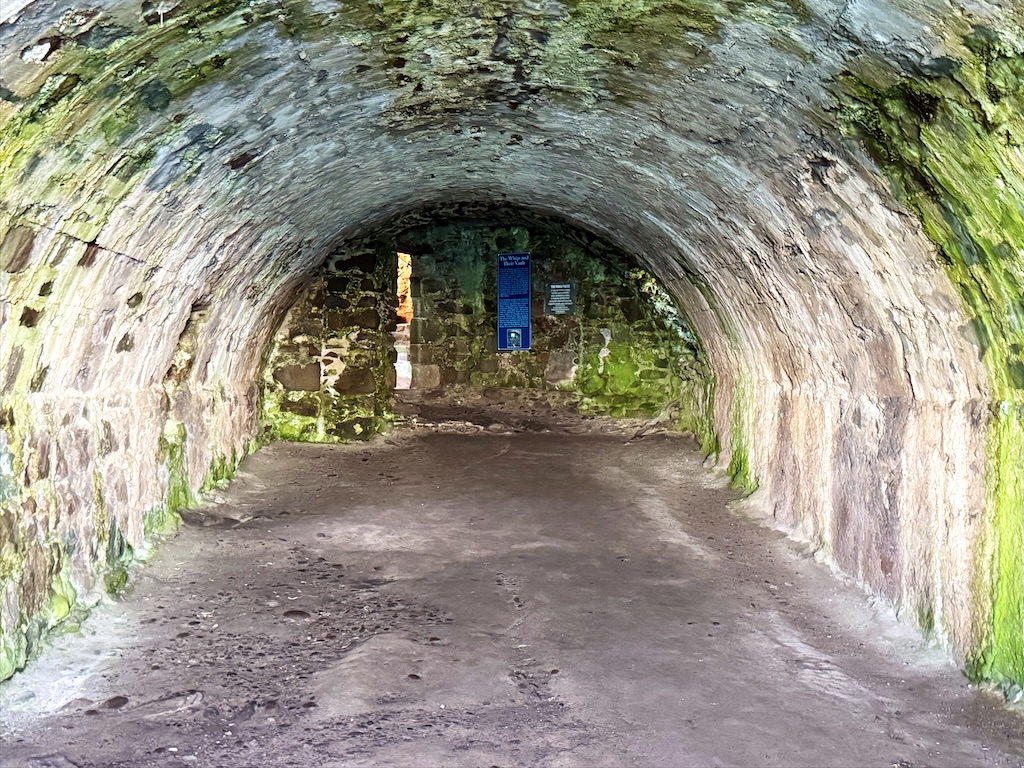
The Persecution of Covenanters In 1661, Charles II imposed episcopacy—church rule by bishops—on Scotland, turning his back on the Covenanter leaders who had helped him. The mostly Presbyterian populace was not happy and started to worship in secret. Matters escalated when a group of Covenanters assassinated the Archbishop of St. Andrews, James Sharp. In response, an enraged Charles II resorted to imprisonment, torture and execution without trial of suspected Covenanters. This dark period became known as “The Killing Time”.
Things didn’t improve when Charles died, as his brother a Catholic, became king of both Scotland and England (James VII and II). Protestants in both countries were alarmed at what a Catholic monarch might do, and rebelled.
The rebellion was led by Archibald Campbell, 9th Earl of Argyll, with support from Covenanters and a faction known as Whigs. In response, Covenanters were made to swear allegiance to the King at Edinburgh. Any who refused were sent to Dunnottar Castle to await transportation to the colonies.
On 24 May 1685, 167 prisoners were imprisoned in the chamber we now call the “Whigs Vault”. Of these prisoners, 37 agreed to sign allegiance and at least five died. Incredibly, 25 escaped, of whom 15 were recaptured and tortured. Two are known to have fallen from the cliff and died during their escape. After ten weeks crammed into the vault, 120 were put on a penal ship bound for New Jersey. Sadly, 70 souls never made it, dying en route.
The Jacobite Risings When the Catholic King James was forced into exile in 1688, the Stuart dynasty came to an end. However, the so-called Glorious Revolution, which saw Protestants Mary (James’s daughter) and her Dutch husband William of Orange become monarchs, was not universally supported. The first Jacobite Rising of 1689 then ensued.
At the time, George Keith, the 8th Earl Marischal, held Dunnottar Castle for William and Mary. During this period, it is believed that a number of Jacobite prisoners may have been held at the castle.
However, subsequent Earls saw things differently. William Keith, the 9th Earl, was imprisoned at Edinburgh Castle in 1708 for his Jacobitism. Then, seven years later, his son, George Keith, the 10th Earl Marischal, joined the Earl of Mar in the 1715 Rising. He and his younger brother both fought in the Battle of Sheriffmuir.
But support for the Jacobite cause came at a heavy price. He was forced to forfeit all his estates, including Dunnottar Castle, which the family had owned for over 400 years.

Conclusion Throughout its long history, Dunnottar Castle has been a fortress, a prison, and a symbol of resistance. It has welcomed royal visitors, and was the seat of the Keiths, hereditary Earls Marischal, and one of Scotland’s most influential families.
Today, Dunnottar Castle is a popular historic site, admired for its dramatic scenery, extensive ruins, and rich heritage. It illustrates the resilience and drama of Scottish history, entwining royal intrigue, war, politics, and religious conflict on a spectacular coastal stage.
Dunnottar Castle: OS National Grid Reference NO 88128 83842
Further reading
Andrew Burnet, 2025 Dunnottar Castle The Official Guide (Jarrold Publishing)
Dunnottar Castle (Official website)


 Thistle & Time
Leave a comment