

A dramatic clifftop setting and a turbulent history make Dunnottar Castle one of Scotland’s most captivating castles. Located on a rocky headland about a mile and a half (2.4 km) south of Stonehaven in Aberdeenshire, it is also one of Scotland’s most visited castles.
A reference to a church associated with St. Ninian indicates that the rock where the castle stands was first used as early as the 5th century. There is also evidence of a Pictish settlement at Dunnicaer, just north of the castle. However, it was not until 1392 that Sir William Keith, the Great Marischal of Scotland, built a stone castle.
Originally, the castle was connected to the mainland by a narrow causeway, but this was removed by hand to improve defence. Today, the path to the castle descends one cliff-face via a long steep set of steps and then ascends the other side.
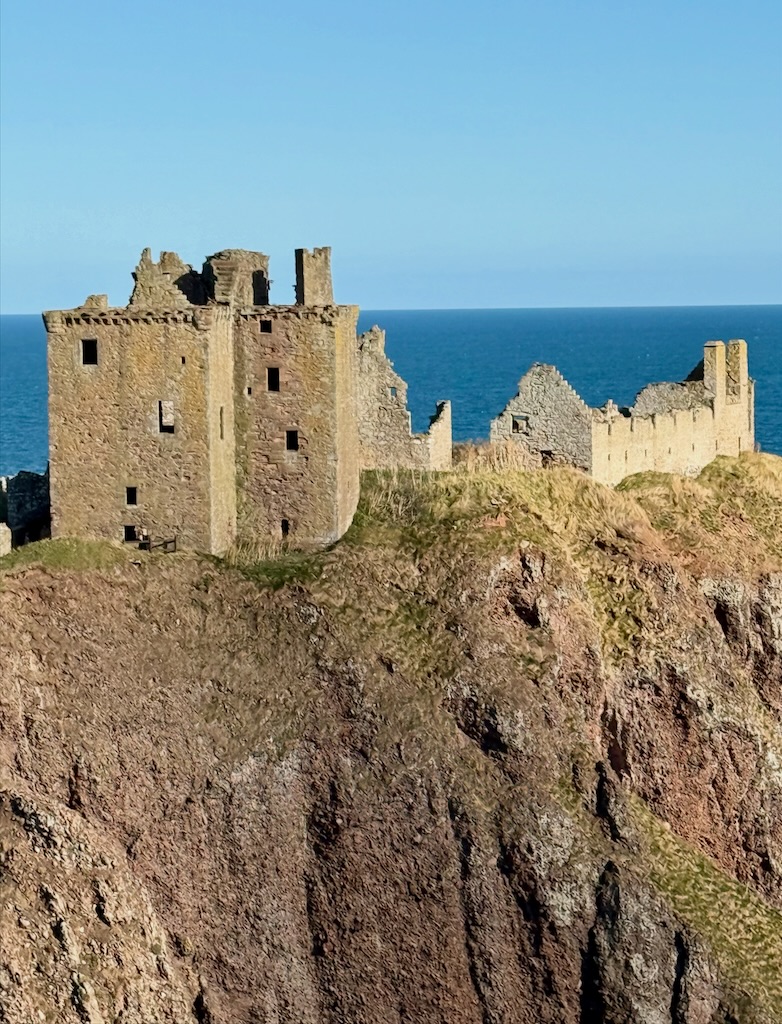
Visitors arrive at the gateway, a feature protected by three tiers of splayed gun-loops. The arched entrance is the sole opening in a solid masonry wall set into a rock cleft. An imposing and commanding entry, it would have been fitted with sturdy wooden doors. To the right is Benholm’s lodging, probably constructed in the 1520s, which features three floors of wide-mouthed gun loops, enhancing the castle’s defensive array.
This need for extensive defences wasn’t just to protect against religious, political or foreign enemies. When William Keith built the Keep, he wanted somewhere for “the safe-keeping of his people and goods”. There were no banks in those days, so a nobleman secured his wealth in his home.
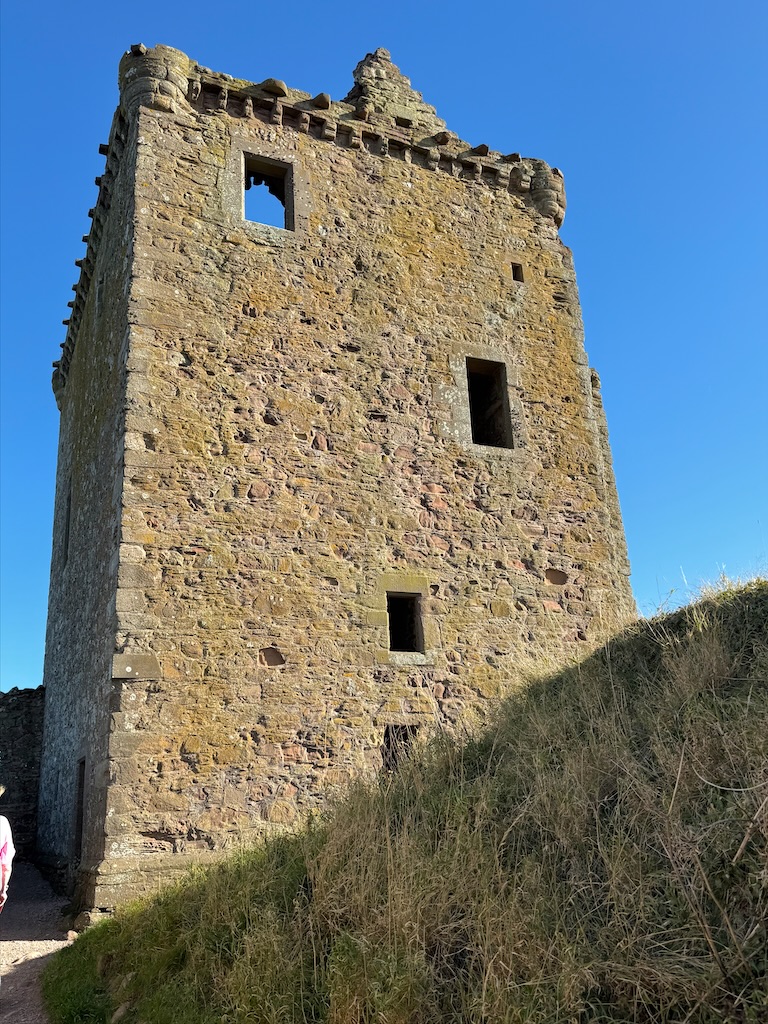
Not surprisingly, the Keep is the most prominent building within the castle. It is essentially an L-shaped tower house with an entrance on the ground floor, secured by a heavy door and a yett. A straight staircase accesses the main hall on the first floor. Beneath the staircase was a prison cell where an accused person would be held before appearing before the Earl Marischal.
Next to the great hall was the original kitchen, which was later moved downstairs; the old kitchen then became a private chamber.
From the main hall, a spiral staircase leads to the second and third floors, where the bedrooms would have been. A caphouse at the very top provided access to a parapet walkway.
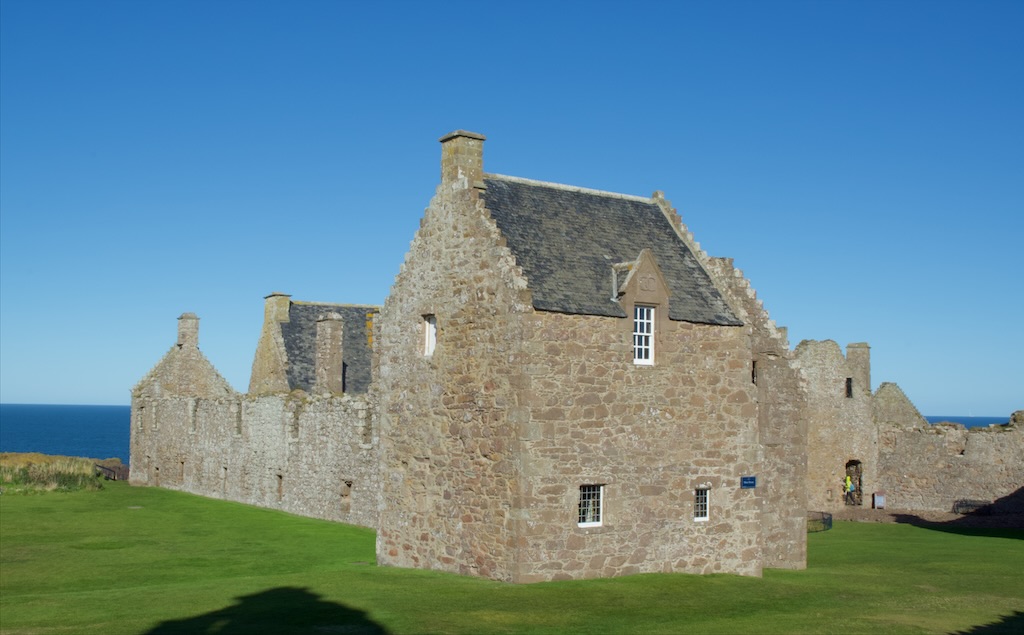
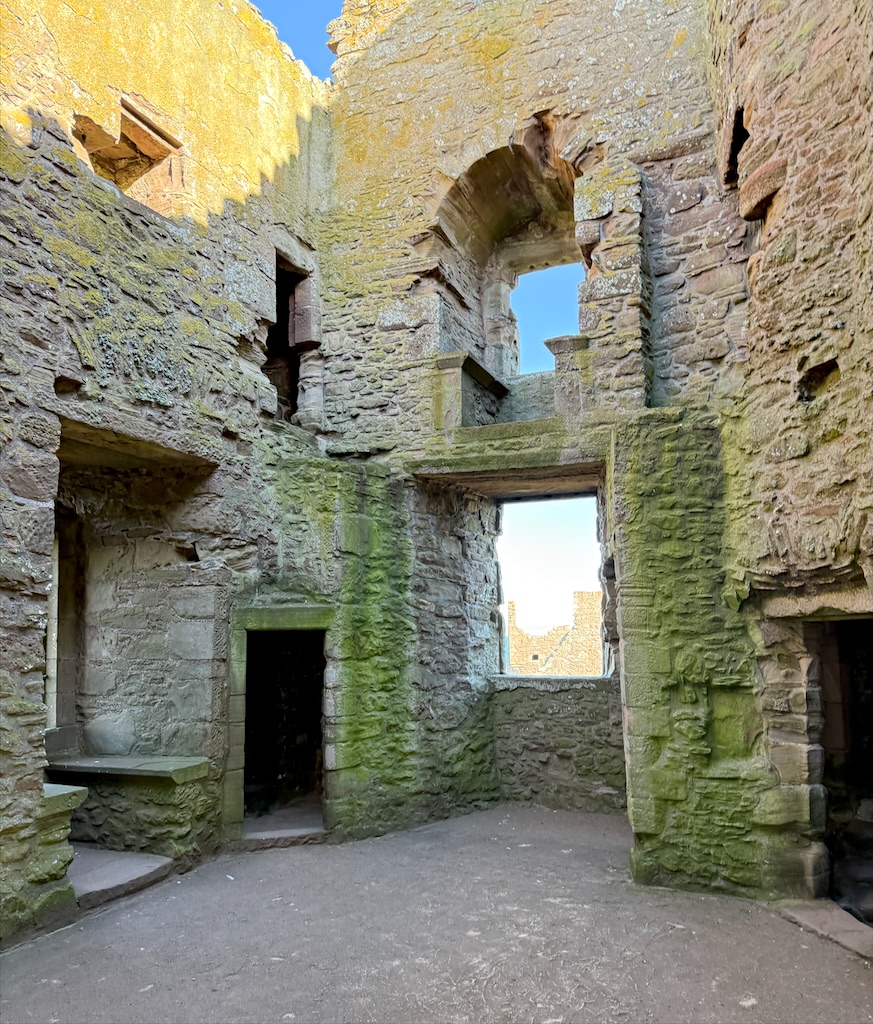
Dunnottar Castle expanded over the years with the addition of a quadrangle. This features three ranges surrounding a garden that contains a large circular water storage pond (The Cistern). This was designed to collect rainwater that seeped through the rock. The west range is the oldest section, built in the last quarter of the 16th century, and includes seven chambers or ‘lodgings’ for guests or retainers. Each lodging had its own front door and fireplace on the ground floor. A long gallery ran the entire length of the first floor of this range. At one end is the Silver House, which contained a strongroom for valuables and housed the staircase connecting the two floors of the West Range.
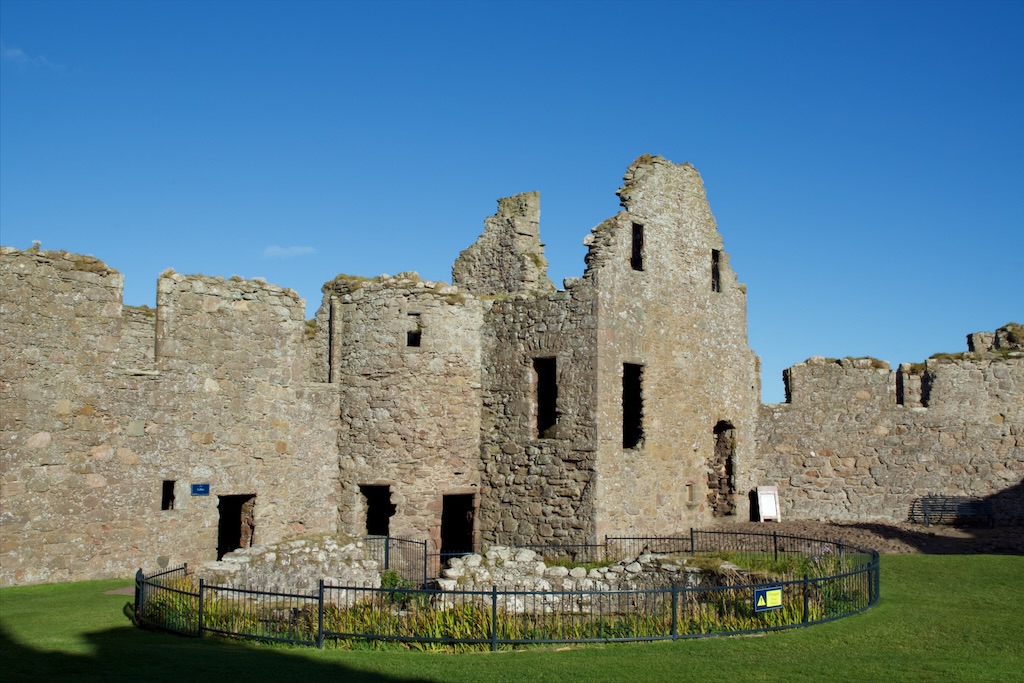
The Dining Room is located in the north range and was built in the first half of the 17th century. It would have offered more space for entertaining than the great hall of The Keep. Adjacent to the dining room is the Drawing Room, which was restored in the 1920s.
The east range contained a suite of private bedrooms above a brewery and bakehouse. Although now in poor condition, in their heyday, this suite would have offered very comfortable accommodation.
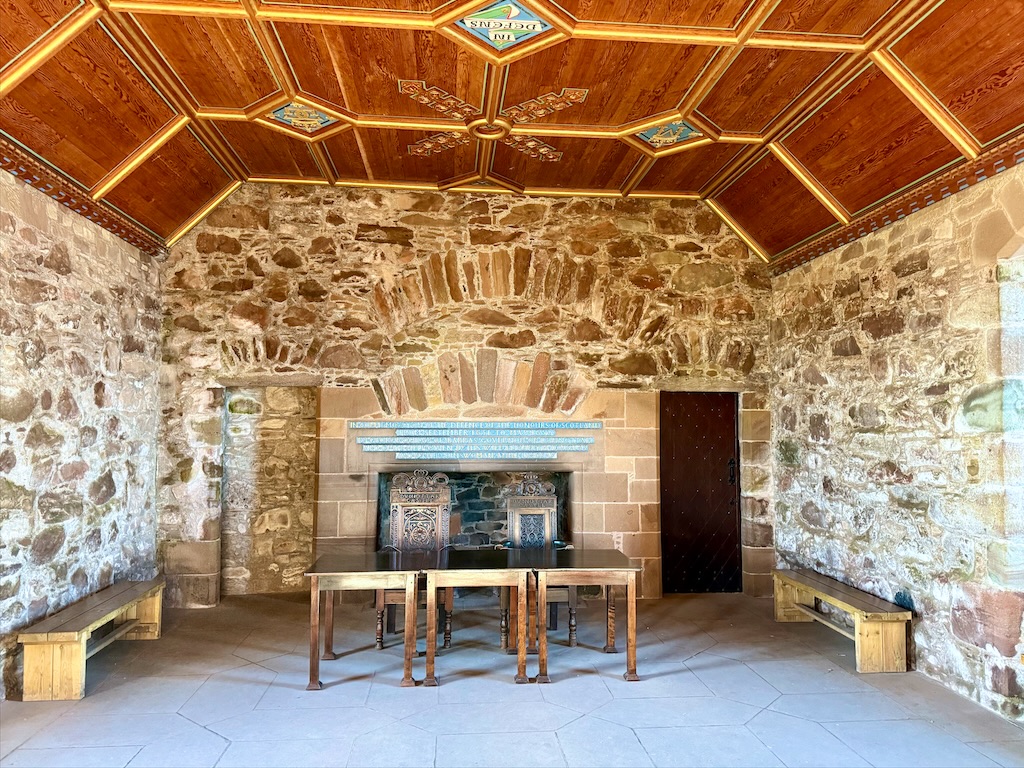
The vaulted chamber known as the Whigs’ Vault lies beneath the suite of private bedrooms in the northeast part of the quadrangle. Initially used for storage, it took on a very sinister purpose in 1685 when 167 Covenanter prisoners were confined there. (For more on this, see the next blog post).
The Chapel on the rock was built in the 1500s, replacing a much earlier structure dating from 1276.
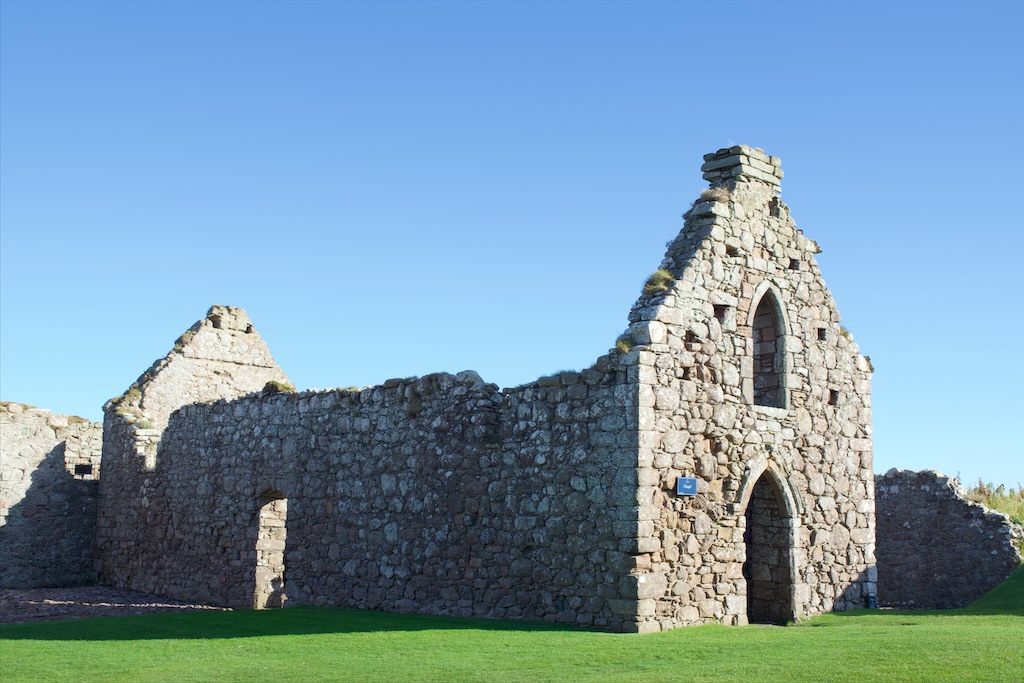
Other features of this expansive and dramatic castle include the ruins of a forge, stables, and a two-storey house. There is also a graveyard.
Dunnottar Castle today is popular with tourists, history enthusiasts, and photographers. The Keith family, who lived there for generations, were involved in some of the key historical events of their time, and these are covered in the next blog post (Dunnottar Castle: Key Events Through History). As for the castle, it was forfeited after the 1715 Jacobite Rising and subsequently sold in 1717, when all valuable items were removed.
What was left went on to become a tourist attraction in the 19th century and has been ever since. It was purchased by the Pearson family in 1919 in whose custody the castle remains.
It is open to visitors almost all year round and entry charges apply.
The Castle is easy to find, situated off the A92 road just south of Stonehaven. There is parking, a cycle rack, toilets, and refreshments (with outdoor seating), all before you head over to the castle. Dogs are welcome. The path to the steps slopes gently downwards, after which there are a number of steps leading down towards the small beach below. After another short path, you climb more steps before entering the castle complex.
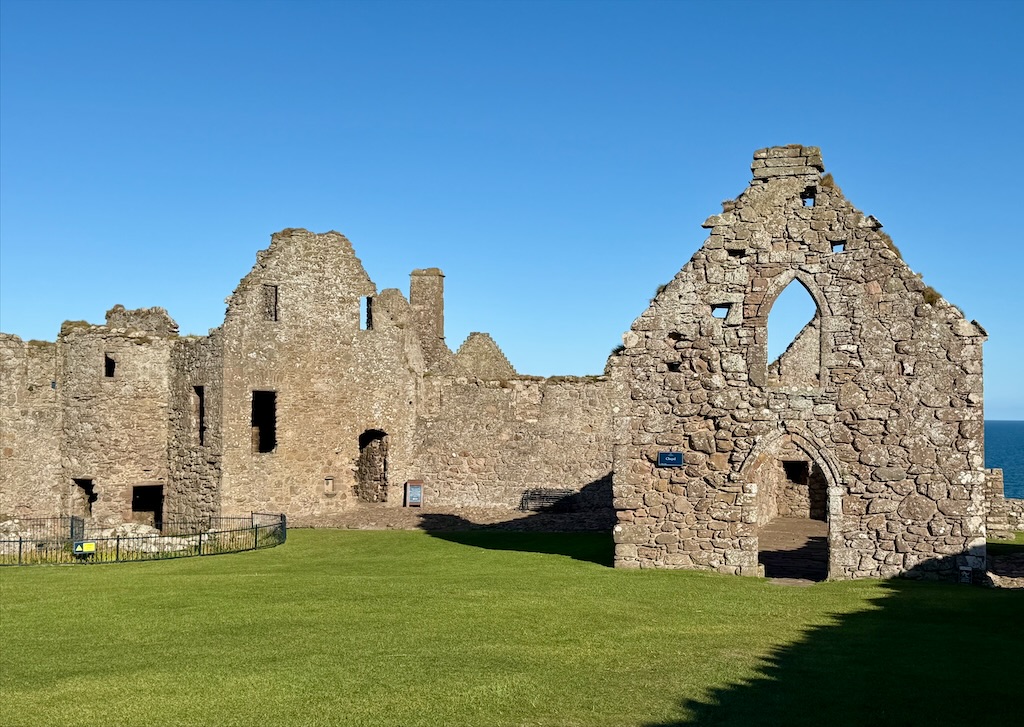
We spent a good hour and a half exploring, but could easily have taken longer. If you are visiting the area, then Dunnattor Castle should be near the top of your itinerary.
Dunnottar Castle: OS National Grid Reference NO 88128 83842
Further reading
Andrew Burnet, 2025 Dunnottar Castle The Official Guide (Jarrold Publishing)
Chris Tabraham, 2005 Scotland’s Castles (Historic Scotland / BT Batsford)
Martin Coventry, 2025 The Castles of Scotland (Goblinshead)
Dunnottar Castle (Official website)




 Thistle & Time
Leave a comment