

Perched on a hillside plateau high above the River Tweed, the ruins of Elibank Castle are a reminder of the Scottish Borders’ unsettled history.
Located about 3 kilometres east of Walkerburn in the Tweed Valley, this late 16th-century fortress was the seat of the influential Murray family of Elibank. Like many of their contemporaries, they played a notable role in local and national politics. From their historical feud with the Scott family to the turmoil of the Wars of the Three Kingdoms, their faith, reputation and allegiance would surely have been tested.
However, to appreciate the history, we must go back to 1511. This was when King James IV of Scotland granted a charter for the lands and forests of Aleburn or Eliburn (known today as Elibank) to Catherine Douglas, the widow of John Liddale, and their son, also named John Liddale. The royal charter specified exact requirements—ordering the construction of a stone house, barn, dovecot, and cattle sheds to secure the family’s land rights. Although no traces remain, a defensible residence or a small tower may have existed on the site nearly a century before the Elibank Castle we see today.
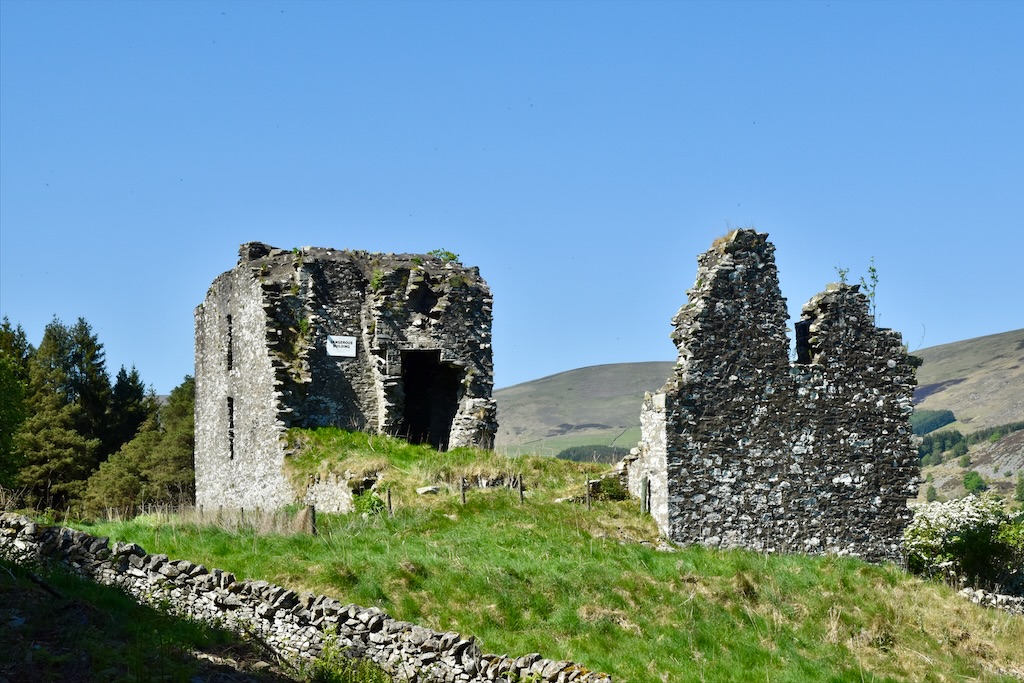
Towards the end of the 16th century, the estate passed to Gideon Murray, and it is believed he had completed Elibank Castle by 1595. As we know, its construction coincided with the latter part of the Border Reivers’ era, when local feuding and raiding demanded fortified residences. The castle’s position high on the valley side offered both strategic visibility and natural defence, overlooking a bend in the Tweed where it could watch movements along this vital route.
But even as pacification of the Anglo-Scottish border was underway following the Union of the Crowns, the troubles of the past could not be forgotten. So in the early 1600s, Elibank was part of an early-warning chain of towers. If raiders from England were sighted, each tower in the chain would light its beacon to signal its neighbours of approaching danger.
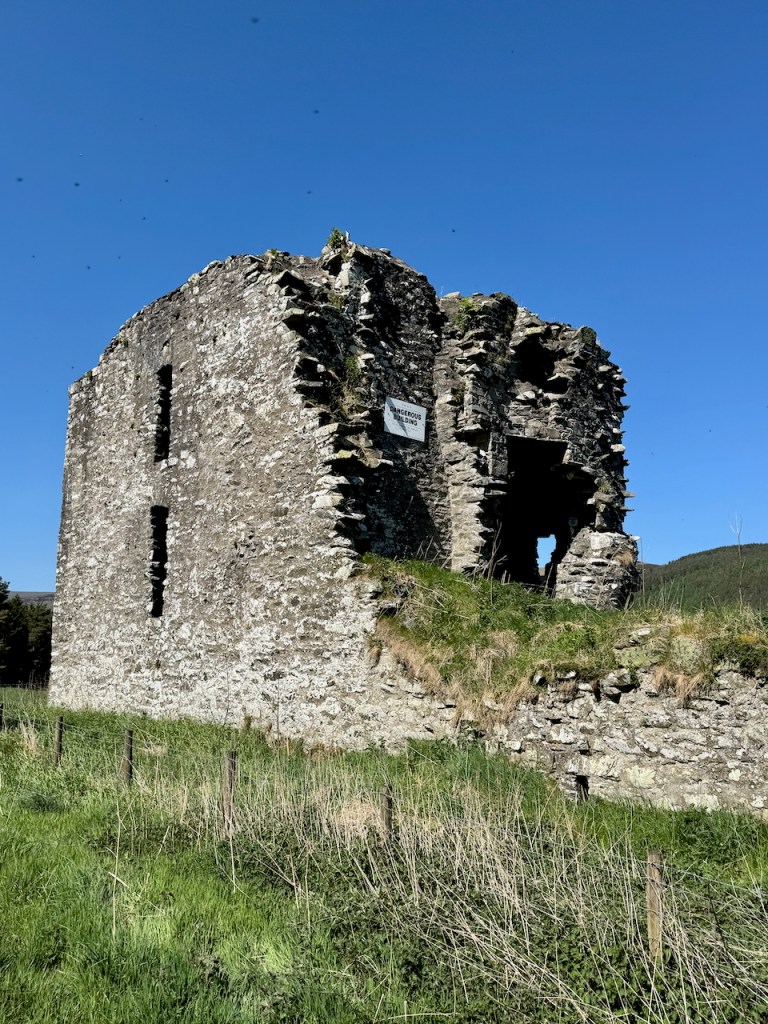
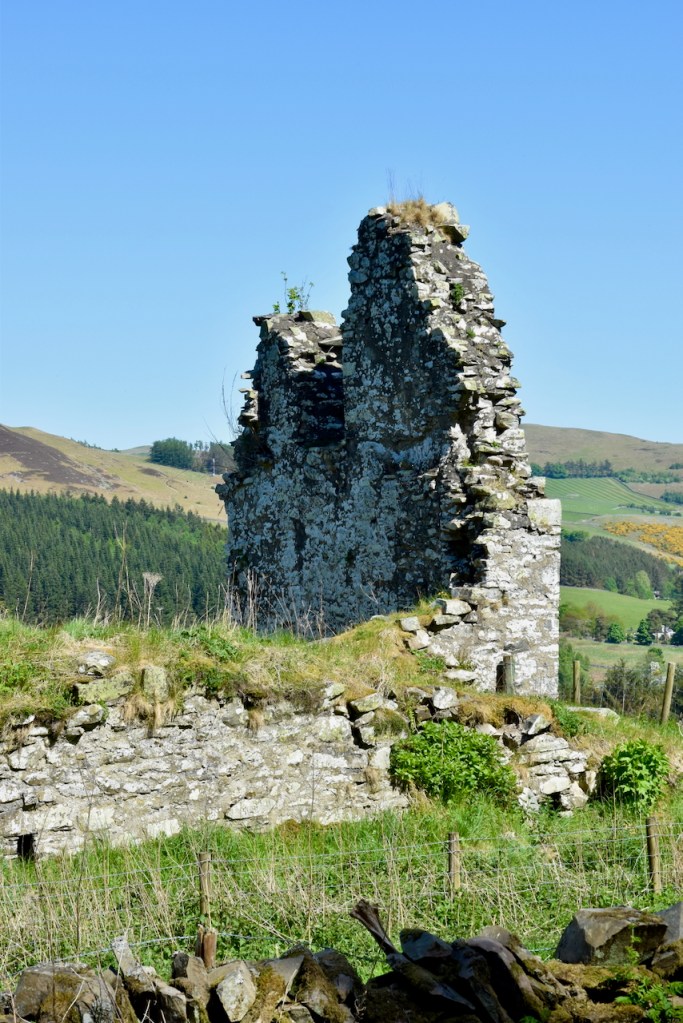
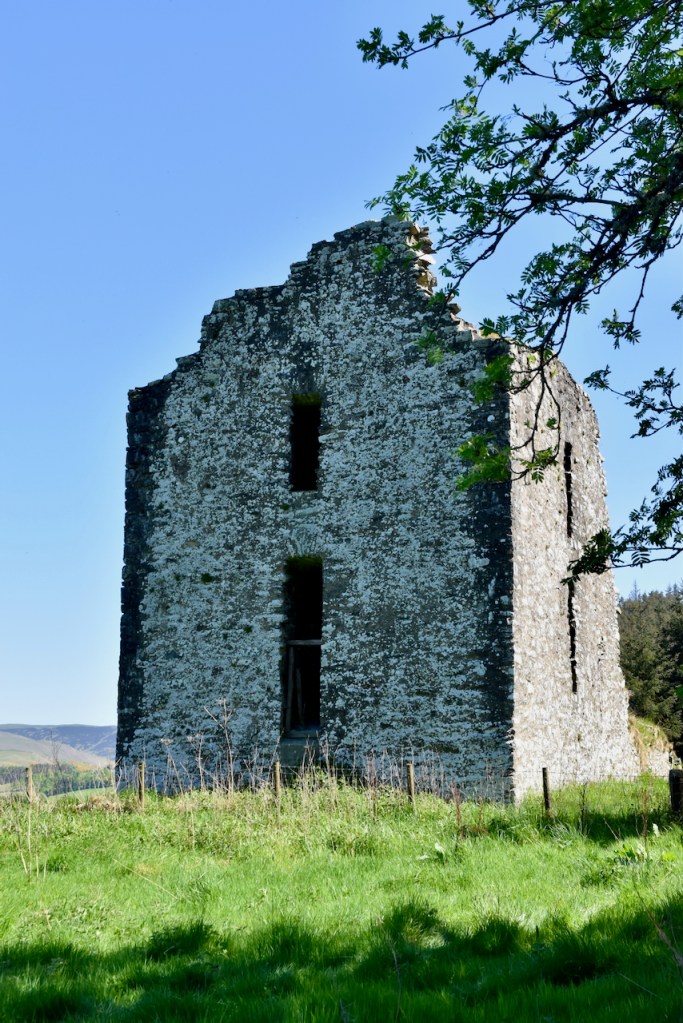
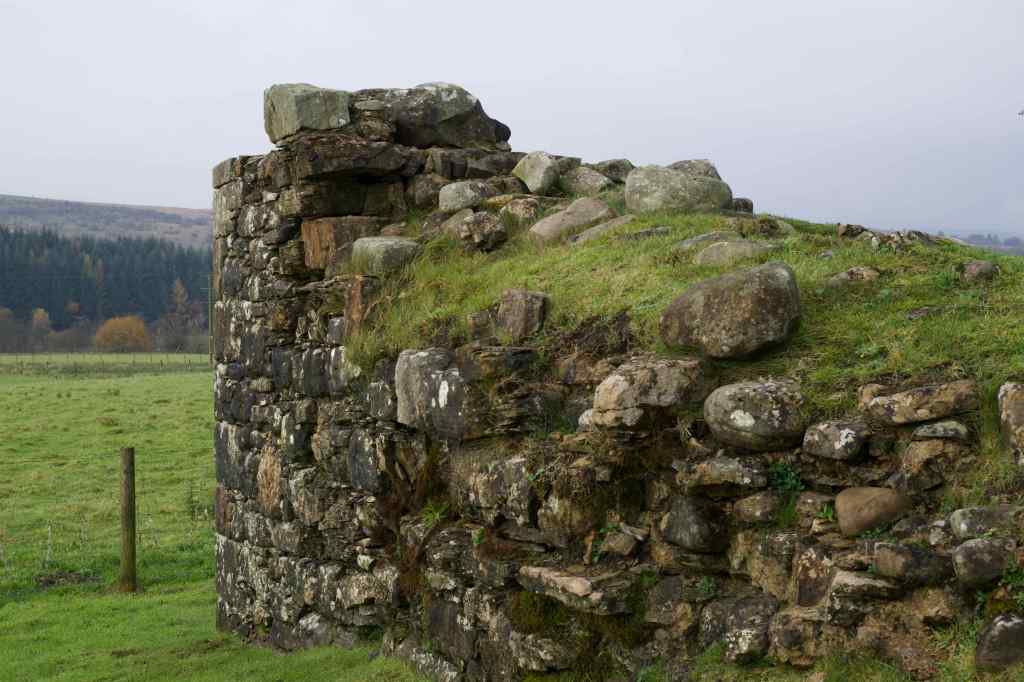
The castle, which was really a grand L-shaped fortified tower house, comprised a main block, four storeys in height, measuring 21 by 7 metres. Attached to its eastern corner was a wing of 7.6 metres square. Today, almost nothing remains of the wing, while the main block is badly deteriorated. The walls are 1.3 metres thick at ground level.
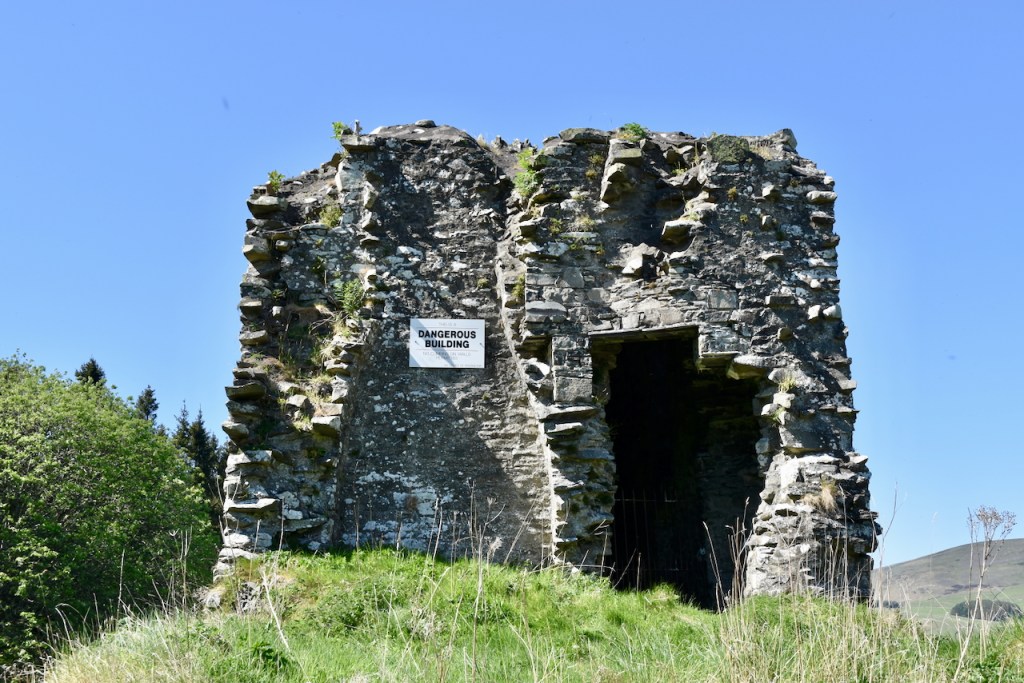
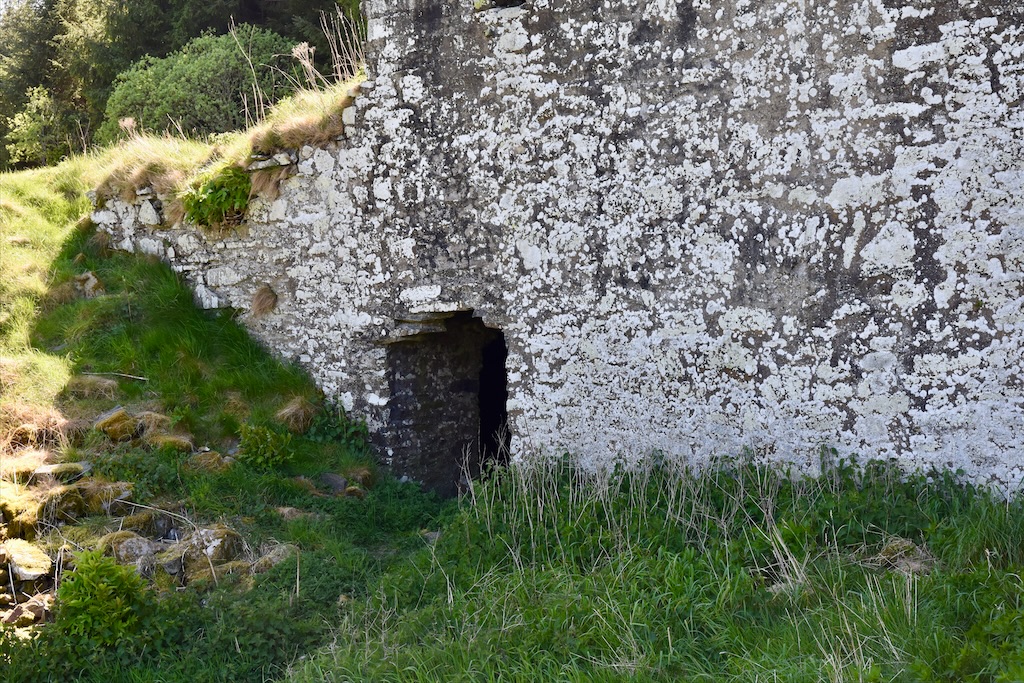
The ground floor comprised two primary vaulted cellars, accessed via a low doorway in the northeast wall. Beyond the southernmost vault, a further chamber extended into the now-collapsed basement of the projecting wing. These deep cellars helped regulate the temperature of stored goods, offered some protection to inhabitants in the event of a siege, and maintained structural integrity for the superstructure above. At the north end of the main block, the structure rises to (almost) its second floor.
Walls extend from either end of the main block to form a forecourt, and at the eastern corner of this, just opposite the wing, there seems to have been a gatehouse.
Listen to the podcast about Elibank Castle, available on all main platforms. Just search for Hidden Histories of the Scottish Borders
One of Elibank’s most celebrated and remarkable features is its Italianate terraced gardens, created from 1603 onwards. Inspired by European landscaping ideals, especially those of England and the Continent, Gideon Murray and his successors constructed a system of terraces on three sides of the castle, cut into the hillside and built up with supporting embankments and walls.
While sharing the ‘L-plan’ favoured for its defence, Elibank Castle’s somewhat more elaborate arrangement—its forecourt, spacious vaulted basements, projecting wings, and attention to landscape—reflects a shift in Scottish architectural ideology from fortress to country house.
Historic Environment Scotland notes:
“Elibank… differs from many towers of the time both in its more elaborate plan and in the landscaping of the area for garden use. It is an important building in the development of the houses of the Scottish gentry, from fortress to house, and in the development of gardens in Scotland”
As for the Murray family, they were indeed quite influential. However, despite their overall success, events could sometimes take an unforeseen turn…
After serving time in prison at Edinburgh Castle for killing a man, and then being pardoned, Gideon Murray gained favour with James VI. He then entered the service of his nephew Walter Scott of Buccleuch as chamberlain of his estates. In June 1587, he married Margaret, daughter of Dionysius Pentland, an Edinburgh miller.
During his time with the laird of Buccleuch, Gideon Murray travelled to the continent as far as Italy. When he returned, he became involved in a border feud: Murray’s master, Scott of Buccleuch, was drawn into the long-running feud between the Maxwells and Johnstones, which culminated, on 7 December 1593, with Gideon leading 500 Scotts against the Johnstones at the battle of Dryfe Sands, at which Lord Maxwell was killed.
In October 1602, Gideon was one of the border lairds who subscribed to the king’s “general band” against thieves, murderers, and oppressors in the borders. James VI was determined, especially when he also assumed the throne of England, to wipe out lawlessness in the region. He soon came to appreciate Gideon’s skills and ruthlessness in this task. Gideon was subsequently appointed a border commissioner, whose autonomy in bringing offenders and potential offenders to justice was almost absolute.
It was in this role as enforcing the law, or perhaps exploiting it, that likely led to a feud between Gideon and the Scotts of Harden. And from this feud sprung one of the Border’s most famous legends, the story of Muckle-Mouthed Meg.
The legend states that the young William Scott, Laird of Harden, led a raid on Elibank Castle and made off with a herd of cattle and sheep. However, upon discovering the theft, Gideon Murray organised a party to apprehend the Scotts. Men were wounded and even killed on both sides, with Gideon Murray gaining the upper hand by capturing both young William and his older kinsman, Simon. They were imprisoned in the dungeons of Elibank Castle and were told to expect the hangman’s rope.
Yet, Gideon’s wife stepped in and proposed that one of the prisoners could make a suitable husband for their daughter, Agnes, better known as Muckle-Mouthed Meg. All versions of this tale imply that Meg is a figure of ridicule, possibly even bullied by her own family, on account of her appearance.
William is said to have persistently refused to marry. However, one account states that Meg’s kind-hearted nature eventually won over the proud young William, leading him to agree to the marriage on the morning of the hanging, so neither man was executed.
Pleased with his services to James IV, in 1605, Gideon Murray was knighted, and in 1613, he was appointed one of the Lords of the Court of Session.
But several years later, upon orders from the king, Gideon was told to await trial following an accusation of wrongdoing. Offended by this sudden turn of events, Gideon started to refuse food, fell into a stupor, and died on 28th June 1621. Afterwards, the king issued documents clearing him of any blame.
Gideon was succeeded by his eldest son, Sir Patrick Murray, who was created a baronet in 1628 and advanced to the peerage as Lord Elibank in 1643.
Jump a few generations, and we come to Alexander Murray (1712-1778). A son of the fourth Lord Elibank (also called Alexander), he was a notable Jacobite agent and political conspirator, best known for his central role in the “Elibank Plot.” This was an audacious plan to kidnap King George II and his family, either to spirit them to France or hold them hostage in the Tower of London. The plot failed to gain momentum, and Alexander Murray’s Jacobite activities made him a marked man. For a time, he lived in exile in France and was known for his intense loyalty to the Stuart cause.
The Murrays didn’t stay in Elibank Castle, likely moving out in the mid or late 1600s. Sadly, by 1722, the castle was already derelict. Now a picturesque ruin, it can be seen from across the Tweed Valley.
The castle is located high above the southern bank of the River Tweed. It is reached by taking the minor road alongside the river. This can be joined in the west from the A72 at Walkerburn or from the east off the A707. About half a kilometre east of the castle, there is a Forestry path that can be followed on foot. This is a wide stone track that ascends gently, so it is not too challenging. The castle itself is on the other side of a stone wall. Unfortunately, the surrounding area was heavily overgrown at the time of our visit so it moving around was not as easy as we had expected. The nearest facilities are in Walkerburn.
Elibank Castle: OS National Grid Reference NT 39694 36308
Further reading
Martin Coventry, 2025, The Castles of Scotland (sixth edition), Goblinshead
Mike Salter, 1994, The Castles of Lothian and the Borders, Folly Publications
Tweed Valley Blogger Podcast The Wife or The Wuddy



 Thistle & Time
Leave a comment