

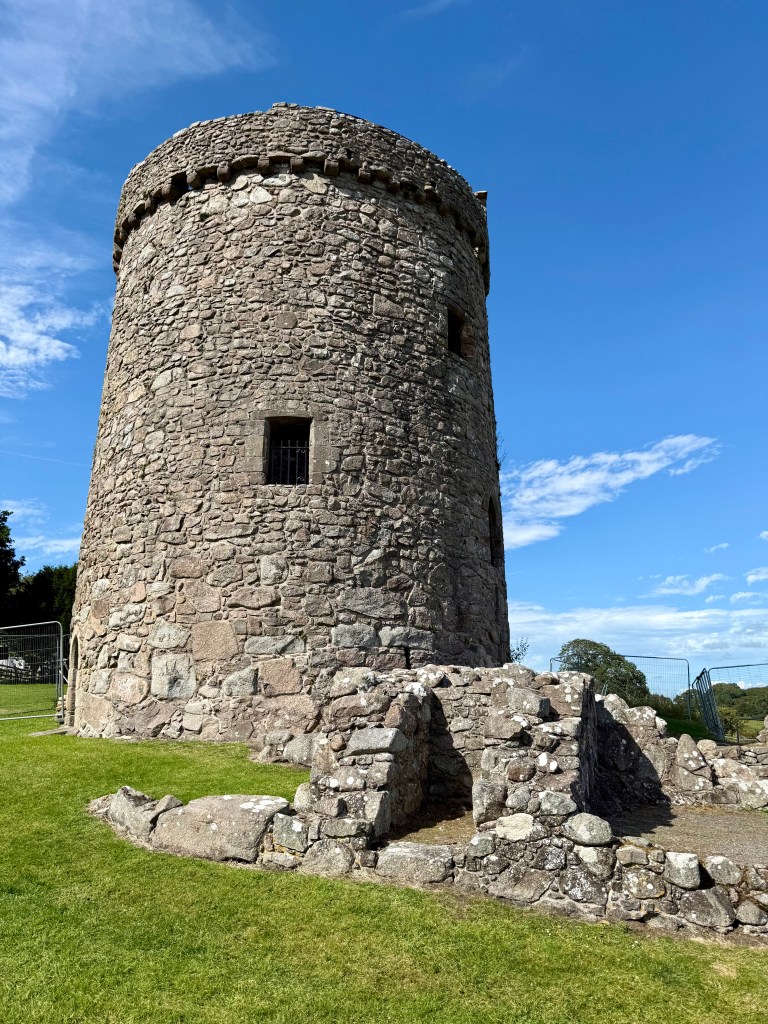
On a quiet rise above the Galloway coast sits a large stone cylinder. Weather‑worn and roofless, Orchardton Tower has stood for over five centuries. As the only free‑standing round tower house in mainland Scotland, it is a singular survivor from an age when power was measured in stone, and safety meant building high.
The tower was commissioned around 1455–1456 by John Cairns, whose family had a long association with the area. But it was by choosing the winning side of King James II when he turned against the Black Douglases that brought the biggest reward.
For his loyalty to the crown, Cairns was granted the lands of Irisbuitle (Orchardton), taken from the defeated Douglases, for the token rent of a single silver penny. John Cairns likely participated in or supported James II’s decisive siege of Threave Castle in 1455, the last Douglas stronghold.
This two-month siege marked the end of Douglas power in Scotland and would have led to Cairns receiving his reward of the Orchardton lands. The siege demonstrated the changing nature of warfare, with James II employing the famous cannon “Mons Meg,” though the castle ultimately surrendered through bribery rather than bombardment.


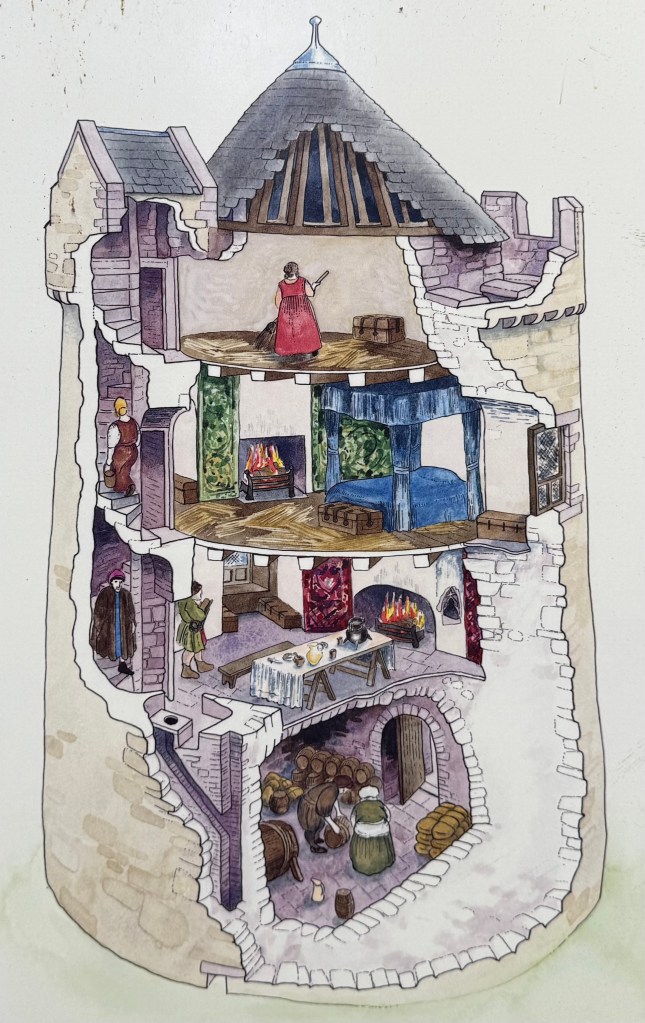
Orchardton Tower is situated approximately 6 miles (10 km) south of Castle Douglas in Dumfries and Galloway. It is a rubble-built structure of four storeys, reaching 10 metres in height, with the wall-head crowned by a parapet and walk, and a small gabled cape-house.
Now roofless, the circular plan is unique; however, in all other respects, the arrangement is very similar to other 15th-century tower houses. As such, it has a vaulted basement, above this a main hall with a fireplace, and two upper floors.

Access to the tower was originally via a removable stair from the courtyard to an old first-floor entrance, though the current north entrance was added in the 17th or 18th centuries.
In the hall, a couple of carved stone features have survived to give an idea of the quality of the lost interiors: a trefoil-headed piscine/aumbry to the left of the fireplace and a decorated stone lamp holder by the door to the narrow stairs.

The remains of a curtain wall, now reduced to turf-covered mounds, lie to the south, east and west of the tower. The remains of secondary buildings with vaulted basements lie to the south.
The tower’s design was not ornamental. It existed at a time when Border Reivers and Anglo-Scottish border warfare defined the region. So Orchardton Tower was built with thick walls, arrow loops and narrow windows to help shield the Cairns from cattle theft, clan feuds, and sudden violence.

Despite this, the Cairns family became directly involved in border conflicts through marriage connections. Margaret Cairns, Lady Orchardton, married Edward Maxwell and became embroiled in the notorious feud between the Maxwells and Johnstones.
Following William Cairns’ death in 1558, Orchardton was partitioned among his three daughters. However, Robert Maxwell gradually acquired all portions of the estate between 1616 and 1640, thereby reunifying the property and adding Orchardton to the Maxwell empire. The new Maxwells of Orchardton were created Baronets.
Legend of the Watcher on the Parapet
They say that on still evenings, when the Solway lies like glass, a lone figure can be seen pacing the parapet of Orchardton Tower. Some swear it is John Cairns, the 15th‑century laird who built the tower, still keeping watch over the lands granted to him for his loyalty to the king. Others believe it is a nameless sentry from the Border Reiver days, eyes fixed on the horizon for raiders who never come. The figure never speaks, never waves — and when you look away, even for a heartbeat, it is gone.
By the 1700s, the tower was abandoned for more comfortable accomodation at Orchardton House. Its roof fell in, its floors rotted away, and the wind and rain claimed the upper chambers. Yet the walls endured.
Today, under the care of Historic Environment Scotland, visitors can climb the very steep spiral stairs to the parapet. Personally, I found this difficult as I don’t like heights. In fact I climbed out onto the parapet on my knees and didn’t move. But from the top, I believe you can see the silver and blue Solway Firth, and the hills rolling away inland, (although I didn’t dare look). However, it’s easy to imagine a watchman scanning the horizon for sails or riders, heart quickening at the sight.
Getting to Orchardton Tower is easy by car. Signposted from the A711, it is approximately 1 mile (1.5 km) down a minor road. There is a small parking area, but no other facilities.
Orchardton Tower: OS National Grid reference NX 81696 55126
Further reading


 Thistle & Time
Leave a comment