
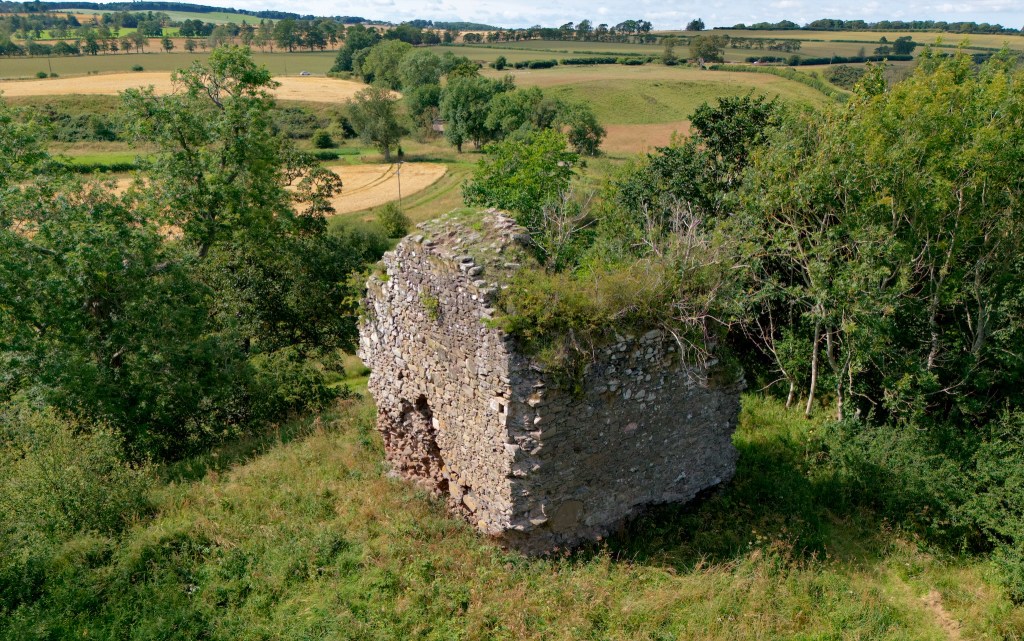
Whitslaid Tower is a ruined 16th-century tower house (Peel Tower). It sits on a strategic site high above the eastern bank of the Leader Water, approximately two miles (3.2 km) south of Lauder in the Scottish Borders. This ancient Berwickshire stronghold was one of several held by the influential Lauder family, who played a significant role in local Border politics for some 300 years.
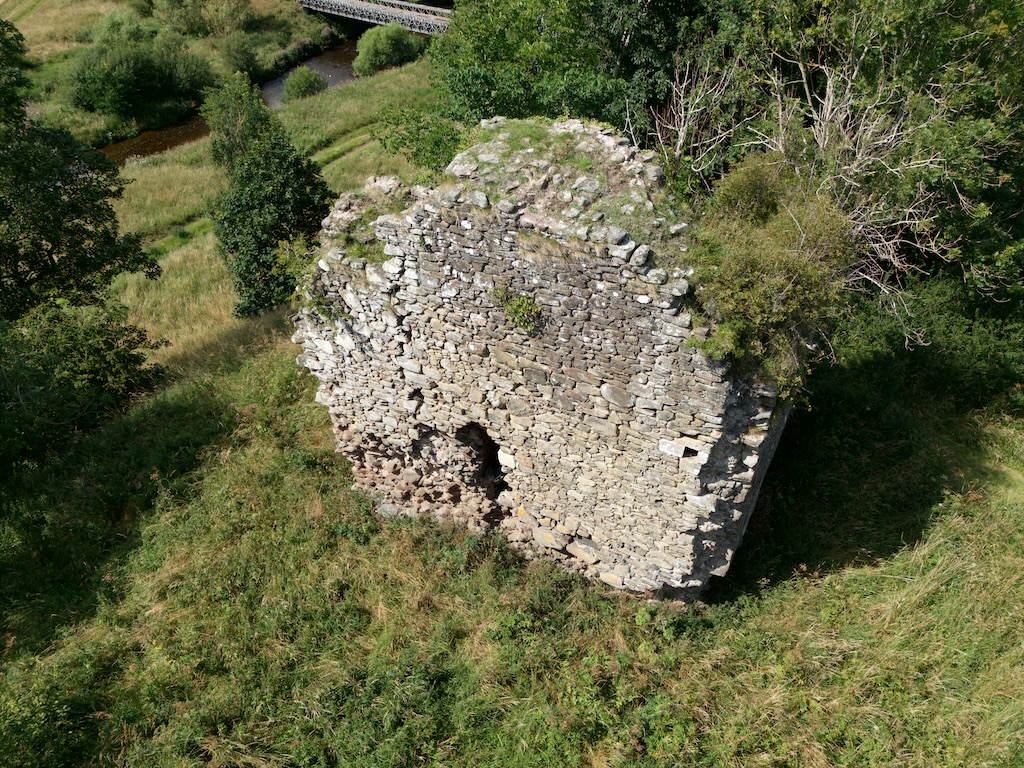
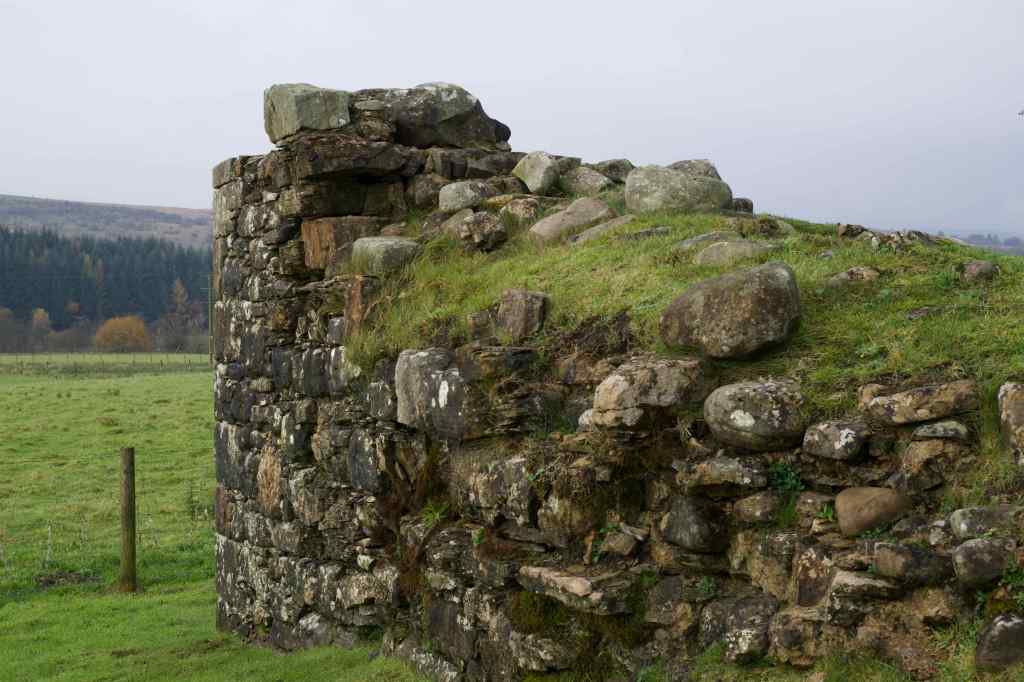
Today, Whitslaid Tower is badly overgrown by vegetation, but there is plenty to see. Compared to some towers, it isn’t particularly large, but it certainly has presence. Up close, the thickness of its walls and overall scale of the structure indicate that this was once an impressive defensive home for an important family.
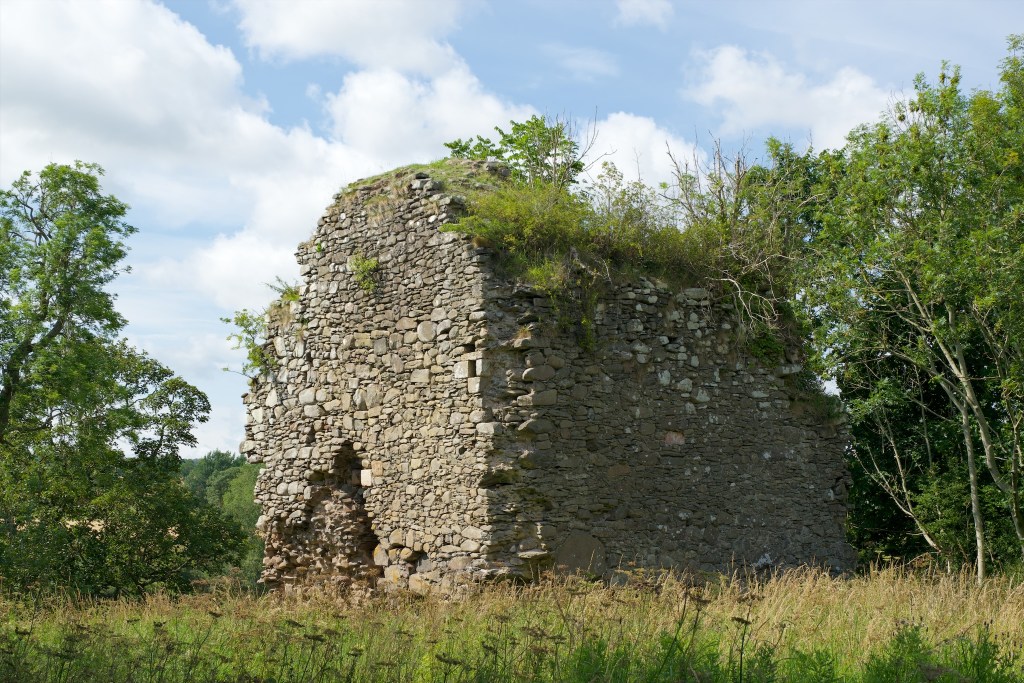
The tower is a simple oblong, and when complete, it measured 12 by 9.5 metres with walls averaging 2.1 metres in thickness, built in rubble masonry. The north wall has collapsed, revealing the barrel-vaulted basement. The main entrance was at the north end of the east wall, giving direct access to the vaulted basement with light coming from a narrow opening in the south wall.
The hall occupied the first floor, and was the main living space of the tower. Its ruinous state means almost no identifiable features remain. Archaeological evidence suggests the hall had windows facing west, south, and possibly north, though only the western window survives in fragmentary form. The main sleeping areas were situated above the hall, but this floor has now gone.
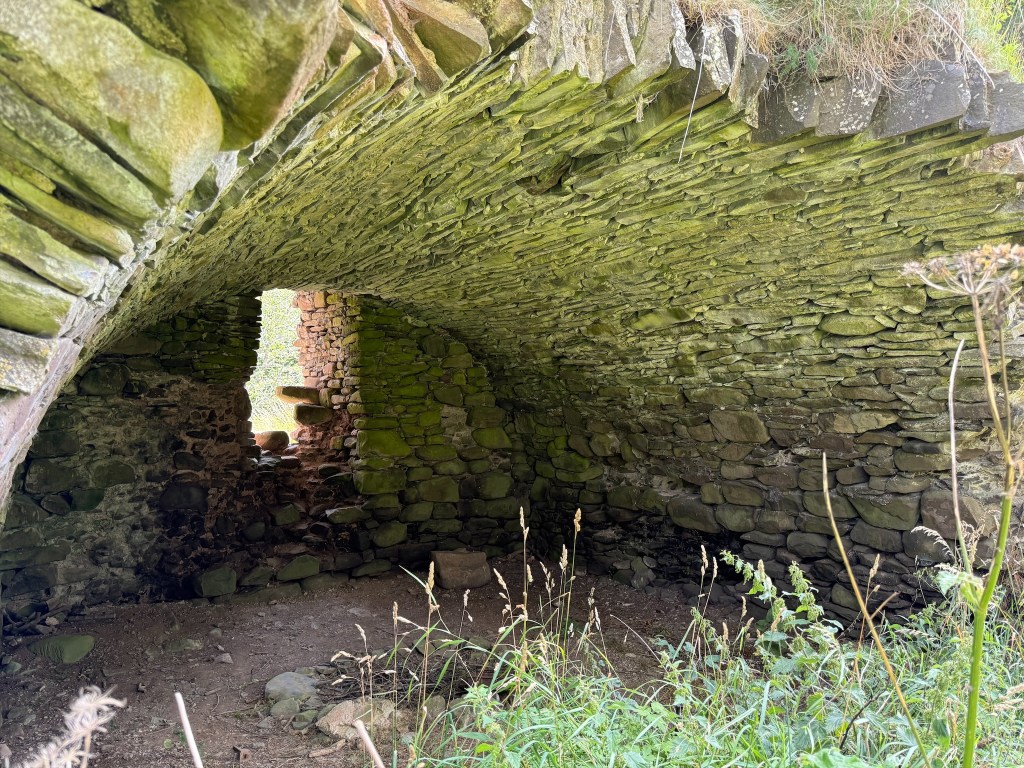
Overall, this layout is typical of the period. Years of conflict with England, together with the feuding and raiding of the Border Reivers, meant towers were built with defence in mind.
It is said that in the 1880s, when more of the building remained intact, visitors could observe a square aperture designed for pouring boiling liquids such as melted pitch onto attackers below.
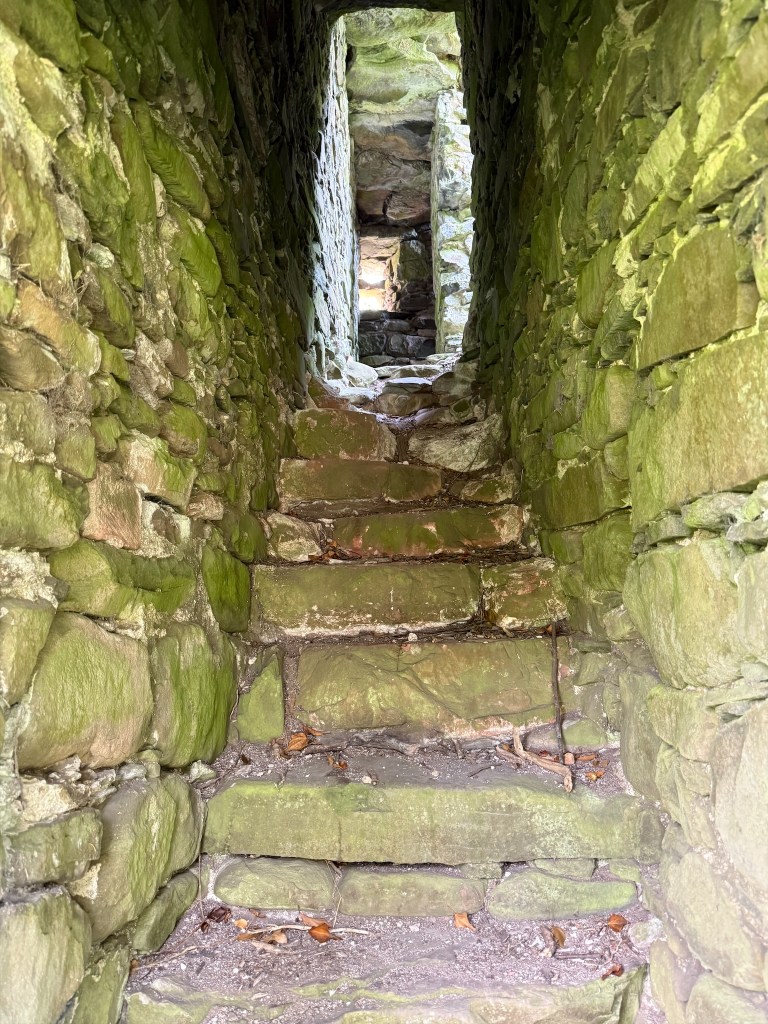
Another common defensive feature of tower houses was a narrow right-spiral staircase. This meant that if an attacker did manage to access the stairs, his sword or dirk would be on the poorly positioned inside (the right). This would give an advantage to the right-handed defenders above. But a notable feature of Whitslaid is the straight flight of steps ascending within the thickness of the walls, providing access from the basement to the upper floors. This type of internal stair system is considered unusual for towers of this period.
On our visit we also saw, standing to the north of the tower, what could have been part of a barmkin (courtyard wall). If so then this would have provided an extra layer of protection when the tower was occupied. Of course this fragment could also have been a piece of the collapsed north wall.
Whitslaid’s association with the Lauder family dates back to the 14th century. In 1369, a charter was issued to Alan de Lauder, the eldest son of John Stewart, Earl of Carrick. This charter granted de Lauder extensive powers, including the right to hold courts and deliver punishment. Then a 1371 royal charter confirmed Alan de Lauder as feudal tenant of the lands of “Whytslaid”, along with half the lands of the Regality of Lauderdale.
But Whitslaid Tower was built much later, most likely in the late 15th or early 16th century. This is consistent with other tower houses in the Borders region. As such, it was possibly the home of Gilbert Lauder of Whitslaid.
He appears in records from the mid-16th century, initially to face a charge of murder for the killing of George Wedderat, a burgess of Lauder, in 1565. A “Warrant under the Signet”, part of the official administrative record of Queen Mary’s government, commanded the sheriff of Berwick and his deputies to apprehend Gilbert, his brother William, and Richard Lauder.
But no surviving record shows that Gilbert Lauder of Whitslaid was ever arrested, tried, or punished for the murder. There are a few possible reasons for this. It may be that he paid over money to the victim’s kin. Alternatively, he may have promised future obedience. Or it may have been a pragmatic or political solution to keep Gilbert, a laird from an influential family, away from punishment. We just don’t know. Regardless of the reason, it allowed him to remain at liberty and to re-emerge later as a recognised laird and Crown servant.
At some point after this, Whitslaid Tower was fortified against potential attacks.
Several years later, in 1572, Gilbert joined a muster, called at Jedburgh, of “fencible persons” (armed local landholders) to attack and defeat the troublesome Border Reivers, the Kerrs of Ferniehirst.
As we know, during the mid-1500s, Henry VIII of England started the Wars of the Rough Wooing against Scotland, during which, towns, villages and houses across the Borders and Lothian were burnt. If Whitslaid Tower stood at this time, it may have experienced just such an attack. But the tower’s strategic location also made it central to ongoing Border conflicts beyond the Rough Wooing. The 1565 murder charges against Gilbert Lauder, the attack on the Kerrs, and the subsequent fortification of Whitslaid demonstrate the ongoing violence that characterised Border life in this period.
By the mid-17th century, ownership had transferred from the Lauder family. Historical records indicate that William Montgomery of Mackbeth Hill owned the tower at that time. It was his grandson who most likely converted the tower into a gabled house in 1798. Soon after, though, Whitslaid had begun to decline into ruin. In the 19th century, the roof and upper floors collapsed, and stonework was removed for use in other buildings.
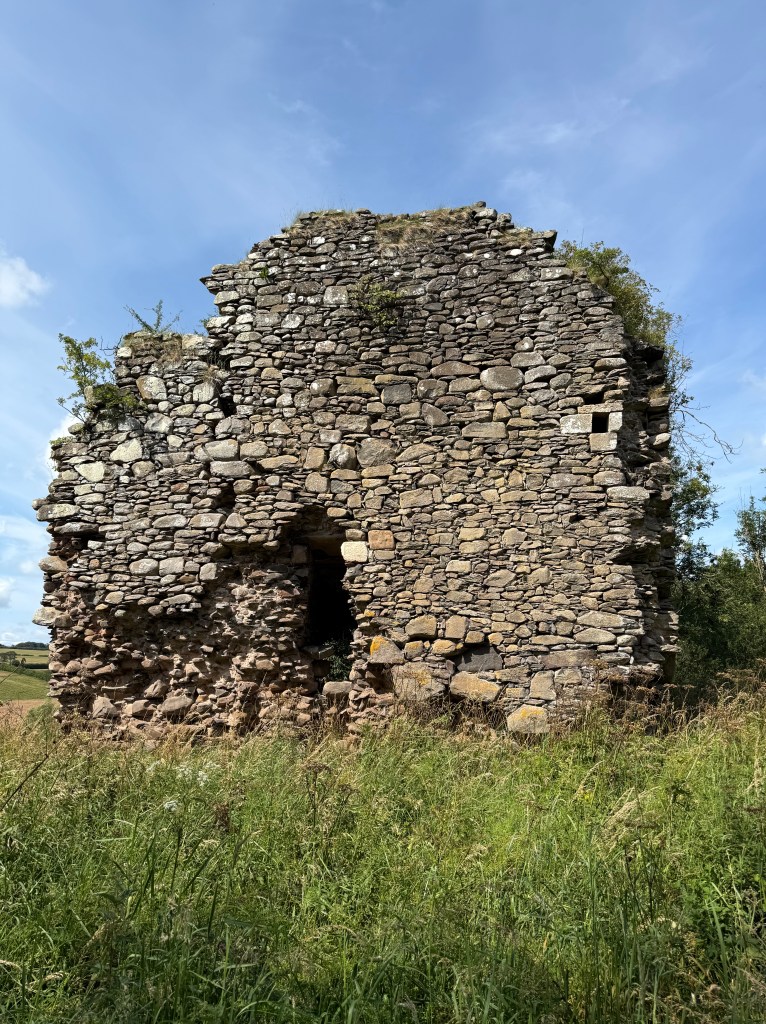
What remains is a historic ruin that provides insight into the life of Border Lairds. Despite its state of ruin, it is an interesting tower and easy to visit. It is located just a short distance east of the A68 between Lauder and Earlston. From the road, take the unmade track down to the bridge and go over Leader Water. The tower will be visible on your right. There is a rough parking area a short distance up the hill. The tower stands on a level, overgrown grassy area. Beware, however, that just beyond the tower the ground falls away steeply towards the river.
Whitslaid Tower: OS National Grid Reference NT 55751 44549
Further Reading
Alistair M.T. Maxwell-Irving 2014, The Border Towers of Scotland 2 (Maxwell-Irving)
Electric Scotland: Clan Lauder



 Thistle & Time
Leave a comment