
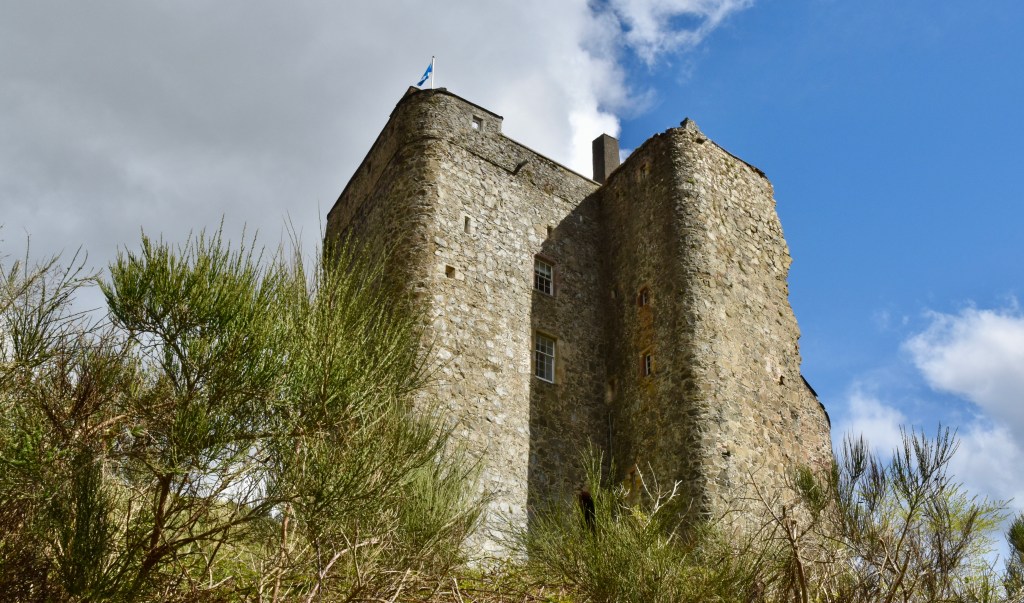
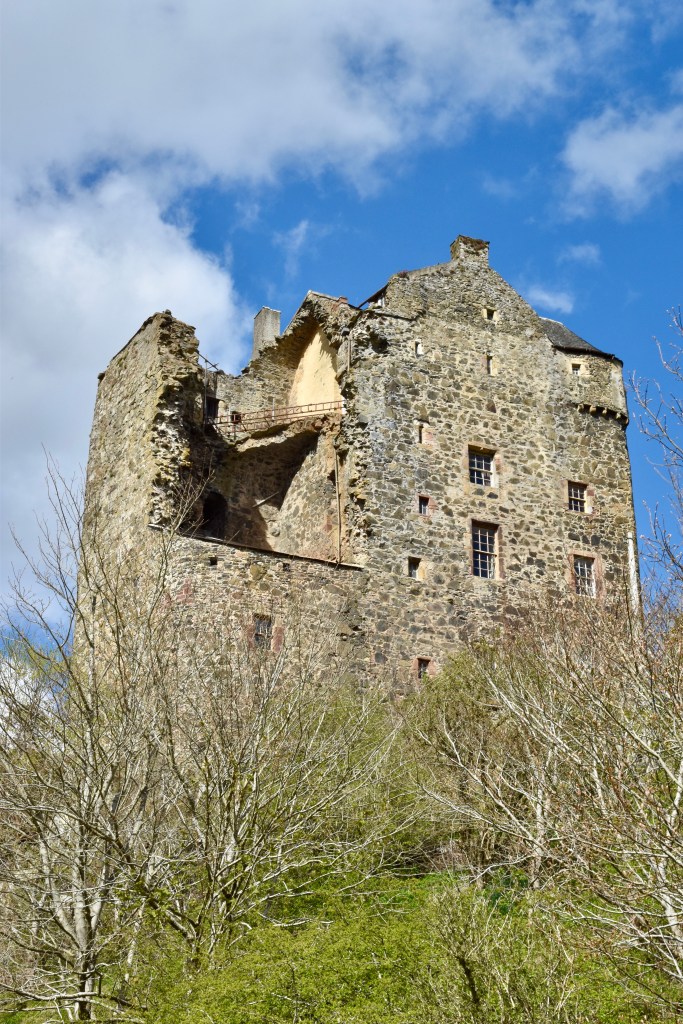
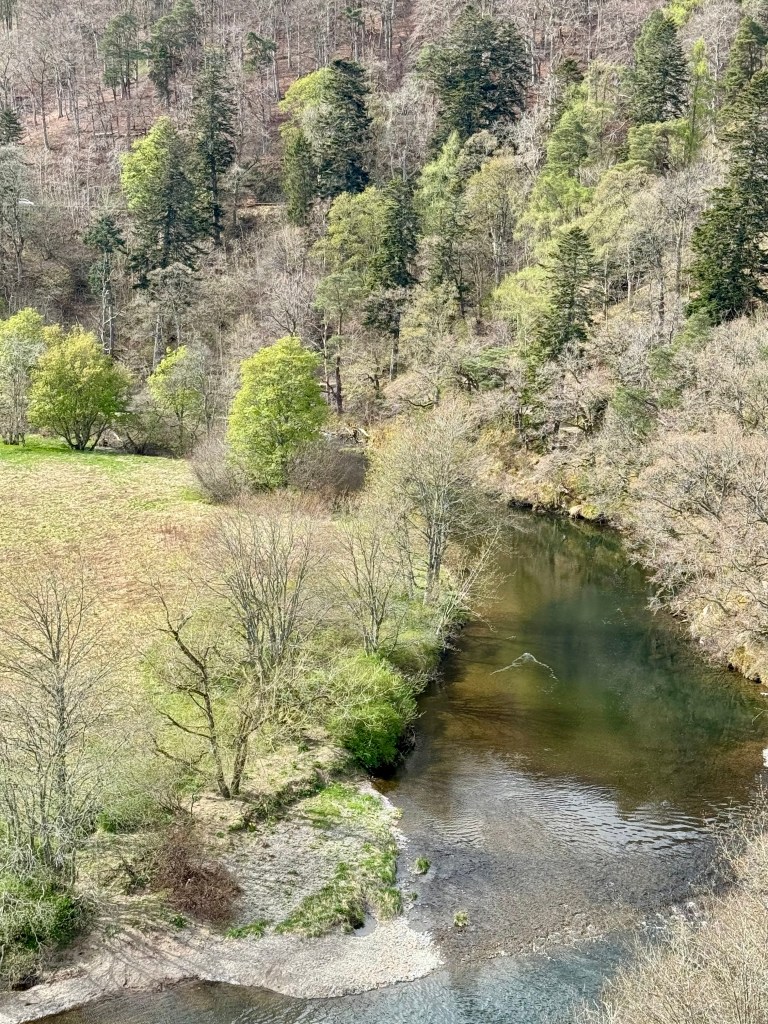
Neidpath Castle is an impressive medieval L-plan tower house, dramatically positioned on a cliff overlooking the River Tweed, about a mile (1.6 km) west of Peebles. It has witnessed some 800 years of Scottish history, having hosted royalty, withstood sieges, and remained a privately owned residence to this day.
The earliest fortification at Neidpath was established by Sir Gilbert Fraser in around 1190, marking the beginning of the site’s long history. It was strategically chosen for its commanding position overlooking the River Tweed, providing excellent defensive advantages.
Sir Simon Fraser, grandson of Sir Gilbert, continued the family’s association with Neidpath while serving as High Sheriff of Tweeddale. Between 1263 and 1266, he likely constructed a more substantial castle on the site.
Sir Simon gained fame for his remarkable military achievement of defeating the English three times in a single day at Roslyn Glen, despite commanding only 8,000 men against an English force three times that size. Despite his military prowess, Sir Simon’s story ended tragically when he was executed in London following his capture by English forces.

The castle also suffered, being burnt to the ground by the English, leaving Simon’s daughter Mary to inherit a ruin.
The castle passed to the Hay family through marriage in the early 14th century when the heiress Margaret, daughter of Simon Fraser’s son, married into the Hay family. This marriage alliance transferred the barony of Neidpath to the Hays, who would maintain ownership for the next three centuries.
It is thought that Sir William Hay, who served as Sheriff of Peebles and died around 1390, built the present castle in the late 14th century. This marks the beginning of the structure that forms the core of what visitors see today.
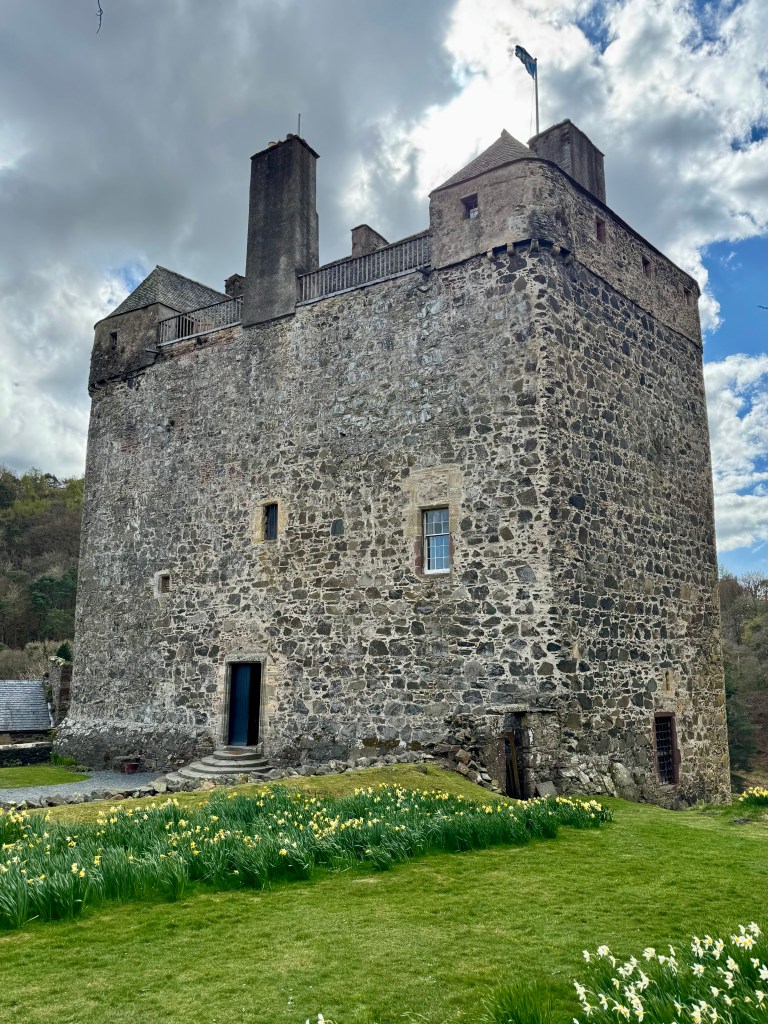
The castle was built as an L-plan tower house with distinctive rounded corners, demonstrating the architectural preferences of the period. The design is partly determined by its surroundings. Built on a rocky crag overlooking the River Tweed, the main block is not perfectly rectangular but takes the shape of a parallelogram to suit the natural contours of the rock.
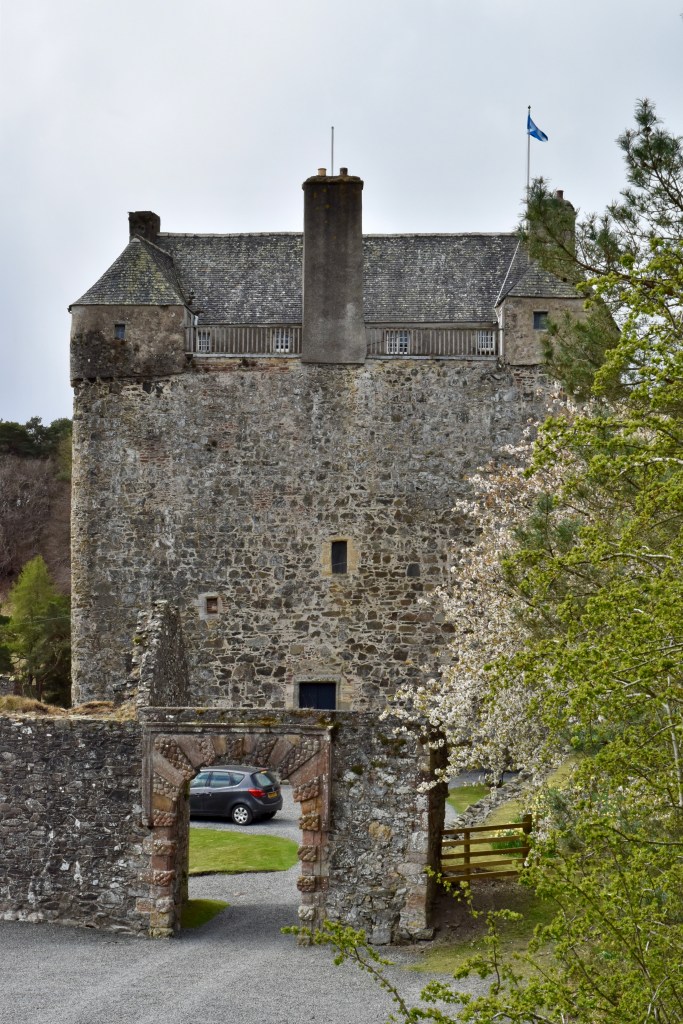
The original entrance was positioned at ground level on the south side of the castle, on the edge of a cliff. Both the main block and the wing featured vaulted basements, creating secure storage areas and foundations for the floor above. There was also a pit-prison in the basement, reached from the guard room above; a sobering reminder of the castle’s role as a centre of power and justice.
Although subdivided overall into five storeys, the tower was structurally divided into just three high compartments, each barrel-vaulted in stone. The great hall occupied the entire second floor, while its kitchen and services filled the wing. Smaller rooms were built ingeniously into the thickness of the walls, which in places reach an incredible 3 metres.
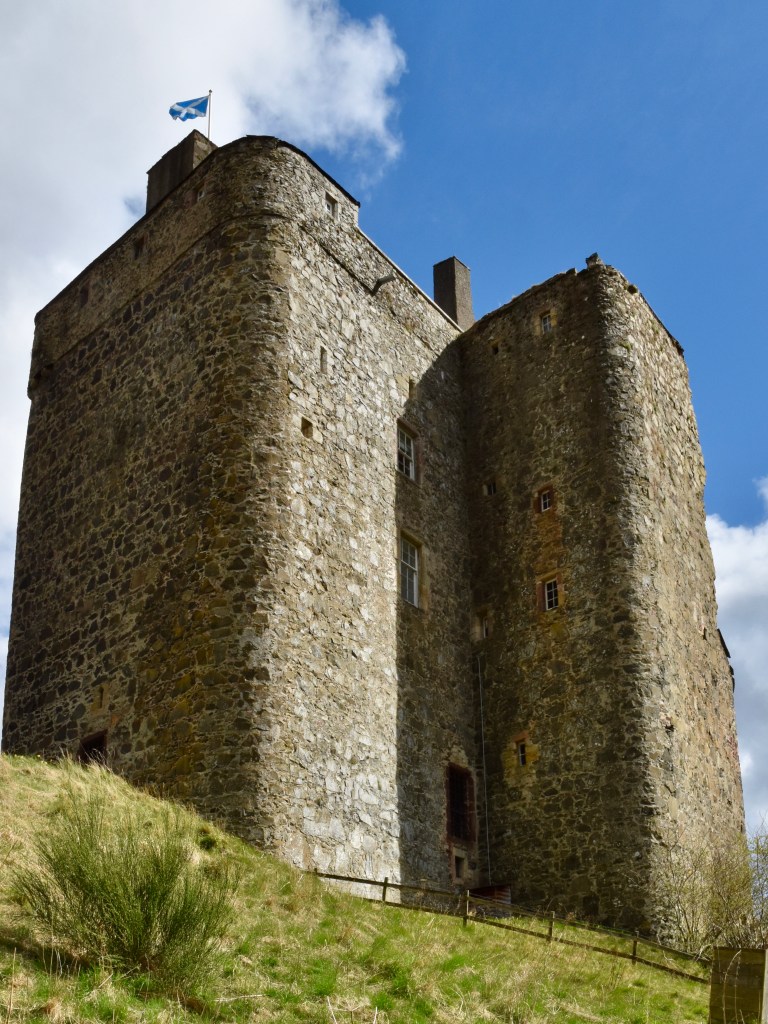
Overall, it’s an immense structure, measuring 19 metres by 12 metres, with a wing projecting 5.8 metres. It reaches a height of 19.2 metres at parapet level.
Neidpath Castle hosted several royal visitors during its long history. Mary, Queen of Scots, stayed at the castle in 1563 during her personal rule of Scotland. This visit came during a relatively stable period in Mary’s tumultuous reign, before the series of crises that would eventually lead to her forced abdication and exile in England.
Twenty-four years later, in 1587, Mary’s son James VI also visited Neidpath. By this time, James had assumed personal rule of Scotland and was navigating the complex political landscape of his kingdom before also inheriting the English throne in 1603.
Interestingly, despite having witnessed almost the entirety of the Border Reivers era, there is no surviving evidence of raids on Neidpath Castle or its occupants having connections to reiving activities. That said, Tweeddale was certainly touched by reiving and in 1585, King of Scots James VI ordered the population of the Borders to meet at Peebles “to halt the crimes committed on the borders by cross‑border raids,”
Also, in 1549, during the Rough Wooing, English forces completely razed Peebles, but the accounts of that devastation do not single out Neidpath Castle as a particular target.
The mid-17th century brought significant challenges to Neidpath Castle during the Wars of the Three Kingdoms. In 1645, the castle was garrisoned against the Royalist forces of James Graham, 1st Marquess of Montrose. Interestingly, following Montrose’s defeat at Philiphaugh, he reportedly attempted to seek shelter at Traquair House, approximately 8 miles (13 km) to the east, but was denied entry. Some accounts suggest he may have stayed at Neidpath, although this remains uncertain.
The castle was garrisoned again five years later, this time against Cromwell’s army. However, accounts differ as to what happened. Some say Neidpath Castle surrendered without a fight, although other sources suggest that it required the longest assault on any stronghold south of the River Forth to force it to surrender. On the other hand, local sources say that the castle sustained artillery fire, with sections of the south wall being damaged. We do know that the castle, held by the royalist Hays, was attacked by Cromwell’s forces under Lambert in 1650 as part of the south‑to‑north advance. Quite how long it held out is clearly a matter for discussion.
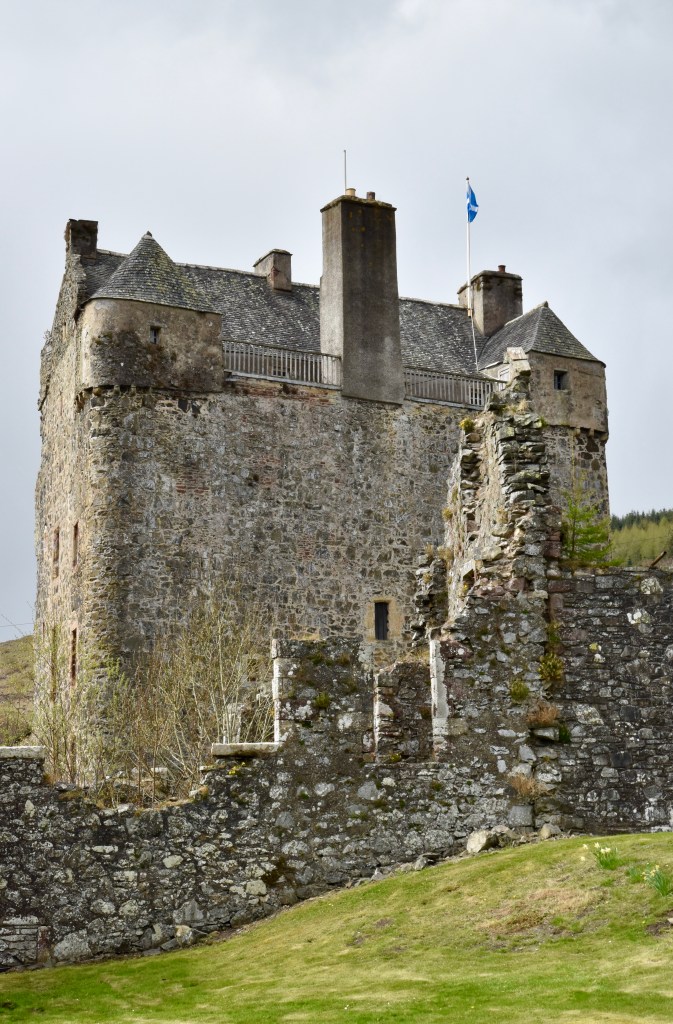
Few alterations were made to Neidpath Castle until the 1590s, when the two upper floors were remodelled. Further alterations took place shortly after Cromwell’s invasion of Scotland. A new entrance was created in the south wall, and a wide staircase was installed in the southeast corner up to the second floor. The great hall was divided into two panelled rooms. Other changes included the addition of outbuildings and the planting of an avenue of Yew trees, of which one side remains today.
In 1686, John Hay, the 1st Marquis of Tweeddale, was declared bankrupt, and he sold Neidpath to William Douglas, the 1st Duke of Queensberry. In 1693, William gave the castle to his second son, who later became the 1st Earl of March, and married Lady Jean Hay, the daughter of the bankrupt Marquis of Tweeddale.
Neidpath Castle stayed with the Douglas family and was let to tenants by the 3rd Earl of March (who was also 4th Duke of Queensferry). Despite his wealth, the castle suffered neglect, and by 1790 the upper storeys of the wing had collapsed (and to this day they have never been restored).
William Wordsworth and Walter Scott both visited the castle in 1803. Wordsworth was appalled at the felling of “a brotherhood of venerable Trees” by Douglas and wrote a sonnet beginning “Degenerate Douglas! oh, the unworthy Lord.” On the death of the Duke in 1810, the castle, along with the earldom of March, was inherited by the Earl of Wemyss, although the dukedom went to the Scotts of Buccleuch.
This transfer marked the beginning of the Wemyss family’s association with Neidpath, a relationship that continues to this day, spanning over 200 years of uninterrupted ownership. The Wemyss family have taken great care to protect Neidpath, and it retains much of its original medieval character. This includes the Great Hall with its panelled walls and fabulous artworks portraying the life of Mary Queen of Scots.
Today, Neidpath Castle serves as a function venue while remaining a privately owned property of the Earl of Wemyss and March.
Neidpath Castle is not without its own ghost story. This is the legend of Jean Douglas, the “Maid of Neidpath.” Forbidden by her father, the Earl of March, to wed the Laird of Tushielaw, Jean pined by a window until illness consumed her. When her lover finally returned, he failed to recognise her frailty and rode on—breaking her heart. She died soon after, and her ghost, clad in a long brown dress with a large white collar, is said to wander the ramparts still waiting for him. Sir Walter Scott immortalised her in the poem The Maid of Neidpath, weaving the poignant tale into Scotland’s literary heritage.
Getting to Neidpath Castle is simple. It is just off the A72 west of Peebles, and is well signposted. However, it is not generally open to the public. Guided tours are available on select dates, typically from May to October and are well worth your time. Alternatively, private tours can be arranged by appointment throughout the year. See the castle’s website (below) for more details.
You can view the exterior of the castle from the footpath along the banks of the River Tweed, with perhaps the best views being from the south bank, just west of the castle.
Further reading
Martin Coventry, 2025, The Castles of Scotland (sixth edition), Goblinshead
Alastair Maxwell-Irving, 2014, The Border Towers of Scotland Vol. 2 Maxwell-Irving
Adrian Pettifer, 2024, Scottish Castles, The Boydell Press
Mike Salter, 1994, The Castles of Lothian and the Borders, Folly Publications



 Thistle & Time
Leave a comment