

Just north of Dumfries, in the quiet countryside of southern Scotland, lies one of the UK’s largest but least-known stone circles: The Twelve Apostles. Unlike tourist sites such as Calanais (Isle of Lewis) or the Ring of Brodgar (Orkney), this ancient monument sits unassuming in a field near the village of Newbridge, just outside of Dumfries. It is surrounded by farmland and the low hum of the modern world passing by. But beneath its grassy setting lies a story still shrouded in mystery.
At first glance, the circle looks deceptively simple. Eleven remaining large stones, some toppled, some still standing, mark out a wide ring almost 90 metres (nearly 300 feet) in diameter, making it the largest stone circle in mainland Scotland. The tallest of the stones still standing is about 2 metres in height.
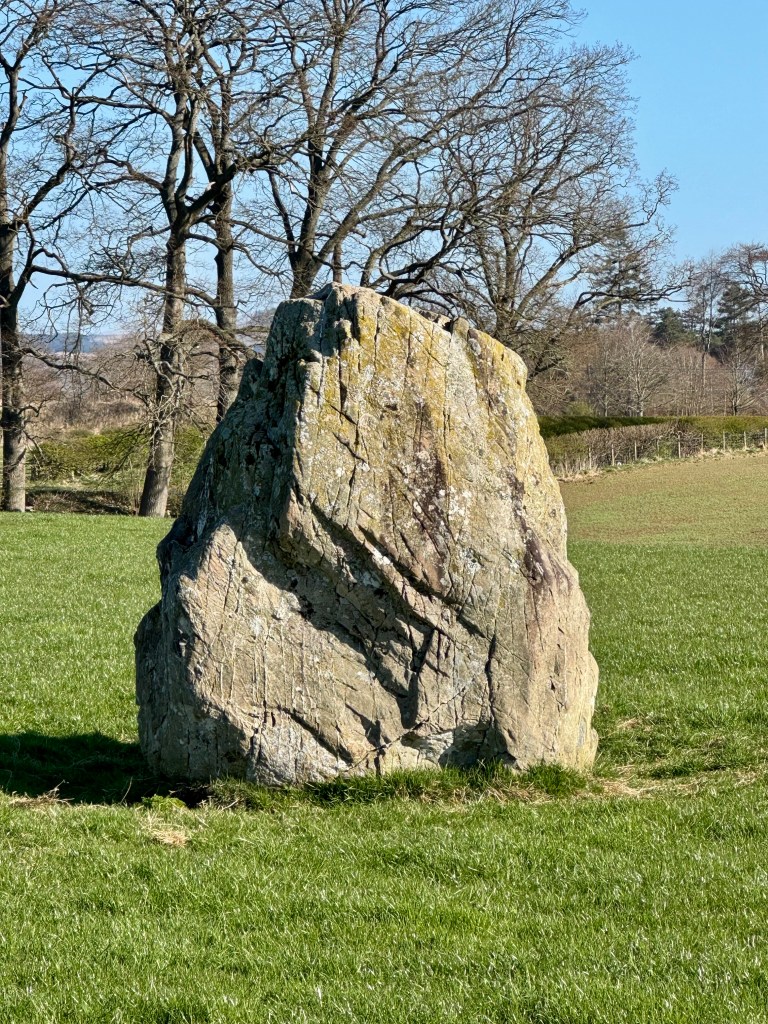
All but one stone is of local Silurian rock; the exception is a porphyry boulder. Interestingly, the nearest occurrence of Silurian rock is two miles away, near Irongray Church, which begs the question: how did its Neolithic builders transport such large stones to the site?
Archaeologists place its construction in the late Neolithic or early Bronze Age, around 2500–2000 BCE. That makes it at least 4,000 years old. The name came considerably later, overlaid with a Christian reference by people who had little understanding of the site’s true origin. It is said that in the 19th century, when the Circle had 12 stones, a farmer destroyed one to use as building material. Some locals described this as like Jesus losing one of his 12 disciples.

No one knows why the Twelve Apostles were raised, but there are clues. Like other stone circles, it perhaps held religious, ceremonial, or social significance. The lack of a central burial or internal structure suggests it wasn’t a tomb, but a place of assembly, where people gathered under the open sky for reasons lost to time.
Its size is possibly a clue. Bigger circles may suggest greater social importance or wider regional use. This wasn’t a backyard shrine; it was a public monument, perhaps shared by several communities. What’s more, the Twelve Apostles are certainly part of a much larger Stone Age complex of nearby monuments. Close by are two cursus monuments, some ring ditches, enclosures and mounds, which again suggest that this could have been a meeting place with strong ceremonial links for differing Neolithic groups of people.
Interestingly, no major excavation has been conducted at the site. Its mostly untouched status leaves more questions than answers, but preserves its mystery.
Today, the Twelve Apostles stand quietly, often overlooked by tourists in search of more famous landmarks. There are no gift shops or interpretation boards. You won’t find tour buses lining up at the field’s edge.
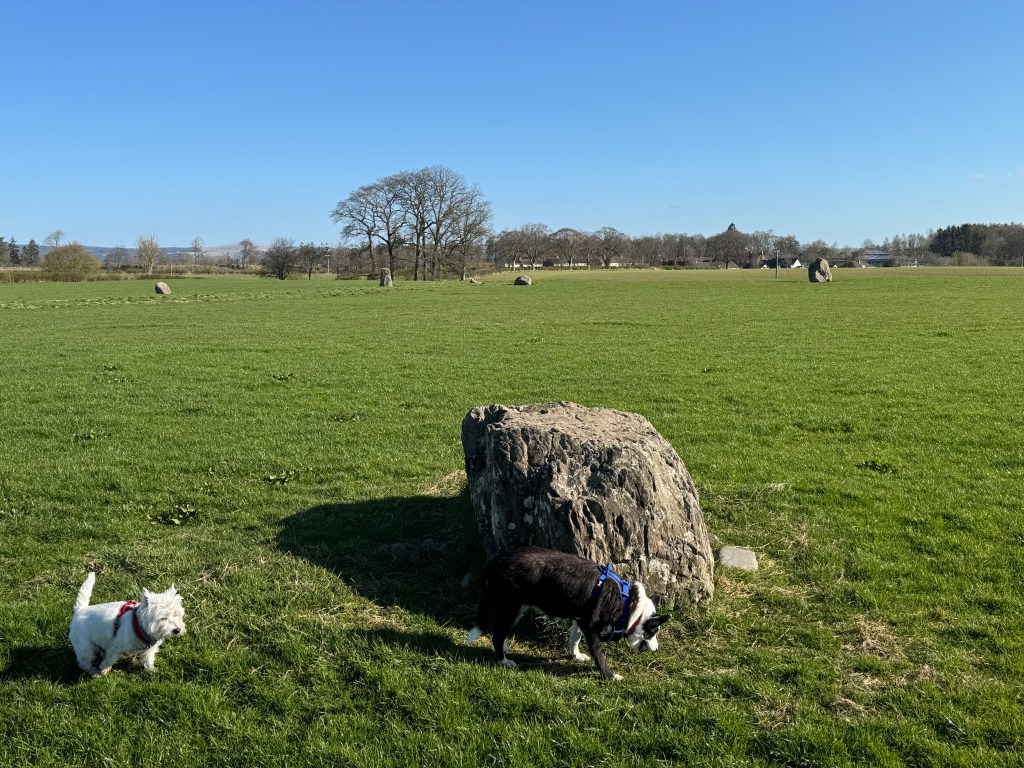
But this anonymity is part of its attraction. Unlike other sites that have been curated and commodified, the Apostles remain silent, still standing, still waiting. They remind us that even in a world full of answers, there are still places where mystery endures. That said, the Apostles don’t have the awe-inspiring presence or atmosphere of a circle like Callanish. Indeed, if you don’t stop to consider why the circle was built, then you may be underwhelmed.
The Twelve Apostles sit in a field just off the A76, northeast of Dumfries. There’s limited signage and no formal parking—this is raw heritage. We parked just off the B729 on the western corner of the field and gained access through a gate. Visitors should be respectful of the land and any livestock (when it will be necessary to keep dogs on a lead). Regardless of how long you stay, tread lightly and bring curiosity, not assumptions.
(Note: There is another stone circle called Twelve Apostles on Ilkley Moor in Yorkshire, England)
Further reading
South of Scotland: Scotland Starts Here




 Thistle & Time
Leave a comment