

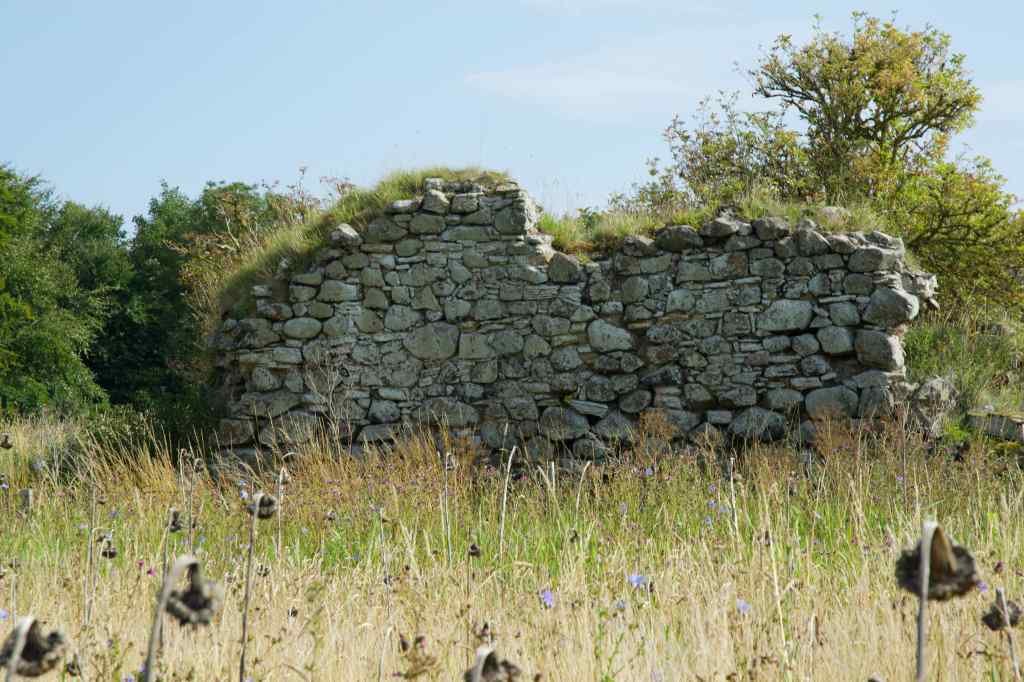
There is not much remaining of Roxburgh Castle. What was once a very large, important and strategically located royal fortress near the Anglo-Scottish border is now just scattered remnants. Portions of the remaining walls rise 4.5 metres and are 3.6 metres thick. These sit high above the River Teviot near its confluence with the River Tweed at Kelso.
Originally, the castle had immense towers at the corners and was surrounded by a deep ditch, said to have been fed by sluices from the River Teviot.
Roxburgh Castle’s origins trace back to at least 1128, during the reign of King David I of Scotland (1124-1153). In addition to making it one of his residences, he also established a royal burgh very near the castle, which later grew into a significant trading centre. Indeed, Roxburgh town hosted trade fairs and benefited from access to river transport, which facilitated trade via Berwick-upon-Tweed.

The castle’s strategic significance extended beyond its economic value. Its position allowed for the domination of the lower Tweed valley and Teviotdale, making it a crucial stronghold for controlling the eastern approaches to Scotland. But its very position made Roxburgh Castle such a coveted prize, resulting in it changing hands many times, each transition marking the ongoing struggle for control of the border.
This process began in 1174 when Roxburgh was surrendered to England, along with other major Scottish fortresses, including Berwick, Edinburgh, Jedburgh and Stirling, as a condition of King William the Lion’s release following his capture at Alnwick. It was later sold back to Scotland by Richard I to raise funds for his crusade.

In 1241 Alexander III was born here, but then in 1296, Roxburgh Castle was again surrendered to English invaders as Edward I sought to consolidate his recent occupation of Scotland. In an attempt to punish defiant Scots, Robert the Bruce’s sister, Mary, was imprisoned by Edward at Roxburgh Castle for four years.
It was retaken in a daring raid by Sir James Douglas in 1314. He approached the castle walls at nightfall while most of the English garrison was making merry in the main hall. According to John Barbour’s poem The Brus, Douglas and his men were dressed in dark cloaks and mistaken for sheep by the guards, enabling them to scale the castle walls undetected. Following this successful raid, King Robert I (the Bruce) ordered the castle to be destroyed so it could no longer fall into English hands.
But the castle was rebuilt in the 1330s by the English when Edward III invaded Scotland and was granted control of southern Scotland by his puppet king, Edward Balliol. Although the Scots again held the castle from 1342-46, Roxburgh was to remain under English control for over a century.

In 1416, a report to King Henry V of England highlighted the need for repairs and upgrades to strengthen the castle. After repelling a Scottish attack in 1417, the work was completed. A further but unsuccessful attempt at capturing the castle was made in 1436.
But it wasn’t until 1460 that the castle was finally retaken. During this siege, the Scottish king James II was killed when one of his cannons blew up. His queen, Margaret Gueldres, continued what he started, and when the castle eventually surrendered, she ordered it to be destroyed.
Later, during the Wars of the Rough Wooing, the English built a fort on the site but this was demolished under the terms of the Treaty of Boulogne.
As for the royal burgh, it no longer exists. Its fortunes were closely tied to those of the castle, with nearby Kelso overtaking it in significance.
Legend says that sometimes a ghostly horseman can be seen riding towards the castle.

Roxburgh Castle is located just a short distance west of Kelso. Today, the castle fragments are visible in places from the riverside path to the south east, and from the A699 road on the north western side. Large chunks of the curtain wall sit above the River Teviot, while at the northern apex are the remains of a half-tower and footings of a barbican.
It occupies the summit of a glacial ridge that rises to approximately 30 metres in height and extends 140 metres transversely from northeast to southwest. The primary walls of the castle are best-preserved on the southeast where a curtain wall of coursed, lime-mortared, roughly-dressed masonry, 1.8 metres in thickness, still stands to as much as 5 metres in height in places. There are at least two postern gates in the surviving masonry along this wall.
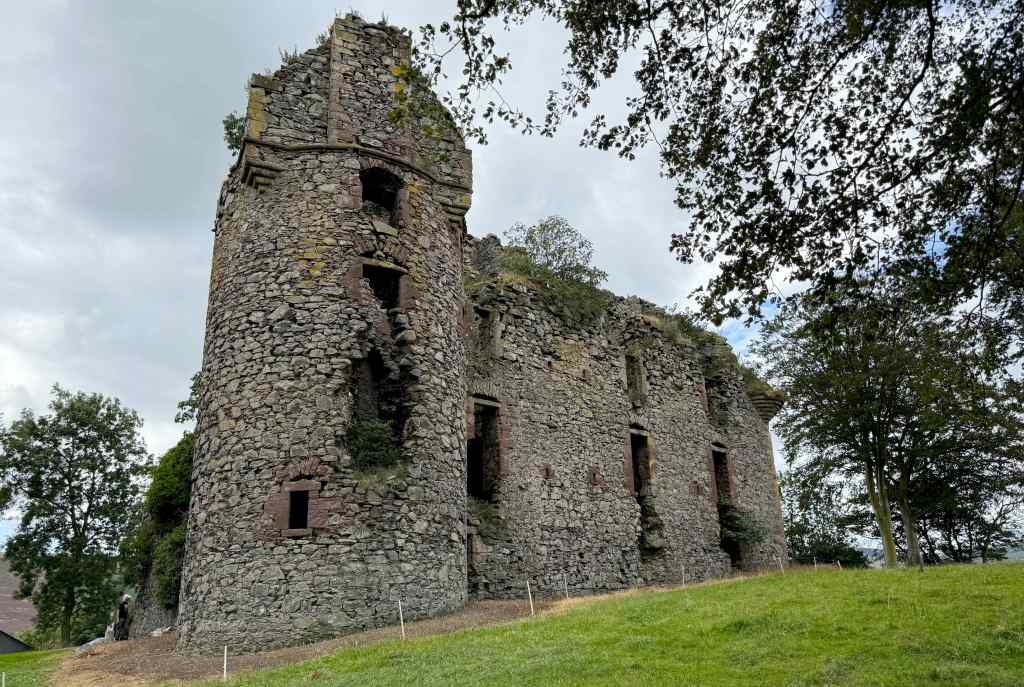
At the northeast end of the castle, there is a very substantial circular tower, about 14 metres in overall diameter, with squared ashlar walls 4 metres in thickness, still standing to a height of 3.5 metres. The raggle of a wall shows that it was squared at the back, and another at right angles indicates it extended to another compartment behind. The projecting D-shaped tower had a vaulted basement and must have stood several storeys in height.
The 16th-century fort was built over the middle section of the castle. The walls consisted mainly of earthen ramparts retained by a stone wall, of which fragments survive on the northwest. In places, the stonework of the castle was reused, with a surviving fragment towards the southwest.
To fully appreciate the scale of the original castle, which was vast, a climb to the top of the hill is recommended. But this isn’t easy, given the steep and severely overgrown terrain. If you have approached from the layby on the road, don’t be tempted to head straight up the mound in front of you, as this falls away to a deep ditch below (once part of the castle’s earthworks). Instead, walk down the path to the river and turn left. With care, a route up from the riverside footpath is possible, near the southern end of the hill, taking a diagonal approach as you ascend.

Roxburgh Castle stands as one of Scotland’s most historically significant yet tragically diminished fortresses, its ruins bearing witness to over three centuries of fierce Anglo-Scottish warfare. While little remains, its story underlines the historical struggle for Scottish independence, ensuring that Roxburgh Castle’s legacy endures far beyond its physical remnants.
Roxburgh Castle OS National Grid Reference: NT 371 337
Further reading
Martin Coventry, 2025, The Castles of Scotland (Goblinshead)
Adrian Pettifer, 2024, Scottish Castles (Boydell Press)
Mike Salter, 1994, The Castles of Lothian and The Borders (Folly Publications)
Floors Castle: James Douglas and the Capture of Roxburghe Castle
The Douglas Archives: Roxburgh Castle


 Thistle & Time
Leave a comment