
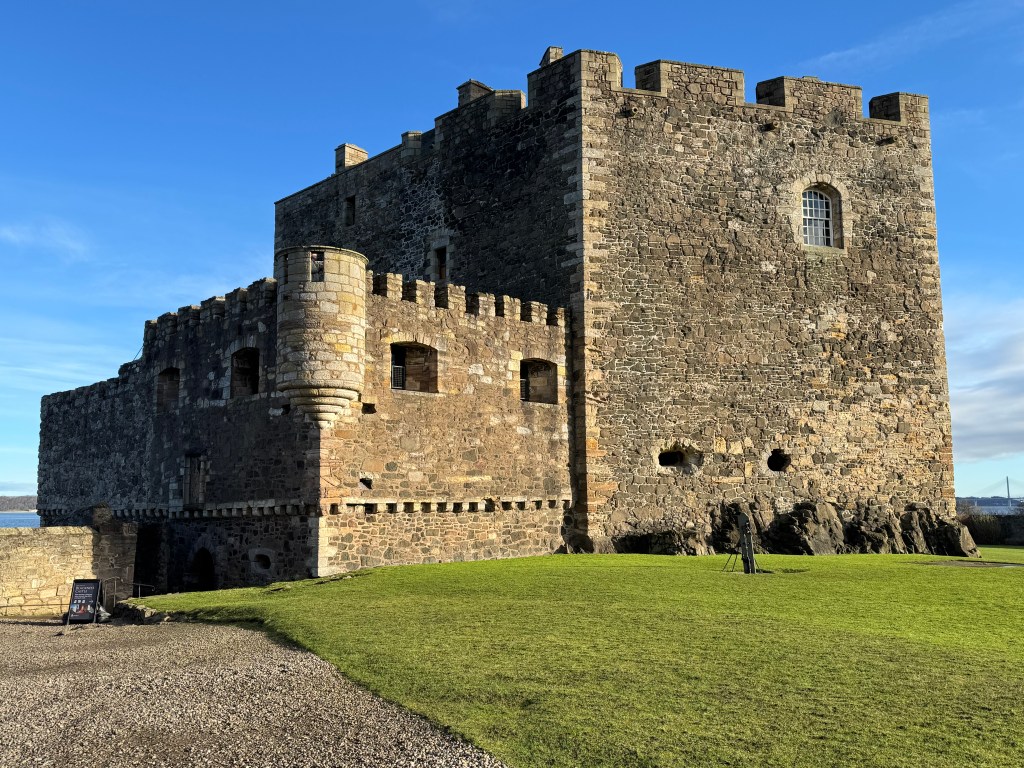
Often dubbed “the ship that never sailed,” this 15th-century fortress has played many roles across the centuries: a royal residence, a garrison fortress, a state prison, and now a fascinating historical site that draws visitors intrigued by its unusual architecture, dramatic past, and, of course, the TV series Outlander.
It is the castle’s layout that provides the comparison with a ship. When viewed from the seaward side, the castle presents an unmistakable resemblance to a great stone ship that has run aground. Its three towers are known as the stem, main mast and stern. What’s more, the curtain wall comes together in a shape resembling a ship’s bow.

Blackness Castle sits on rocks jutting into the Firth of Forth. It is 5.5. miles (9 km) upstream of Queensferry and 4 miles (6.5 km) north east of Linlithgow. As early as the 12th century, Blackness Bay was used as a port for the royal burgh of Linlithgow. But the castle came much later.
The first mention of Blackness Castle was in 1449. It was built by Sir George Crichton, who was already sheriff of Linlithgow and by then had risen to Admiral of Scotland. But Sir George’s favourable relationship with the King, James II, started to sour in 1453. In the following year, he was compelled to name James II as heir and assign to him all his assets, including the castle. Perhaps not surprisingly, George’s son objected, locking his father in the castle. But the king arrived with artillery, and after two weeks, George’s son surrendered.
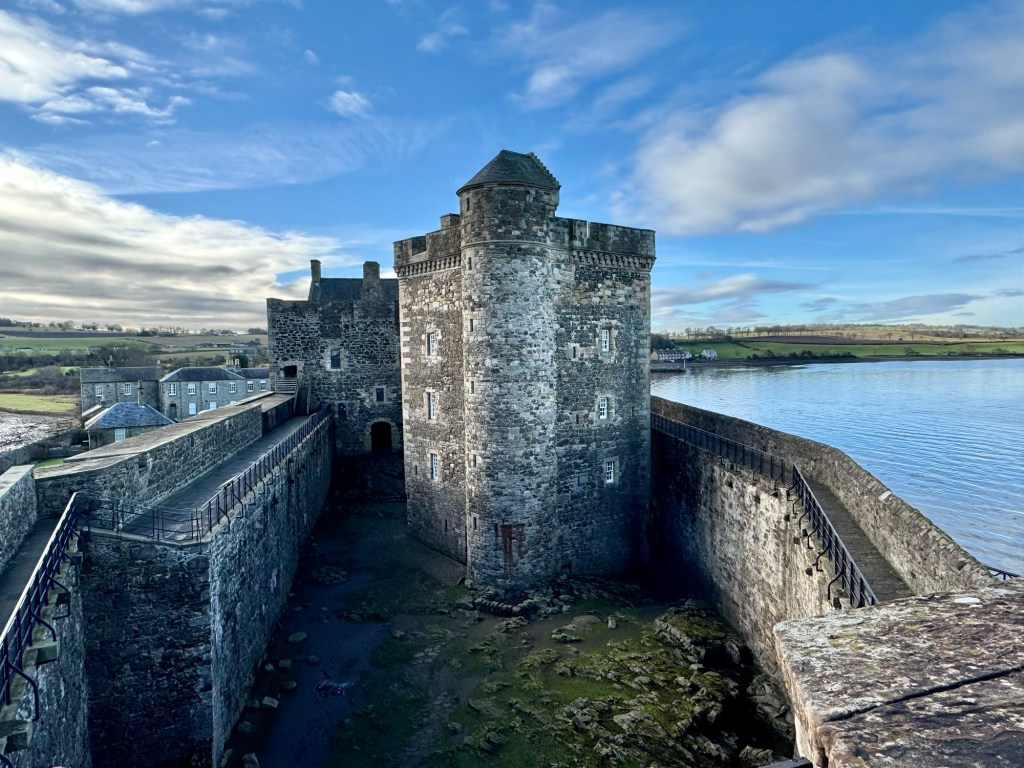
Once in royal hands, the Crichtons were replaced by a succession of “royal keepers”, nobles appointed to manage the castle on behalf of the king. But although the castle was kept in readiness for royal visitors, only James IV is known to have visited more than once.
Fast forward to 1537, and James V oversaw extensive remodelling of the castle. It was prompted by changes to warfare with more sophisticated artillery, and the mounting threat from Henry VIII of England. The result was enormously thickened walls and space for defensive guns. By 1543, Blackness Castle had become an important stronghold. Indeed, its strategic position, controlling the approach to Linlithgow and commanding views across the Firth of Forth, made it an essential component of Scotland’s coastal defence network.

Its first test came during the War of the Rough Wooing, when Henry VIII sought to force a marriage agreement between the infant Mary Queen of Scots and his son Edward. The first major action of this brutal war took place in 1544, resulting in the destruction of Leith and the burning of Edinburgh. At this time, Blackness Castle served as a vital fallback position for Scottish forces retreating from the English. But as the war progressed, the castle became directly involved, enduring multiple sieges. Some reports say it was captured by the English in 1547 but recaptured shortly afterwards, with French help. But whether or not this happened, it was definitely used by the French as a garrison and armoury. The fortress’s resilience enabled it to serve as a rallying point for French reinforcements disembarking at nearby Blackness Bay throughout 1549–1550.

While the war raged, Blackness Castle was also used as a state prison, its most famous inmate being Cardinal David Beaton, Archbishop of St. Andrews. Over the years, several high-profile high-ranking prisoners were held at the castle, but they were not confined to the dungeon. Instead, they lived in ways similar to how they had at home, even enjoying going up to 3 miles (5 km) from the castle walls during the day. On the other hand, those prisoners of lower status, such as “Crukit Dande” Ormiston, a Border Reiver, were thrown into the north tower dungeon.
In the 1560s, the castle was garrisoned by both the Earl of Arran and Sir Claud Hamilton in support of Mary Queen of Scots, both of whom used the castle to launch raids into Linlithgowshire and the towns on the north bank of the Forth.

But the most severe test of Blackness Castle’s defences came in 1650 during Oliver Cromwell’s invasion of Scotland. Despite the extensive 16th-century modifications that had successfully repelled earlier attacks, the fortress could not withstand the devastating firepower of Cromwell’s heavy artillery. The English forces positioned their cannons on the rise to the south of the castle, systematically destroying the chapel in the process and inflicting severe damage on the fortifications. The bombardment left permanent scars that remain visible today, serving as a stark reminder of the destructive power of 17th-century artillery. The garrison was ultimately forced to surrender, marking the end of Blackness’s reputation as an impregnable fortress and demonstrating the continued evolution of military technology.
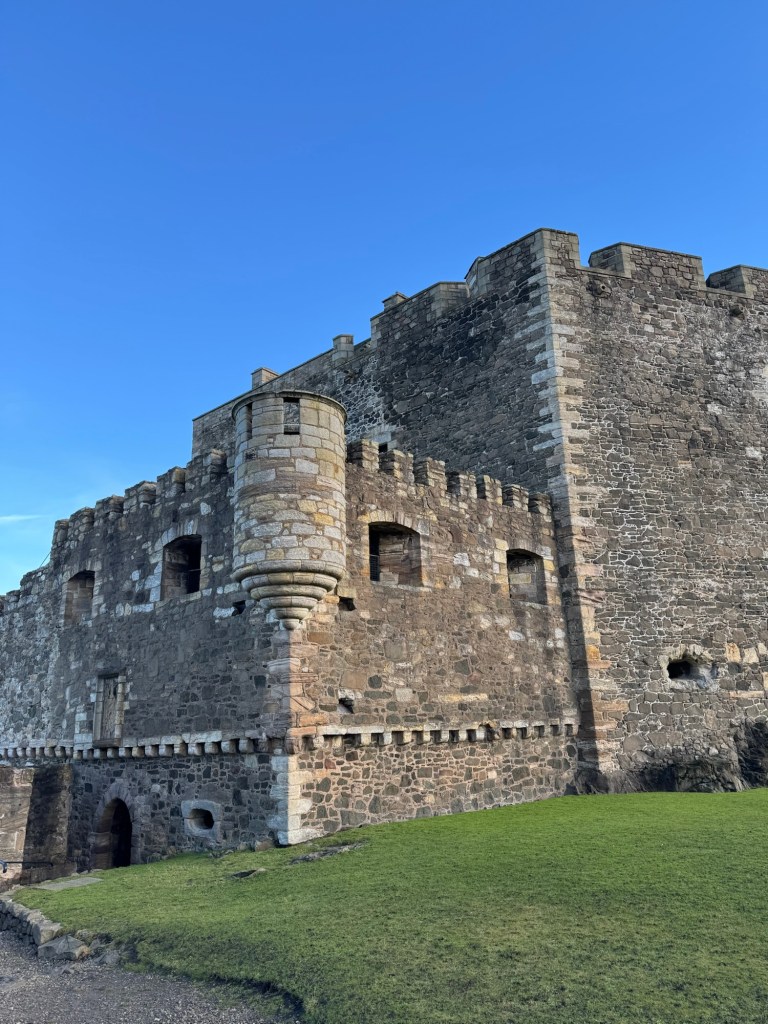
Blackness was repaired and rearmed when the monarchy was restored in 1660, and in the same decade, the central tower was fitted out as a prison for Covenanters. By the end of the century, the castle prison was full of Jacobites who had opposed the accession of William and Mary (thus ending the Stewart dynasty).
However, following the Union with England in 1707, the garrison at Blackness Castle was greatly reduced.
The 19th century brought a new chapter in Blackness Castle’s history when it was transformed into Scotland’s central munitions depot from 1870 to 1912. This period saw the construction of new buildings, including barracks and officers’ quarters, to accommodate the personnel required for this important logistical function. A new pier was constructed on the north side of the castle during this period, connecting directly with the courtyard via a drawbridge and a gateway cut through the west curtain wall.
But by 1912, Blackness Castle had served its purpose, and it passed into state care.

Most recently, Blackness Castle has played a starring role in the popular TV series Outlander. It has also been used as a location in the films Outlaw King (2018) and Mary Queen of Scots (2018).
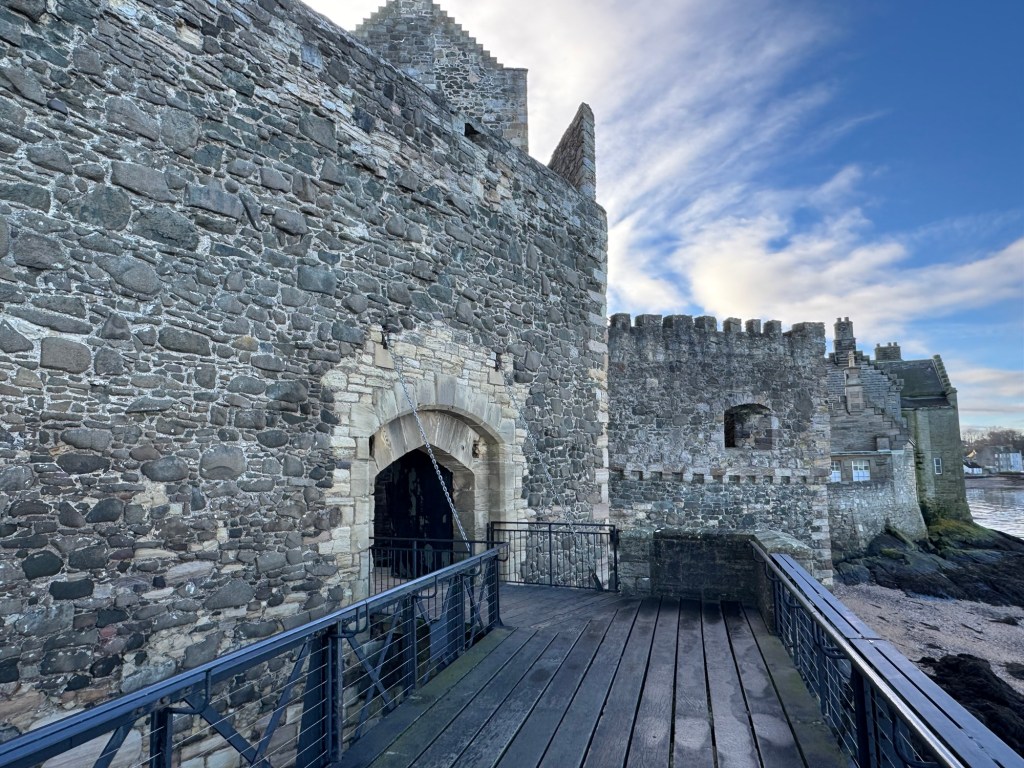
Today, it is managed by Historic Environment Scotland and attracts visitors from all over the world. Its role in major historical events, together with its unique shape, provides a fascinating window into Scotland’s turbulent past. The fortress’s designation as one of only four castles whose maintenance was guaranteed by the 1707 Act of Union underscores its national significance.
Blackness Castle is open to the public throughout the year except on Christmas and New Year holidays. For opening times, entry prices and information about facilities on site, please refer to the Historic Scotland website. (Please note, the smallish car park can fill quickly in busy periods).
Blackness Castle OS National Grid Reference: NT 055 083
Further Reading:
Historic Scotland Blackness Castle Official Souvenir Guide
Merriman (2000) The Rough Wooings, Mary Queen of Scots 1542-1551, Tuckwell
Historic Environment Scotland Portal
Archaeology Scotland Blackness Castle and its Prisoners




 Thistle & Time
Leave a comment