
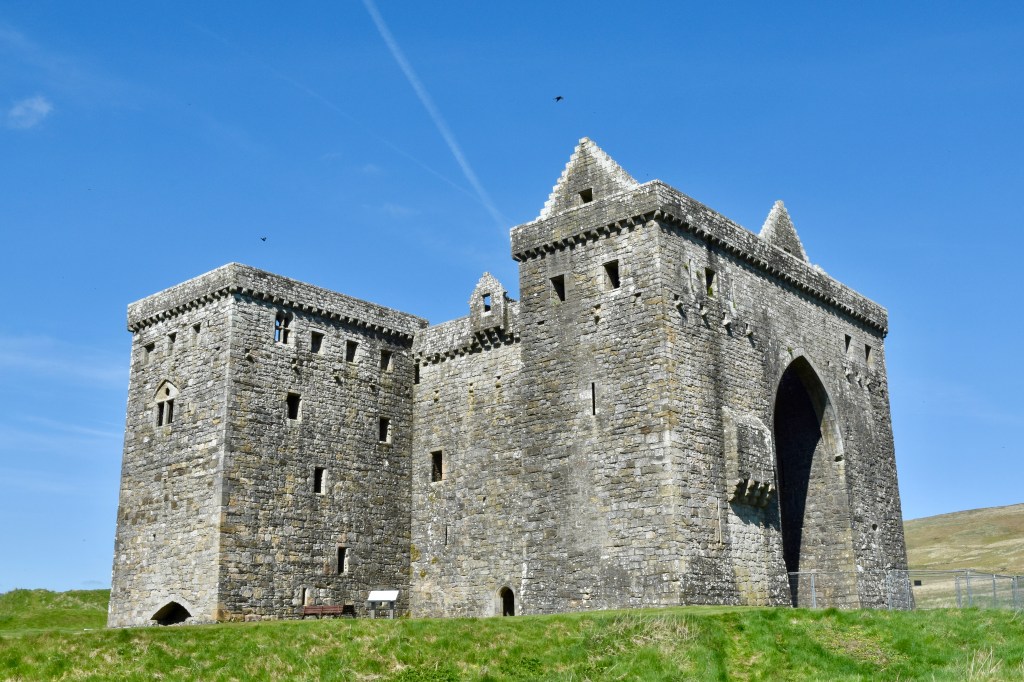
Introduction: One of the most visually dramatic castles along the Anglo-Scottish border, and stuffed with history. It literally towers above the visitor, evoking awe and reverence that such a structure was built without modern technology.
Location: Hermitage Castle is approximately 9.5 kilometres (6 miles) north of Newcastleton in the Scottish Borders region.
Historical context: The impressive fortress we see today was completed by the Douglases in the early 1400s.
But for its beginnings, we must travel back to 1140, when David I granted Ranulf de Sules the Lordship of Liddesdale. It’s thought that the de Sules family moved to Hermitage in the 1240s and built an earlier castle on the site, most likely as a timber construction.
The castle then changed hands a number of times during the Wars of Scottish Independence. Understandable, perhaps, given its strategic location.
This started in 1296, when Edward I of England captured Hermitage and gave it to Sir John Wake. But when Robert the Bruce became King of Scots, he restored the land to the de Sules family. Then, in 1320, William de Sules was imprisoned for conspiring against Robert the Bruce, and the castle was passed to Sir Robert Bruce, the Scottish king’s son.
Bruce held the castle until a treaty in 1328 said that the castle should be returned to English lords who had lost lands. Thomas Wake claimed Hermitage, but the Scots didn’t hand it over. This led to further conflict between supporters of the English-backed claimant to the Scottish throne, Edward Balliol, and supporters of Bruce’s successor, his son David II. In 1332, Balliol defeated David II but was soon ejected from Scotland by Bruce loyalists.
Yet whether Hermitage Castle actually passed into Thomas Wake’s hands isn’t clear. Anyway, by the time Wake died, Hermitage was under the ownership of Englishman Sir Ralph de Neville.
Then in 1338, the castle was captured by Sir William Douglas, the Knight of Liddesdale. Keen to consolidate his position and angry with Scottish King David II for not making him Sheriff of Teviotdale, Douglas took steps to get what he wanted. The actual postholder for the sheriff, Sir Alexander Ramsay, was seized by Douglas and held prisoner at the castle. The gruesome conditions led to festering wounds, starvation and Ramsay’s eventual death.

But a family power struggle saw Douglas murdered by his godson. However, ownership of the castle passed back to English hands when Douglas’s widow, Maragaet Stewart, married William Dacre.
Dacre’s ownership lasted almost 20 years, during which a fine stone house was built on the site in around 1360. This building still forms the core of today’s castle.
But by 1371, Hermitage Castle was back in Douglas’ hands. The family transformed the castle, turning Dacre’s house into what is now the castle’s central tower. They held the castle for over a century, adding the four corner towers, and using the castle as a base for their own power-building. Then in 1491, Archibald Douglas, known as Bell the Cat, was found having treasonous dealings with the English. James III ordered that the castle be passed to the Hepburn family.
The Hepburn family’s ownership of Hermitage Castle (1492–1567) marked a transformative period in the fortress’s history, characterised by political ascendancy, royal favour, and eventual downfall. They leveraged their position to influence Scottish politics, host monarchs, and fortify the castle against the evolving threat of artillery.
As Owners of Liddesdale, the Hepburns used Hermitage to administer justice, imprison reivers, and negotiate with English counterparts. They did this through their association with the Scotts of Buccleuch, who’d been helping to keep the castle since the Douglas days. The castle’s pit prison, a dank underground cell, held captured reivers. On one particular occasion, James Hepburn, the 4th Earl of Bothwell, had been injured in a skirmish with the notorious reiver John Elliot. This precipitated a visit to the castle from Mary Queen of Scots. It is this visit, on 15 October 1566, that adds an extra dimension to the Hermitage Castle story.

Mary made what would have been a difficult 25-mile ride from Jedburgh to visit Hepburn, her lieutenant and rumoured lover. Indeed, her visit has often been described as a lovers’ tryst, but in reality, she came on business and stayed only two hours. As a skilled horse rider, Mary was used to covering such distances. But on her return journey, crossing the rough border terrain, she fell from her horse into a bog. When she arrived back in Jedburgh, she became seriously ill and nearly died.
Of course, future events went badly for the couple. In June 1567, after only one month of marriage, Mary’s forces were defeated at Carberry Hill, and Hepburn fled into exile, never to return. He died in a Danish prison.
This effectively ended the Hepburn connection to Hermitage. The castle passed to Francis Stewart (James Hepburn’s nephew), but in 1594, he was forced into permanent exile for arousing the anger of James VI.
Sir Walter Scott, the “Bold Buccleuch” was then given possession of Hermitage Castle. The Scott family were notorious reivers, despite their titles and responsibilities. Famously, Walter Scott was instrumental in the daring rescue of another reiver, Kinmont Willie Armstrong, from imprisonment in Carlisle jail.
The castle’s role as a border fortress ended following the union of the crowns in 1603, when James VI also became James I of England. Hermitage was abandoned and fell into ruin. However, it was two other Walter Scotts who gave it life as a visitor attraction. Firstly, the work of famous writer Sir Walter Scott led to renewed interest in Scottish heritage. Then in the 1830s, Sir Walter Scott, 5th Duke of Buccleuch, carried out repairs on the castle. It passed into state care in 1930.
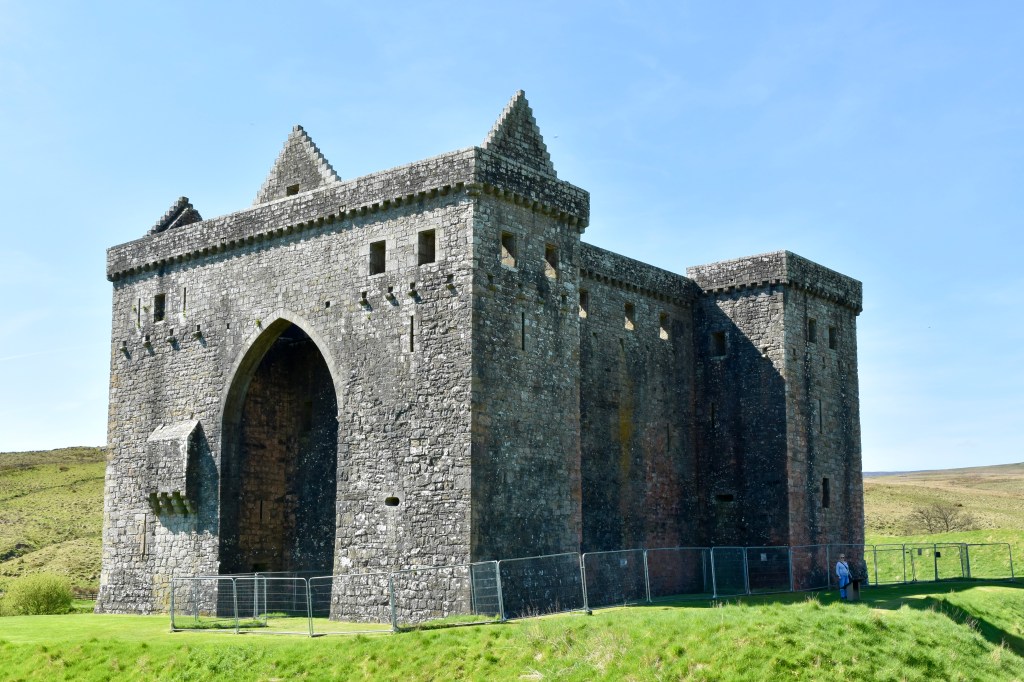
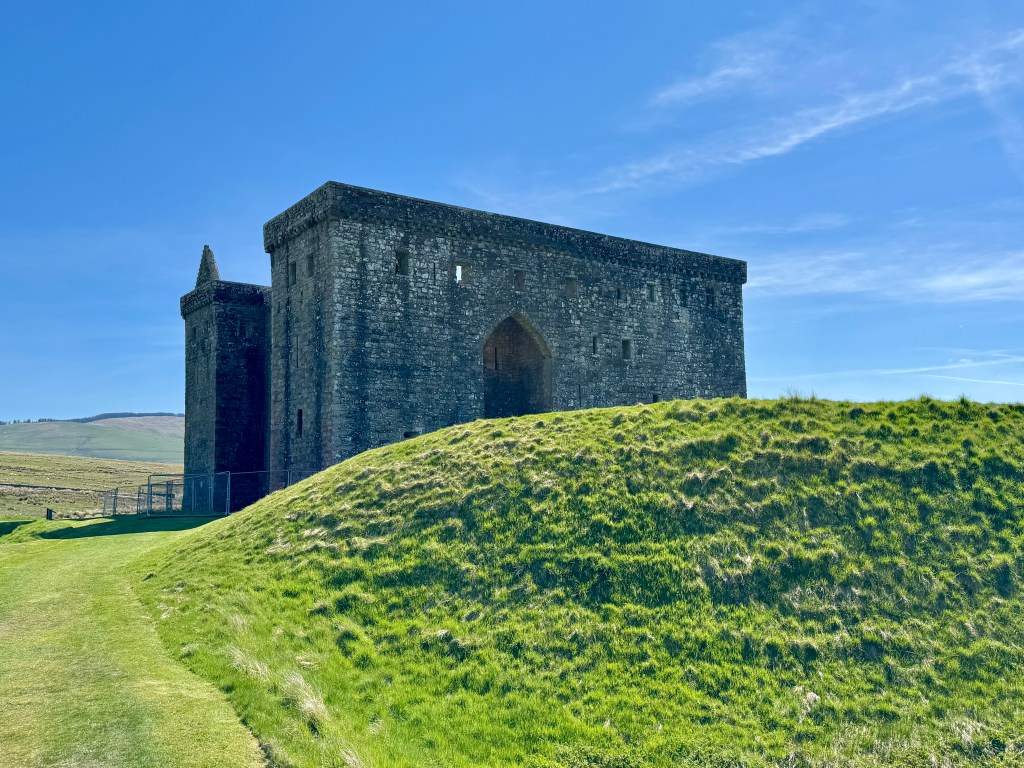
What you can see: Standing before the castle today, visitors are faced with a large and imposing structure. The enormous arches tower overhead could be mistaken for monumental entrances, but they are in fact supports for the upper floor. Looking upwards, imagining what the castle was like in its prime, can be quite a profound experience.
Stepping back for a wider view, the outside has what looks like top-floor windows. In fact, these are doorways that gave access to a wooden fighting platform. It would have been erected at times of need, and enabled the castle’s defenders to protect the walls if attacked from below.
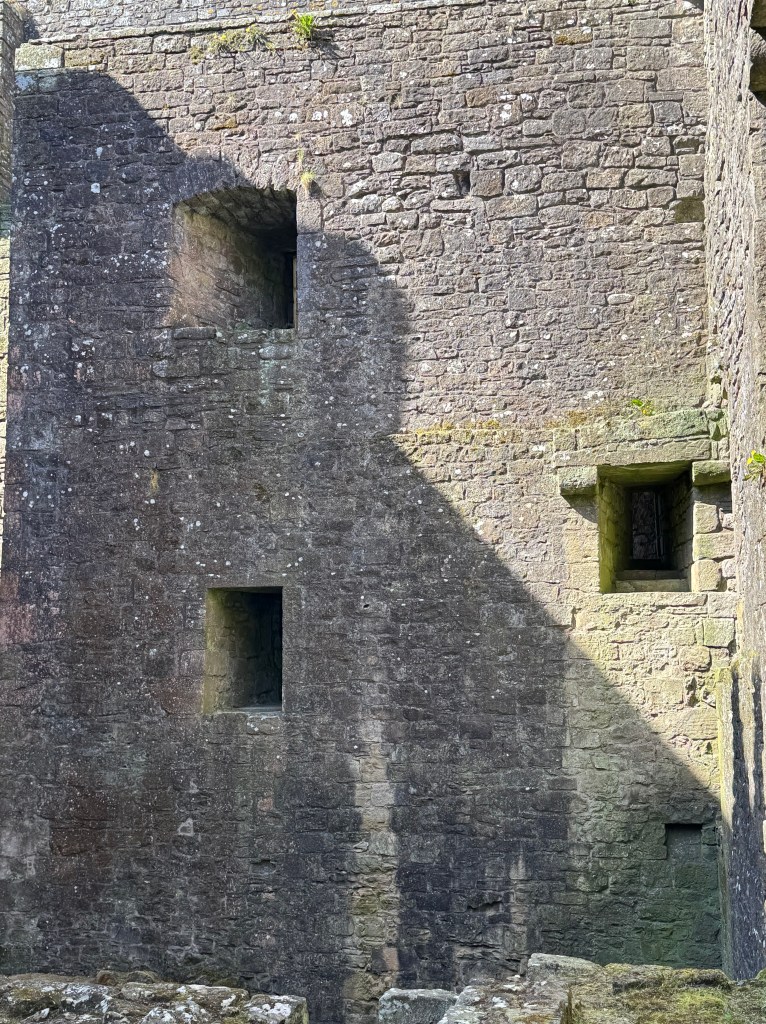
Also visible on the outer wall are horizontal gunholes that allowed a wider field of view. These were added in the mid to late 1500s. At the same time or shortly after, the earthworks outside the castle were improved to prevent access by siege machines and artillery.

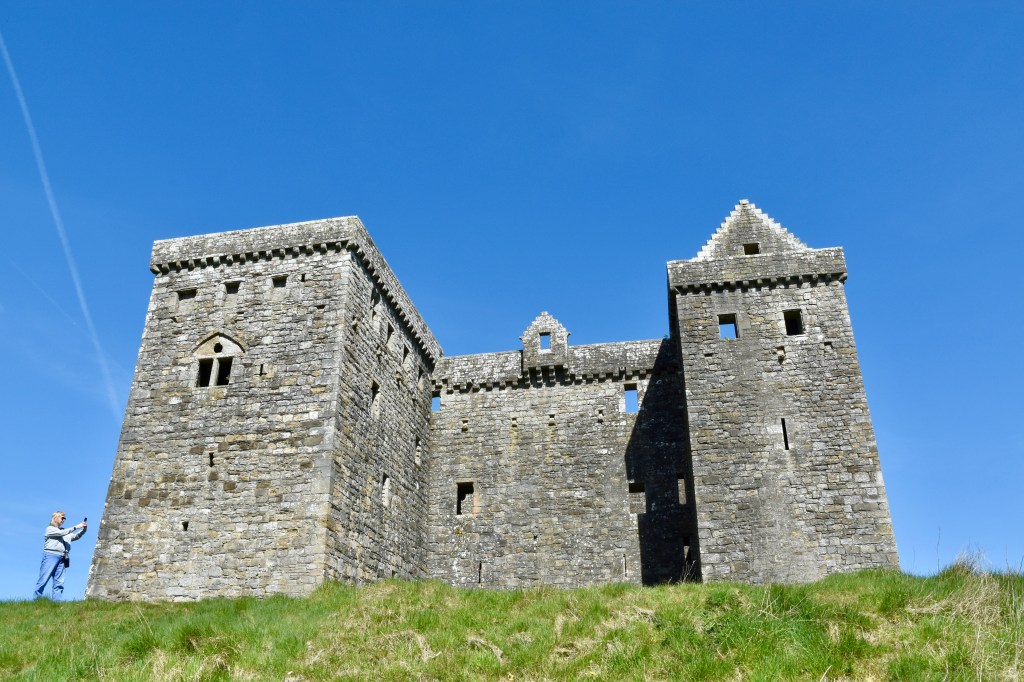
The castle follows an approximate ‘H’ shape layout, consisting of a central hall block with small square towers at the northwest, northeast, and southeast corners, plus a larger oblong wing on the southwest corner. This is the Douglas tower. Its upper floors comprised the best rooms in the castle, with large fireplaces and windows, as well as en-suite latrines. It is believed that James Hepburn received Mary Queen of Scots in one of these rooms. The block would also have had a kitchen.
The south east tower housed the castle’s main well, giving a steady supply of water, while the north east tower housed the prison. Those of a higher status were held on the first floor, with access to a latrine and some daylight. They were the lucky ones. Prisoners of lower status were held on the floor below, the aptly-named “pit prison”, which had no light or toilet. Surely, anyone thrown into the pit rarely lived to tell the tale.

The central block would have been home to the common hall for household staff, while above would have been a hall reserved for senior members of the household.
Myths and Legends: Like all good castles, Hermitage comes with its own tales of myth and legend, and it is Sir William de Sules who has attracted the most macabre story.
History tells us that de Sules was imprisoned and presumably executed for plotting against Robert the Bruce. But folklore claims he was a sinister practitioner of the Black Arts who kidnapped local children for blood rituals. He was said to have conjured a demonic familiar named Robin Redcap (sometimes called Redcap Sly), a fearsome goblin who thrived on violence and death.
According to tradition, the local people, desperate to end his reign of terror, received permission from King Robert to deal with de Sules as they wished. They wrapped him in lead and boiled him alive in a cauldron. His ghost, along with the sobs of his young victims, is said to haunt the castle’s corridors, and the malevolent Redcap is also believed to linger in the ruins.
Another legend is the “Hermitage Curse,” said to have been placed by a young woman named Mary Scott. Accused of witchcraft and tortured to death by William Douglas, she allegedly cursed the castle and the Douglas family, predicting its ruin and the family’s downfall within nine generations. The ghost of Mary, the supposed witch, is said to roam the castle seeking revenge.
A third story tells of the ghost of Sir Alexander Ramsay, Sheriff of Teviotdale. He was starved to death in the castle’s prison pit by Sir William Douglas in 1342. His ghost is said to haunt the lower areas of the castle.
A short distance from Hermitage Castle are the foundations of a 13th-century chapel. Near to this is a plaque to the “Cout of Kielder.” Legend said he was a borders lord who terrorised the region and was eventually drowned by de Sules’s men. The plaque may mark the grave of Sir Richard Knout (Knut), of Kielder in Tynedale, Sheriff of Northumberland, who died between 1289 and 1291.
Finding the castle: Hermitage Castle is not near any major roads or transportation hubs, but can be found on a minor road off the B6399. Its isolated location means a lengthy journey for most visitors, but this will be on narrow roads through the beautiful borders countryside, climbing and descending many hills on the way.
There is only a small car park on the roadside with no marked bays. The small visitor centre is 100 metres from the car park, while the castle is a further 100 metres from there, with some steep sections when crossing the old castle defences. The castle floor has a mix of cobbles and gravelled areas. There are no accessible toilets on site; the nearest ones are in Newcastleton, 9.5km (6 miles) away. For more accessibility information, please refer to the Historic Environment Scotland website.
Dogs must be kept on a lead, and unless assistance dogs, are not allowed in any roofed areas. The visitor centre is very small, selling entry tickets and guidebooks only. There is a toilet, but no other facilities. The castle is open daily from April to September.

Conclusion: Hermitage Castle’s legacy as a guardian of the bloodiest valley in Scotland endures through its architecture and folklore. From the de Sules legend to Mary’s ill-fated ride, each event underscores its role in Scotland’s struggle for sovereignty and order. Today, this imposing ruin offers a connection to a past where power was seized-and often lost-through betrayal and bloodshed. If you come to the borders, then a visit to Hermitage Castle will not disappoint.
Further reading
Historic Environment Scotland Portal



 Thistle & Time
Leave a comment