
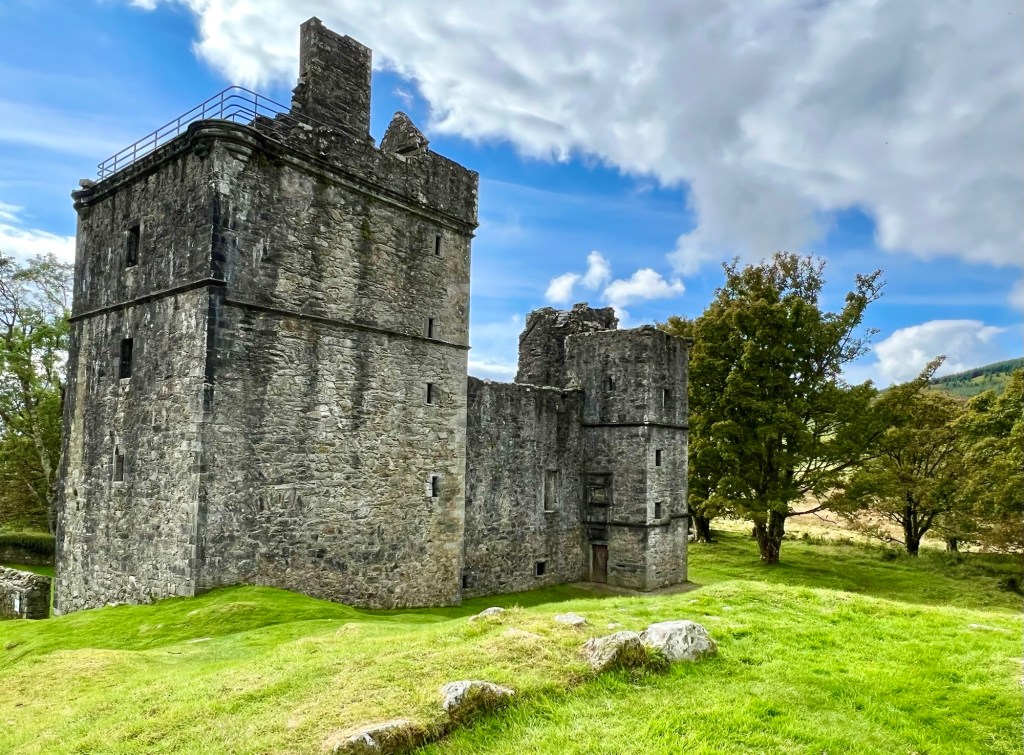
Carnasserie Castle is a fascinating historical site located near Kilmartin in Argyll. Though now a partially ruined structure, the castle tells stories of religious reform and rebellion.
We explored the castle back in 2022 during a trip to Argyll and Bute, a region on Scotland’s west coast.

It was a steep walk up the path towards the castle. But as it came into view, we couldn’t help but be impressed.
Carnasserie is a grand, imposing structure that sits in beautiful surroundings.
It was built in the 1560s by John Carswell, a prominent figure in Scotland’s Protestant Reformation and later becoming the Bishop of the Isles. Carswell is perhaps best known for publishing the first book printed in Gaelic, Foirm na n-Urrnuidheadh, a translation of John Knox’s Book of Common Order (1567). This was the first book printed in any Gaelic language, promoting Protestant prayer among Gaelic speakers. He also worked to dismantle Catholic practices and establish Reformed doctrines across his diocese.

The castle was designed not just as a residence but as a statement of power and refinement. Unlike many fortified structures of its time, Carnasserie Castle incorporated Renaissance influences, including large windows, ornamental carvings, and a sophisticated layout. These features set it apart from traditional tower houses, which prioritised defence over comfort. That said, it is still well defended, featuring a parapet walk, corralled angle turrets and gun loops around the building.
The layout comprises a keep or tower on the edge of the slope, with a domestic range of three stories running west and terminating in a tower stair and entrance door projecting to the northwest.
It is believed that John Carswell had been inspired by the work of the masons used by James V at Stirling where he had served as Chaplain.

Following Carswell’s death in 1572, the castle passed in 1643 to the Campbells of Auchenbreck. John Campbell of Ardkinglas, who was implicated in the murder of Campbell of Cawdor, was imprisoned and tortured in the castle.

But one of the most dramatic chapters in Carnasserie Castle’s history occurred during the Earl of Argyll’s Rising in 1685. This rebellion was led by Archibald Campbell, the 9th Earl of Argyll, against the Catholic King James VII of Scotland and II of England. The uprising sought to restore a Protestant ruler in Scotland.

Carnasserie Castle, being a Campbell stronghold, became a focal point during the rebellion. However, the rebellion lacked widespread support among Covenanters, ultimately contributing towards its failure. After the rebellion was quashed, the castle was captured and partially destroyed by royalist forces. The damage inflicted during this period marked the beginning of its decline.

Today, Carnasserie Castle is managed by Historic Environment Scotland and is free to enter. Visitors can explore the castle’s well-preserved ruins, including its towering five-story tower house and hall, and take in stunning views of the surrounding Kilmartin Glen. There is a car park below the castle, just off the main A816. However, it is a steep 550 metre uphill walk to reach the castle. The path also passes through farmland so keep dogs on a lead and respect the Scottish Outdoor Access Code.
There are no facilities (toilets or refreshments) on site, so for these you are best visiting Kilmartin village, 2 miles (3.2 km) south of the castle.
The castle’s location in Kilmartin Glen adds to its historical importance. The glen is home to one of the most significant concentrations of Neolithic and Bronze Age monuments in Scotland, making a visit to Carnasserie Castle part of a broader journey into Scotland’s ancient past.
Sources:




 Thistle & Time
Leave a comment