

Crichton Castle’s is an impressive ruin that sits on a hill overlooking Tyne Water and the beautiful Midlothian countryside. It’s a shame walls don’t have ears because over the years, different occupants of the castle were involved in or linked to some pretty awful incidents. Indeed, although significant events didn’t take place at the castle, its connection to powerful people associates it with some of Scotland’s darkest episodes.
The castle’s history begins in the late 14th century when it was originally built by John de Crichton, a loyal supporter of Robert the Bruce, King of Scots. The Crichton family quickly rose in prominence, and by the early 15th century, John’s son, Sir William Crichton, had become one of the most influential figures in Scotland.

Sir William Crichton was appointed Lord Chancellor of Scotland in 1439, a position of immense power. This period, however, was fraught with political turmoil, particularly in the struggle for influence over the young King James II. Crichton Castle became a centre of power, but also a place of betrayal.

In 1440, Sir William is said to have orchestrated the infamous “Black Dinner”. Alarmed at the significant power and influence of the Douglas family, William and his ally Alexander Livingstone set up a dinner for the 16 year-old Earl of Douglas and his younger brother with King James II at Edinburgh Castle. This was after hosting the brothers first at Crichton Castle. During the dinner in Edinburgh, the Douglas brothers were seized and then executed following a mock trial.

Some historians question the details and motive behind the black dinner, arguing that the Douglas brothers were simply too young to be a political threat, and that a more likely explanation is that their great uncle, James, Earl of Avondale, was behind it in order perhaps to get his hands on the Douglas lands.
Following the “Black Dinner,” Crichton’s fortunes initially declined. In 1444, he was forced from office as Chancellor of Scotland. However, he eventually regained favour with James II, receiving the title of Lord Crichton.
But forty years later, allegations that the 3rd Lord Crichton was plotting against King James III led to the family’s fall from grace and the castle being forfeited. in 1488, Patrick Hepburn was made Earl of Bothwell and received Crichton Castle as part of his holdings.

Crichton Castle stayed with the Hepburn family and ultimately, passed to James, the 4th Earl of Bothwell. Many years later it was this Bothwell who provided the link between Crichton Castle, political intrigue, and even murder at the highest level, leading ultimately to the beginning of the end for a young Queen of Scots .
At this time in the 16th century, Mary of Guise was regent of Scotland, ruling on behalf of her daughter Mary, Queen of Scots, who was still in France. Her pro-French, pro-Catholic policies (at a time when protestant reform was gaining ground) set the stage for religious tensions that would affect her daughter’s reign. The Earl of Bothwell, although a non-practicing protestant himself, gave his support to Mary of Guise in opposition to the many powerful Scottish noble families.

By the time Mary Queen of Scots returned from France in 1561, Scotland was a protestant country. Being catholic herself, she was careful not to stir matters and pursued pragmatic religious policies.
In 1562 Mary stayed at Crichton Castle for the wedding of her half-brother, Lord John Stewart, to Jean Hepburn, Bothwell’s sister.

But Bothwell later became a suspect in the murder of Mary’s then husband, Lord Darnley in 1567. Later that year, in May, he married Mary and this intensified political tensions with other Scottish nobles. They rose up against them both, and this led to Mary’s eventual abdication following her surrender at Carberry Hill later that year.

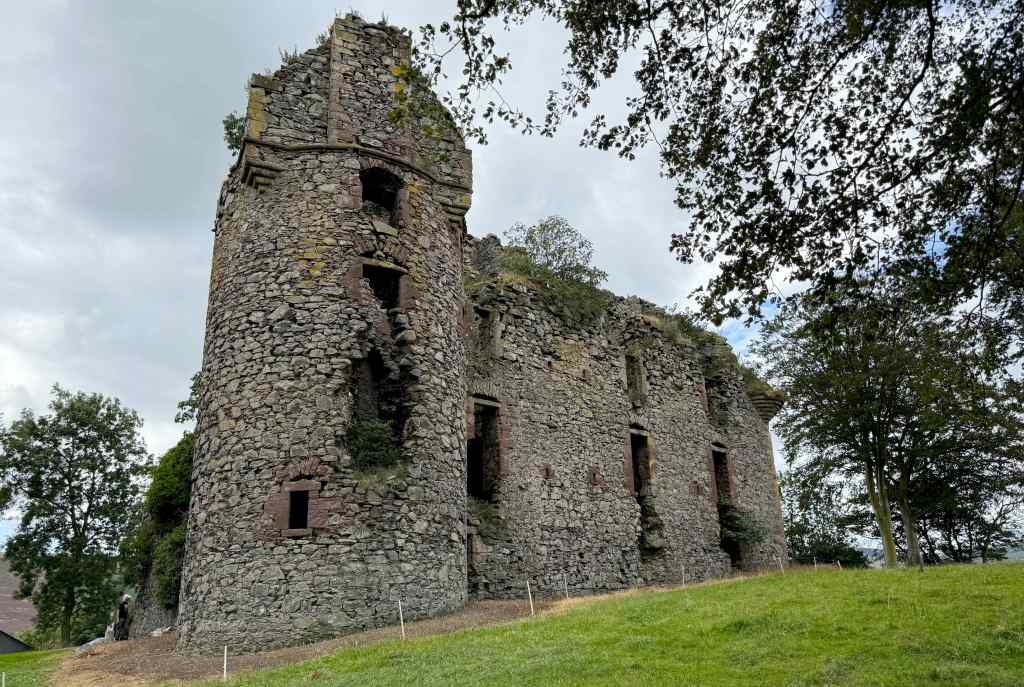
As for the castle’s structure, it remains impressive even as a ruin. It is certainly large. The castle’s original tower house was expanded significantly in the 15th century. But it was Bothwell in the 16th century who was responsible for the most distinctive architectural feature of the castle: the Italian-inspired internal façade that overlooks the River Tyne. Unfortunately, at the time of our visit, access inside the castle was not possible (see below) so we didn’t get to see it for ourselves.

Crichton Castle is located about 12 miles (19 km) south east of Edinburgh. It can be reached by car from Pathhead or Gorebridge, and there is a small car park near the Collegiate Church (which dates from 1449 and was built by Sir William Crichton). There is a 500 metre walk from the car park to the castle on rough ground, so good footwear is advised.
The castle is managed today by Historic Environment Scotland and an entrance fee would normally apply. However, currently the castle is closed for conservation work so there is no access inside.

Sources
Historic Environment Scotland and the Official Souvenir Guide
The Centre for Scottish Culture


 Thistle & Time
Leave a comment