
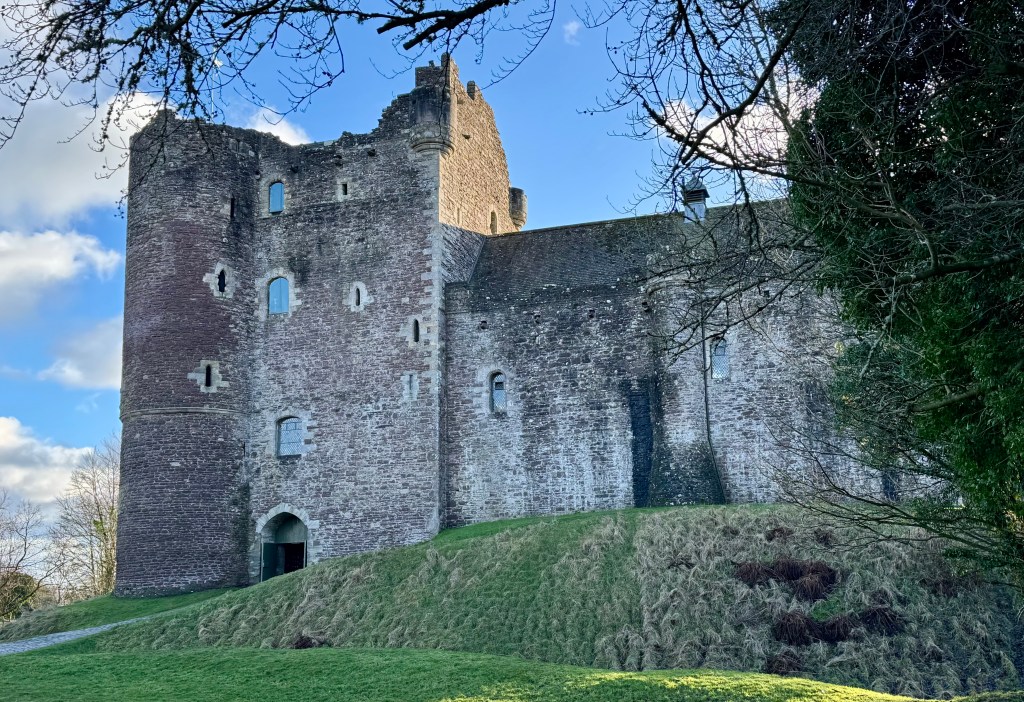
If your father is the king, then power, fine living, and castles will seem normal. So when in 1361 Robert Stewart, younger son of King Robert II, acquired the lands (through his marriage to Margaret Graham, Countess of Menteith) it was no surprise that Doune Castle became one of Scotland’s most important centres of wealth and power.
Today, this impressive stronghold near the village of Doune in the Stirling regional council area offers visitors an authentic taste of Scottish medieval heritage. With its imposing towers and walls , it is remarkably well preserved for a castle of its age.
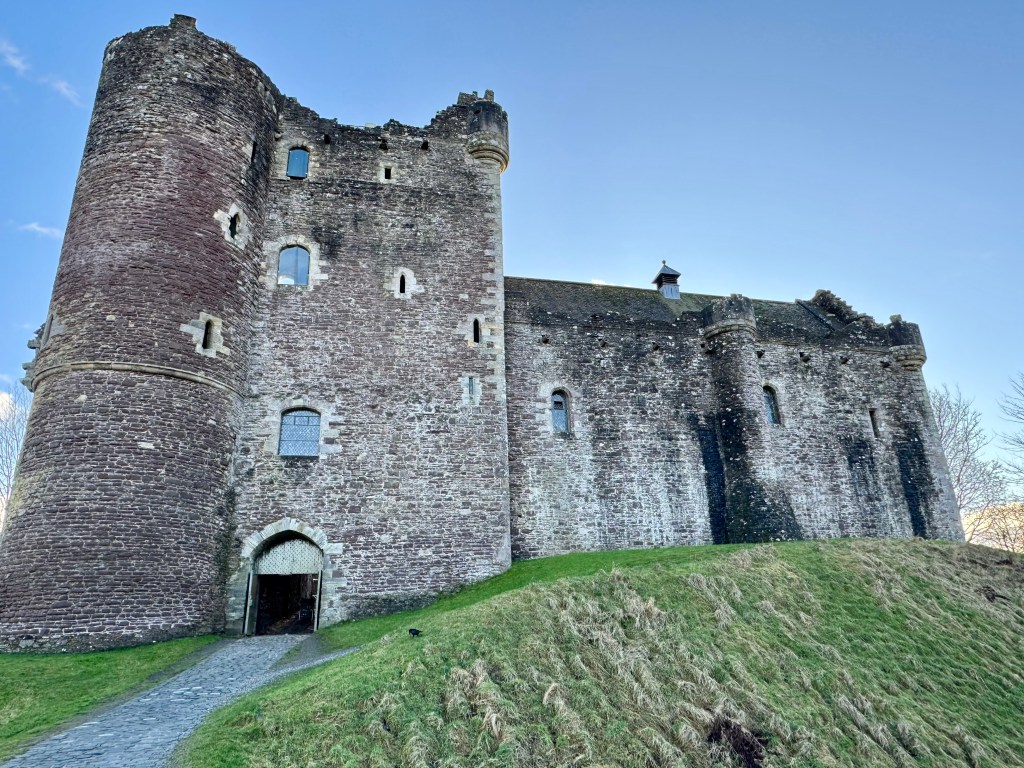
Due to an ever-present risk of hostilities with England, Robert Stewart needed to protect his property. So the castle occupies a strong defensive position at the confluence of the River Teith and the Ardoch Burn. It is situated on a wooded bend where the two waterways meet, with steeply sloping ground providing natural defences on three sides. This advantageous position, located just 8 miles (13 kilometers) northwest of Stirling, places the castle near the geographical centre of Scotland at a historically significant crossroads between the Highlands and Lowlands.
At the time, politics in medieval Scotland was fraught with changing power relationships. Some might even describe it as toxic.
In 1384 Robert’s eldest brother, John, Earl of Carrick (the heir apparent), grew impatient and engineered a transfer of power to himself that effectively removed the king from authority in all but name. This was enabled by the king’s declining health. But in 1388 John suffered a serious injury from a horse’s kick. Seeing an opportunity, Robert Stewart used this to upstage his brother and become guardian of Scotland, effectively making him the “uncrowned king”.
Then in 1390, King Robert II died, and as the rightful heir, John became King of Scots (taking the name Robert III). But his younger brother Robert Stewart continued to be powerful, keeping significant control over government, and was made Duke of Albany in 1398.
As Duke of Albany, Robert Stewart was considered highly effective by his contemporaries. However, he was associated with the death in 1402 of his nephew, David, Duke of Rothesay (eldest son of Robert III). As heir to the throne, Rothesay had been acting with increasing force and independence. It is believed that Albany and others engineered Rothesay’s arrest and he was imprisoned at another of Albany’s castles, Falkland, where he later died.
With suspicious circumstances surrounding David’s death, Robert III was concerned about the safety of his other son, James (now heir to the throne). James was all that stood in the way of the royal line transferring to the Albany Stewarts. Robert III therefore sent young James to France for protection. But en route, James was captured by the English and would remain their prisoner for 18 years. A month later in 1406 Robert III died and Albany was again made Governor, putting him back in control of Scotland.
Albany did try to secure Jame’s release, but quite how hard he tried we will never know. But while the future king remained in an English prison, Albany was able to consolidate his position as governor.
During this period, Doune Castle served as one of Albany’s primary seats of power and a visible symbol of his authority. It is reported that he spared no expense in the construction and furnishing of Doune Castle. This extravagance reflected the understanding of that time that a ruler’s power and authority were partly demonstrated through visible displays of wealth and architectural grandeur.

Following Albany’s own death in 1420, Doune Castle, along with the dukedom of Albany and the Regency, passed to his son Murdoch Stewart. But this transfer of power proved short-lived. The captive King James I finally returned to Scotland in 1424 after payment of a ransom to the English, and moved swiftly to assert his authority. He imprisoned Murdoch Stewart and two of his sons for treason before executing them in May 1425.
With these executions, Doune Castle became a royal possession, placed under the control of an appointed Captain or Keeper who would oversee the property on behalf of the crown. It became a royal hunting lodge and then later, a residence for the widows of the kings James II, James III and James IV.

In 1570 Doune Castle experienced a siege when its keeper, James Stewart, who had become a supporter of Mary Queen of Scots following her abdication, refused to hand over the castle. He surrendered after three days on condition that the castle was not destroyed. At this point Doune then became a prison for Mary’s supporters.
Many years later, during the 1689 and 1715 Jacobite risings Doune Castle was garrisoned by British government troops, but in the 1745 rising, it was held by the Jacobites to house government prisoners.
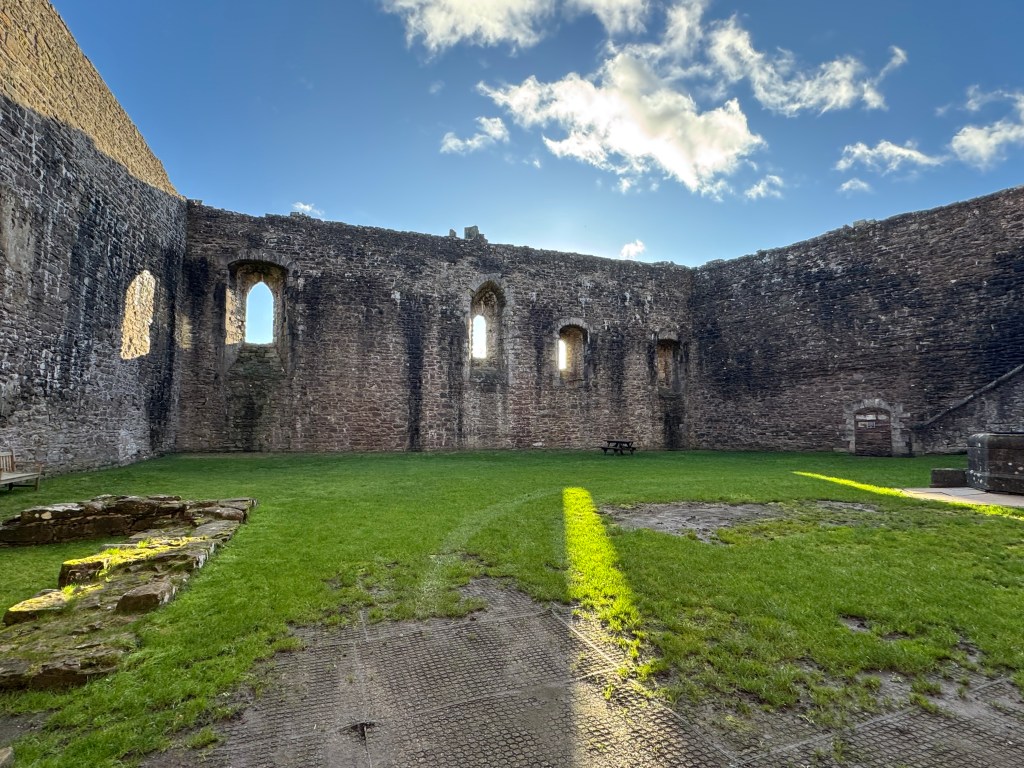
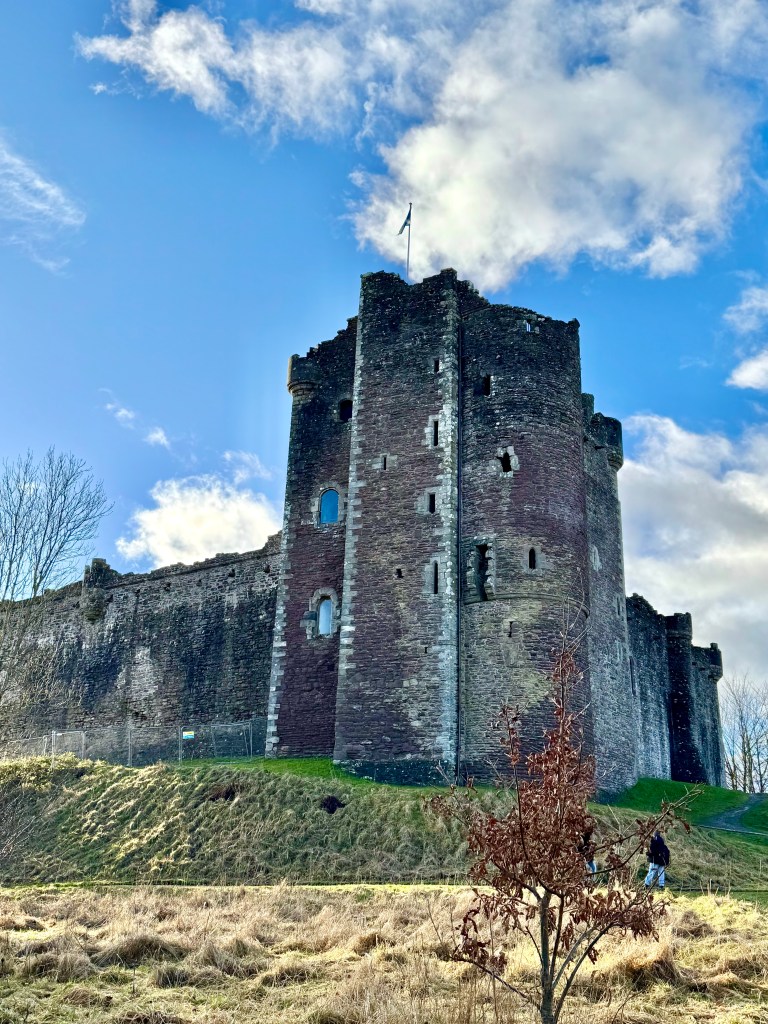
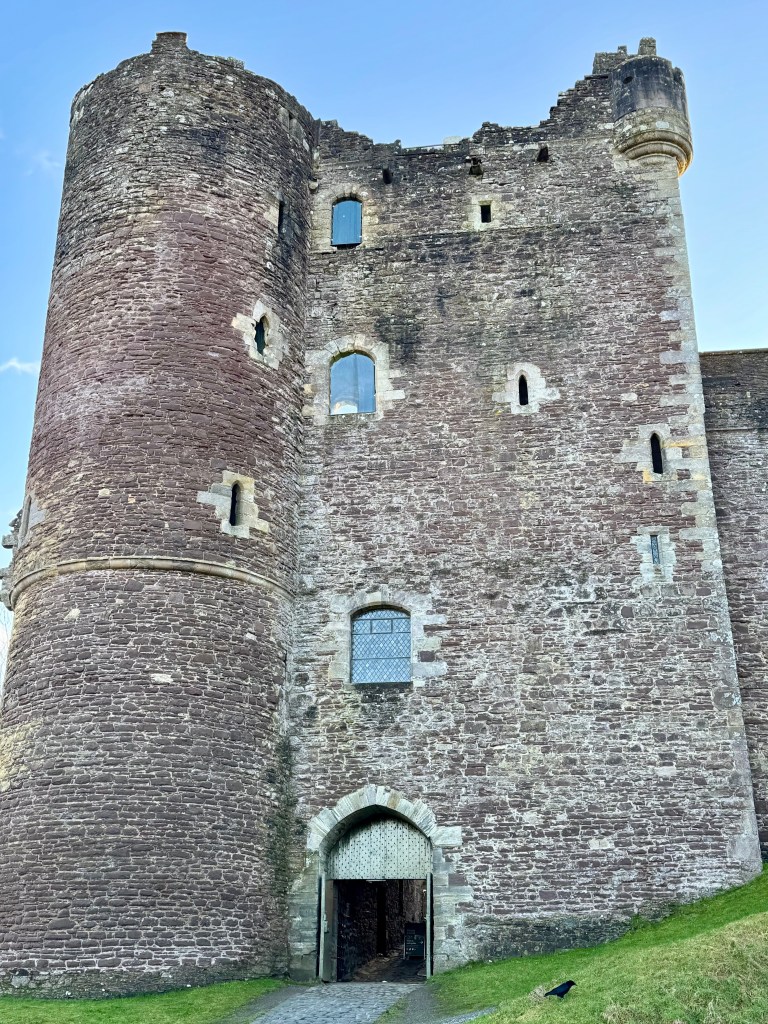
The current structure of Doune Castle largely dates from the late 14th century. It features two primary towers linked by a range of buildings. The larger of these, the gatehouse or lord’s tower, contains the castle’s main entrance passage and rises to five stories with a gabled garret within a flush parapet. This imposing structure housed the duke’s private apartments and administrative spaces, demonstrating the dual military and residential functions of the castle.

After entering through the gatehouse, today’s visitors see a large grassed courtyard. However, In Albany’s day the courtyard would most likely have had a dirt and cobbled floor; and evidence suggests there were probably buildings along the east and south sides.
The second major tower, the kitchen tower, stands at the western end of castle and provided culinary facilities as well as additional high-status chambers on its upper floors.
Between the two towers is the great hall, the ceremonial heart of the castle and the setting for formal gatherings, feasts, and the administration of justice.
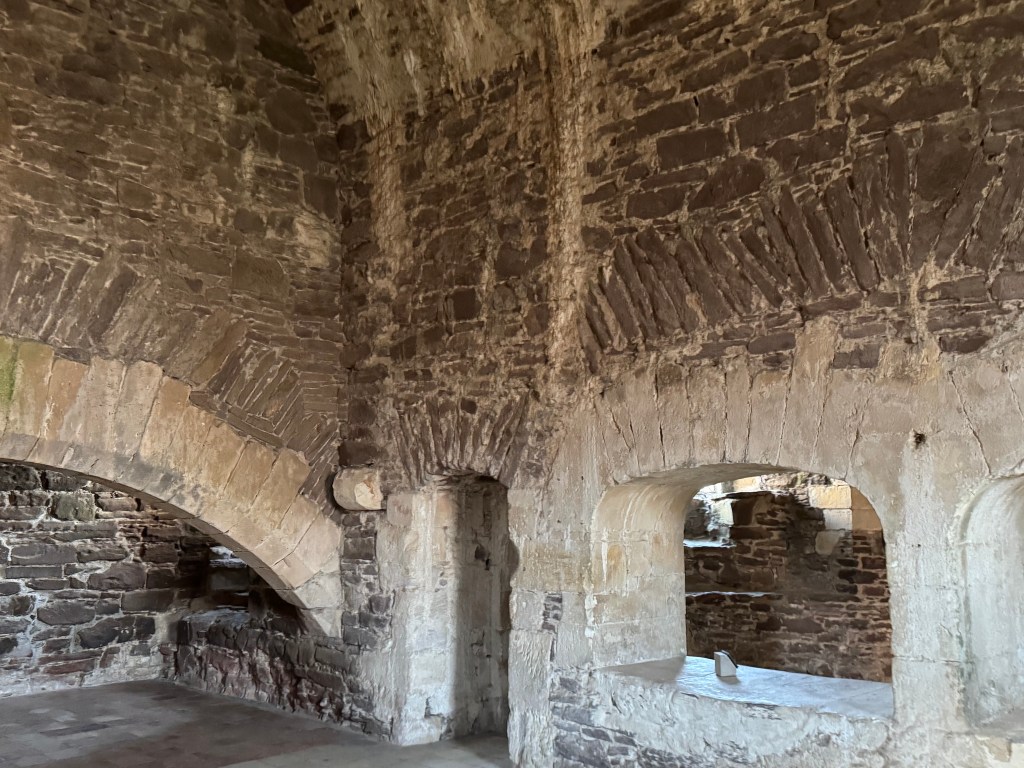
The great hall is the largest room in the castle, and it would have been lavishly furnished back in the early 1400s. The hall was restored in the 1880s and much of what can be seen today dates from then. The roof beams are supported by corbels carved with a variety of faces, some of which are the medieval originals.

Minstrels would have provided entertainment for those dining in the great hall, but more importantly, their playing announced meals were being served.

Next to the great hall is the duke’s hall. Located in the gatehouse tower, this would have provided a more private dining space, as well as a place where the duke could conduct business or meet guests. As with the great hall, the decor dates from the 1880s, and likely looked much different back in the 1400s.
While many Scottish castles developed piecemeal over centuries, resulting in a mixture of styles and approaches, Doune’s main structures were largely completed within a single building campaign, providing a good example of the architectural thinking of the period.
During the 1800s, Doune Castle became increasingly ruinous but due to interest from tourists, some restoration work was carried out in the 1880s. But in recent years it is not just the public who have shown an interest in this castle. In 1975 it provided a location for the comedy film Monty Python and the Holy Grail. More recently, it was used for the pilot of Game of Thrones by the US network HBO.
But perhaps is greatest role was as Castle Leoch in the TV series Outlander. It is regularly visited by fans of the show, and the castle’s shop sells a number of Outlander themed souvenirs.

Doune Castle is managed by Historic Environment Scotland and is open to the public throughout the year. Entry fees apply. If you are travelling with dogs, please remember that they are not permitted inside the castle itself (but assistance dogs are welcome). There is a car park accessed by a one-way system but motorhomes, campervans and caravans cannot be accommodated. If arriving from the east on the A820, beware of the extreme sharp left turn you need to make just before the castle. More details about getting to the castle, including public transport links, can be found on the website.
An audio guide featuring Monty Python’s Terry Jones and Outlander’s Sam Heughan is available free with your entry ticket. Decent walking shoes are advised as the ground is uneven. There is also a very pleasant woodland walk that will take you around the castle grounds and along by the river.
Sources:
Historic Environment Scotland Doune Castle Official Souvenir Guide
Historic Environment Scotland website


 Thistle & Time
Leave a comment