

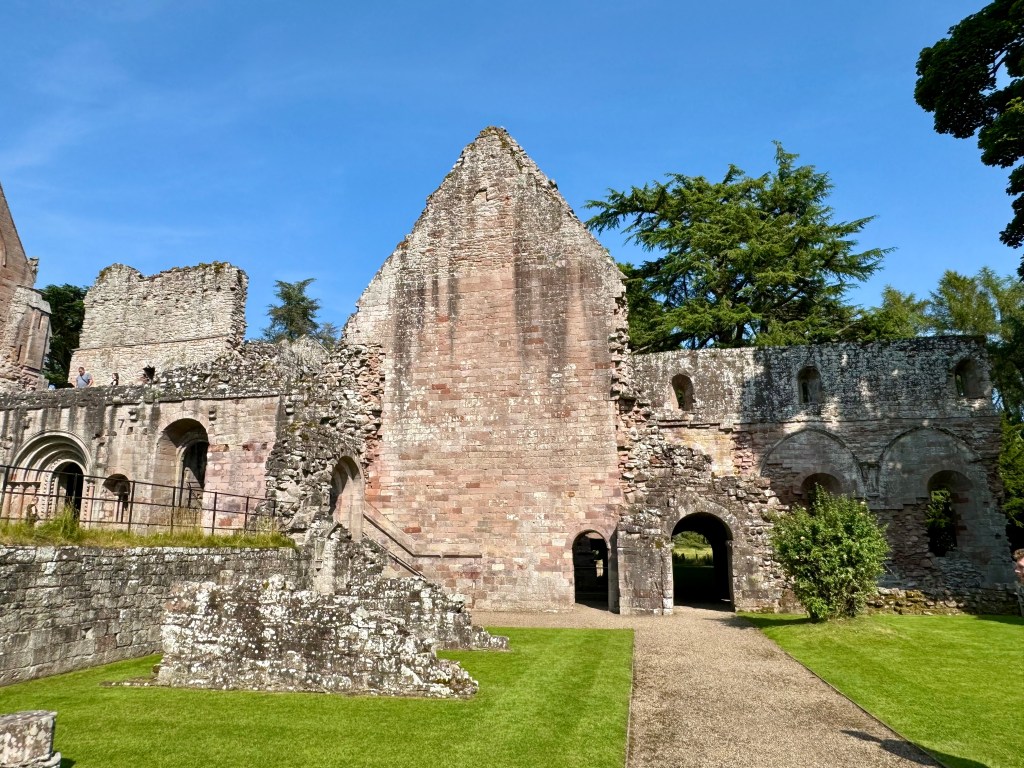
On the banks of the River Tweed, in a wonderfully secluded and picturesque location near St. Boswells in the Scottish Borders, are the ruins of Dryburgh Abbey.
It is one of four such abbeys within a 20 mile (32km) radius of each other, making up the Borders Abbey Way (the other three are at Melrose, Jedburgh and Kelso).
Dryburgh Abbey was founded in 1150 by Premonstratensian canons, an order of monks also known as Norbertines, at the invitation of Hugh de Moreville, Lord of Lauderdale and High Constable of Scotland.

The abbey followed the same architectural principles as other monastic orders, with a cruciform church and surrounding monastic buildings for daily life, work, and worship. It prospered during the medieval period, becoming an important spiritual and economic centre in the Scottish Borders along with nearby Melrose Abbey. Its monks engaged in agricultural work and managed vast estates, contributing to the local economy and fostering a close relationship with the surrounding community. However, it was never as wealthy or influential as neighbouring abbeys.

Like many religious sites in the Borders region, Dryburgh Abbey suffered heavily during the Wars of Scottish Independence and later Anglo-Scottish conflicts. It was seriously damaged by the English in 1322 when Edward II’s soldiers turned back to set fire to Dryburgh, having heard its bells ringing out as the English army retreated. It was rebuilt with the financial assistance of Robert the Bruce.
But then in 1544 when English troops mounted a cross border raid as part of the “Rough Wooing“, it was all but destroyed along with the village of Dryburgh itself.

A decade and a half later, the Scottish Reformation marked the beginning of the abbey’s decline. With the dissolution of monastic orders and the shift in religious practices, the abbey was abandoned by the monks. Over the centuries, it fell into ruin, with some stonework being taken for other building projects in the area.

Much of what we see today comes from the 12th and 13th centuries. Interestingly, most of the abbey’s church has been lost to war and fire, but the chapter house and dormitories of the monks remain in place.
In the 1700s, the ivy-clad ruin attracted the attention of David Erskine, 11th Earl of Buchan and chief founder of the Society of Antiquaries of Scotland. Buchan bought Dryburgh House and set about creating a charming landscape in which the ancient abbey figured prominently. When he died in 1829, he was laid to rest in its sacristy.

Sir Walter Scott, the famous novelist, and Buchan’s close friend, was buried here three years later, on 26 September 1832. His tomb is in the north transept (which he called ‘St Mary’s Aisle’).
The grounds are home to a collection of very old trees, including a 900 year-old Yew tree. Together with the ruins, these are roosts for three species of bats: pipistrelle, daubenton’s and brown long-eared.
Of course no historic ruin in Scotland is without its myths and legends. At Dryburgh Abbey the spirit of a young woman is said to wander the the grounds. She had drowned herself in the Tweed after her lover, a monk, was executed when the affair was discovered.
Another story tells of a woman made homeless after the 1745 Jacobite uprising who took up residence in the abbey ruins. She was kept company by a ghost called “fat lips” who used to look after her improvised home whenever she was away.

Today Dryburgh Abbey is managed by Historic Environment Scotland. It is open all year (except for Christmas and the new year period) and entrance fees apply. With its secluded position, there is no direct access from the main A68 trunk road. It is necessary drive through St. Boswells on the B6404 and then follow the signposts on the B6356. There is car parking and a shop selling entry tickets, guide book and souvenirs.
Walking through the ruins it is easy to imagine life all those hundreds of years ago. It is certainly a fitting place for quiet contemplation.
Sources:
Historic Environment Scotland website
Historic Scotland magazine, Autumn 2024


 Thistle & Time
Leave a comment