
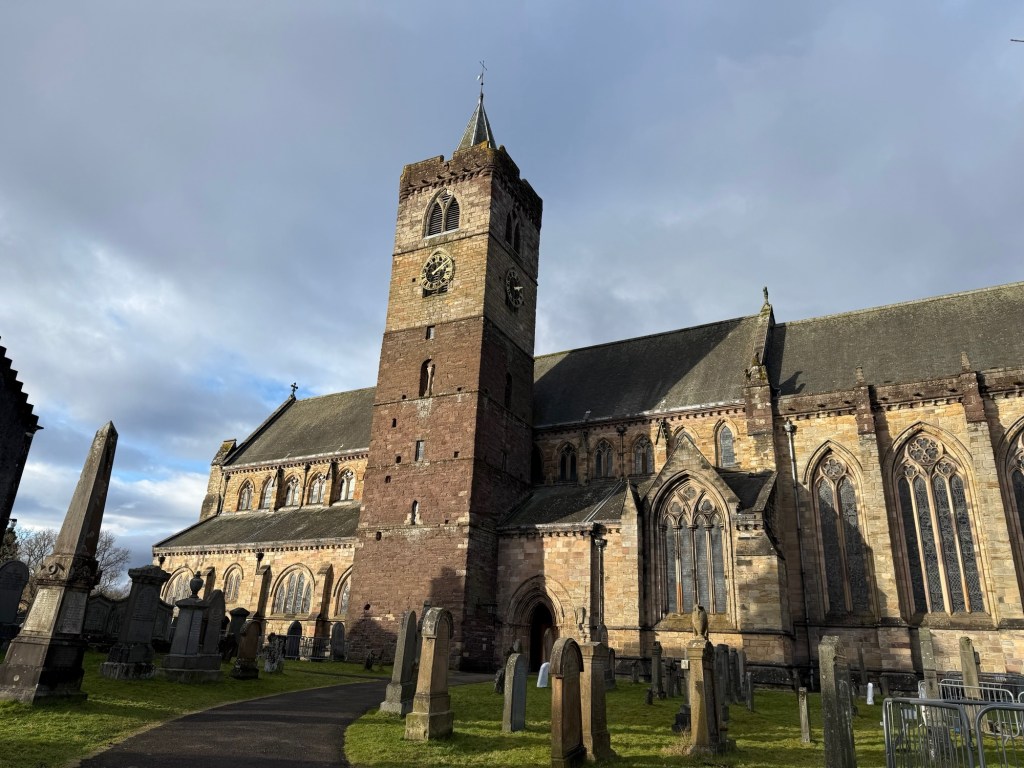
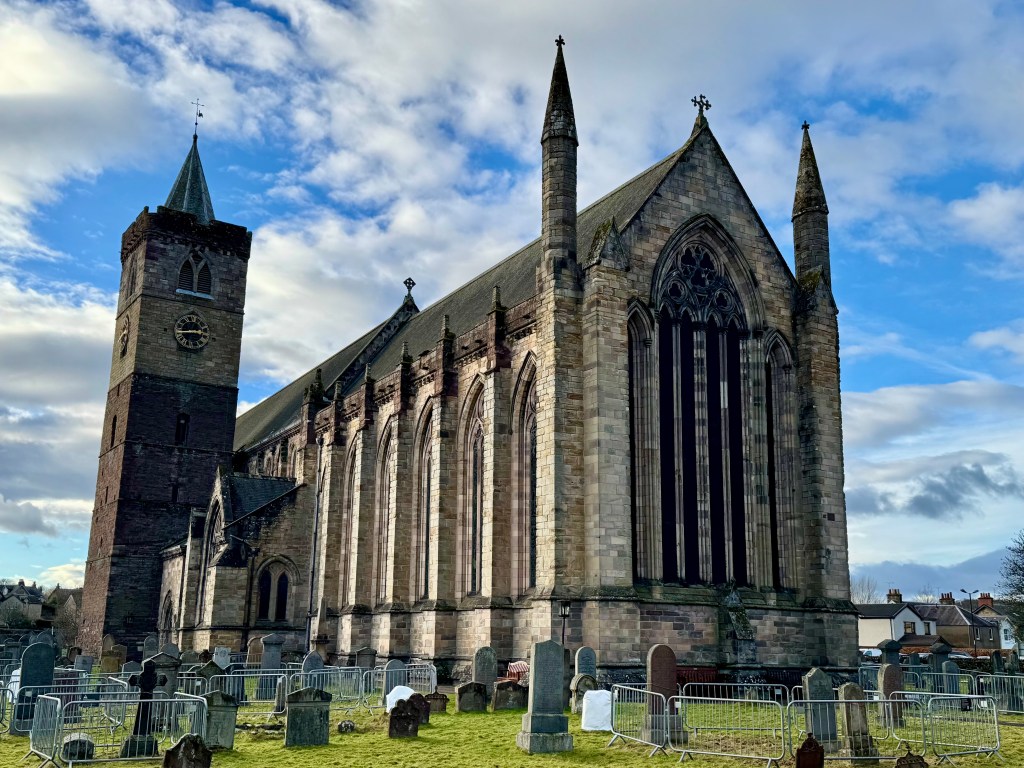
Dunblane Cathedral, near Stirling in Scotland, has a thousand year history. Its earliest stones were laid in the 11th century, yet it is still in use today. Restored in the late 1800s and early 1900s under the guidance of Sir Rowand Anderson, it retains the name of Cathedral only in recognition of its earlier role. These days it operates as a Presbyterian parish church.

As you enter the cathedral into the nave, you get a sense of the work involved in the building’s restoration. It is spacious, with aisles and a galleried clerestory (upper part containing windows). Magnificent arches line the aisles.
Interestingly, the nave is home to two early cross-slabs (perhaps Pictish in origin), suggesting that a much earlier religious community existed on or near the site chosen for the cathedral. In one corner you will also find the Great and the Lesser bells. These date back to 1612 and 1687 respectively. They were replaced in 1908 when a new clock face was fitted in the tower.

To the right of the entrance is the chancel. Choir stalls here date from 1429-47, while the stained glass windows, installed much more recently, were designed by renowned artists including Charles Eamer Kempe and Louis Davis.

The main structure of the cathedral was built back in 1237, when Bishop Clement secured the Pope’s approval to build a new cathedral. The red sandstone bell tower is the oldest surviving complete section of the cathedral. It was heightened between 1487 and 1526 by Bishop James Chisholm. This can be seen by the lighter dressed stone that has been used.

By the 1550s Dunblane Cathedral would have been full of ornate statues, paintings and stained glass windows. And over the years, its bishops would have been important figures locally and beyond, even advising Scottish monarchs. Michael Ochiltree for example, who was bishop between 4 July 1430 and 12 April 1431, was an ally of Robert III and was appointed chief almoner by James I. Following James I assassination, he officiated at the coronation of James II, placing the crown on the young kings head.

Sadly the opulent decorations and connections to royalty didn’t last. Following the Scottish Reformation, when all symbols of Catholicism were purged from the cathedral, the nave fell out of use, leading to the collapse of its roof. Public worship was confined to the chancel, and for 300 years the stone pillars were open to everything the Scottish weather had to offer. Today their weathered look adds to the aesthetic.

When plans were drawn up to restore the cathedral, there was opposition, with John Ruskin arguing that restoration “would be the most vulgar brutality Scotland has committed since the Reformation.” The plans were amended in light of his objections and the restoration project began in 1889.

With so much destroyed during the Reformation, much of the cathedral’s interior furnishings were installed following this restoration. This includes three lines of heraldic shields along the roof timbers, and the carved canopied stalls in the choir. A new organ was installed as recently as 1990.

Dunblane Cathedral is the burial site for some significant historical figures. These include Margaret Drummond and her sisters Euphemia and Sibylla. Margaret was a mistress of King James IV of Scotland. Plaques in the chancel say that she and her sisters were reportedly poisoned in 1501 after Margaret secretly married James IV. Other notable figures at rest in the cathedral include the previously mentioned bishops Clement and Ochiltree.

In the chapter house, leading off the chancel, are memorials to those who died in the two World Wars. A more recent tragedy is commemorated in the nave, where a stone was unveiled in 2001 to honour those affected by the events at Dunblane Primary School on 13 March 1996.

We visited the cathedral at the end of January 2025 on a bright but cold afternoon. We were welcomed by a volunteer from Historic Environment Scotland who gave a brief summary of the cathedral’s restoration and what we would see.
I’m not religious myself, but I do find old buildings like this fascinating, especially when they come with so much history. Walking around it was easy to appreciate the skill of the work undertaken first to build, and then later restore the cathedral. The historical perspective added to my experience and understanding.
There was lots to take in, more than I can cover in this short blog post, but it was definitely time well spent.

The Cathedral is located in the centre of Dunblane. There is only limited parking nearby and time restrictions apply. However, there is further parking at Mill Row down by the river. There is no entrance fee but to help with the cathedral’s upkeep, a donation is appreciated. Although the Church of Scotland is responsible for the religious workings of the cathedral, the fabric of the building is maintained by Historic Environment Scotland. As the cathedral is a working church, opening times may vary due to services and events.
Sources:
Historic Environment Scotland Official Souvenir Guide




 Thistle & Time
Leave a comment