

Imagine living where invading armies and raids from your neighbours were a daily threat. But back in the 15th and 16th centuries, life along the Anglo-Scottish border was anything but peaceful. So those with the money built strong defensive homes such as Cessford Castle.

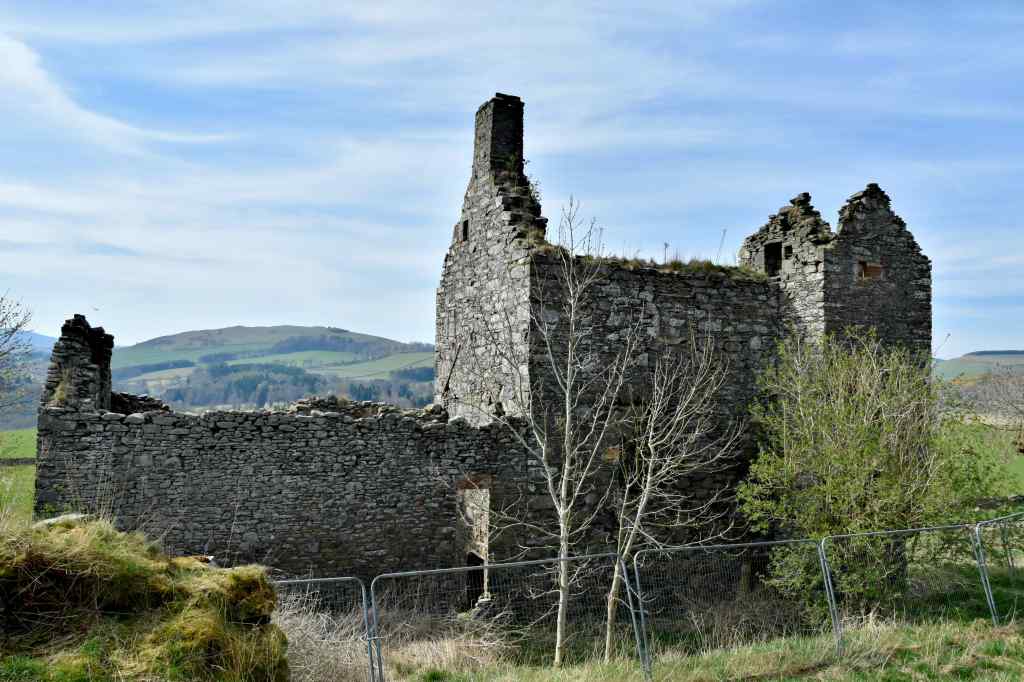
This striking ruin sits on a prominent hill some six miles (9.6 km) south of Kelso in the Scottish Borders. In its day Cessford was a large, L-plan castle rising to three storeys in the main block and four in the wing. The interior space within the main walls measured 39 feet long by 20 feet broad, (12 by 6 metres) providing living quarters for the family, their servants, and a garrison of up to 60 soldiers. Most of these troops would have been accommodated in the courtyard area surrounded by the barmkin (defensive wall) rather than in the main keep itself.

Built to withstand artillery, its massive defensive walls were some 12 feet (3.6 m) deep; and they were certainly put to the test. The castle suffered from frequent English invasions. It was attacked in 1519, burnt in 1543, and attacked again in 1544.
Most famously, it was besieged by the English Earl of Surrey in 1523. He was the man who had defeated the Scots at the Battle of Flodden just 10 years earlier. On this occasion Cessford successfully held out against English artillery until the defenders negotiated its surrender and their safe passage.
But that wasn’t the end of it. The castle was again attacked by the English in 1545, during Henry VIII’s campaign of “rough wooing“.

It’s believed that Cessford Castle was constructed by Andrew Ker (which today would be spelt Kerr) in the 1450s. The Kers were a powerful family of notorious Border Reivers. Cessford was their main stronghold in a network of fortified houses. As was normal for the time, they would steal livestock and goods from others on both sides of the border, using blackmail and violence when necessary.

The Kers also held political power, with some serving as Wardens of the Middle March. Paradoxically this would have given them authority to suppress reiving, something they ignored or exploited to gain advantage over rivals .

But it wasn’t just the English that caused conflict. The Ker family had a long running and bitter feud with the Scott family of Buccleuch, causing members of both families to be killed by each other.
The feud began at what became known as the Battle of Darnick in 1526. A large contingent of Scotts, Elliots and Armstrongs clashed briefly with the 6th Earl of Angus, Archibald Douglas. The aim was to free the young King James V from Douglas influence. Angus was backed by the Kers and Homes.

The Scotts were repelled but one of their supporters killed a leading Ker, sparking bitter enmity between the families. Despite attempts at reconciliation through marriage, the attacks on each other continued for the best part of a century. During one such attack in 1550, the Kers set fire to properties belonging to the Scotts, burning the elderly mother of the Scott family Laird. The bitterness reached a crisis point two years later. So far the feud had been confined to the border region. But in Edinburgh 1552, a party of Kers came upon Walter Scott (Wicked Wat) and murdered him in the street.

Along with other border reivers, the Ker and the Scott family reputations as skilled horse riders made them valuable at times of war. The family’s would fight alongside each other against the English. But they would also form temporary allegiances with reivers in England, and even the English authorities when it suited them.
To complicate matters further, there were also disagreements between different branches of the Ker family itself. In 1568, the Cessford Kers backed the coalition at Langside opposing Mary Queen Scots. Meanwhile, the Ferniehirst Kers (from near Jedburgh) backed Mary, highlighting the family’s divided loyalties.
Nor were the family averse to changing their minds when it suited them. In 1545, during the “rough wooing”, the Scottish army defeated the English at Ancrum Moor in the Scottish Borders. The Cessford and Ferniehirst Kers had, for payment, taken up arms for the English, but when the battle turned in favour of the Scots, they switched sides. Because they changed sides late at Ancrum Moor, but clearly contributed to the English defeat, the Earl of Arran (leader of the Scottish forces) decided the Ker motto should be Sero Sed Serio, or “Late, but in earnest.”
The castle’s eventual decline followed the broader pacification of the Borders under James VI (James I of England). As reiving waned, the Kers transitioned to aristocratic legitimacy, with Sir Robert Ker leaving Cessford in 1607. By 1650 Cessford Castle had been abandoned.
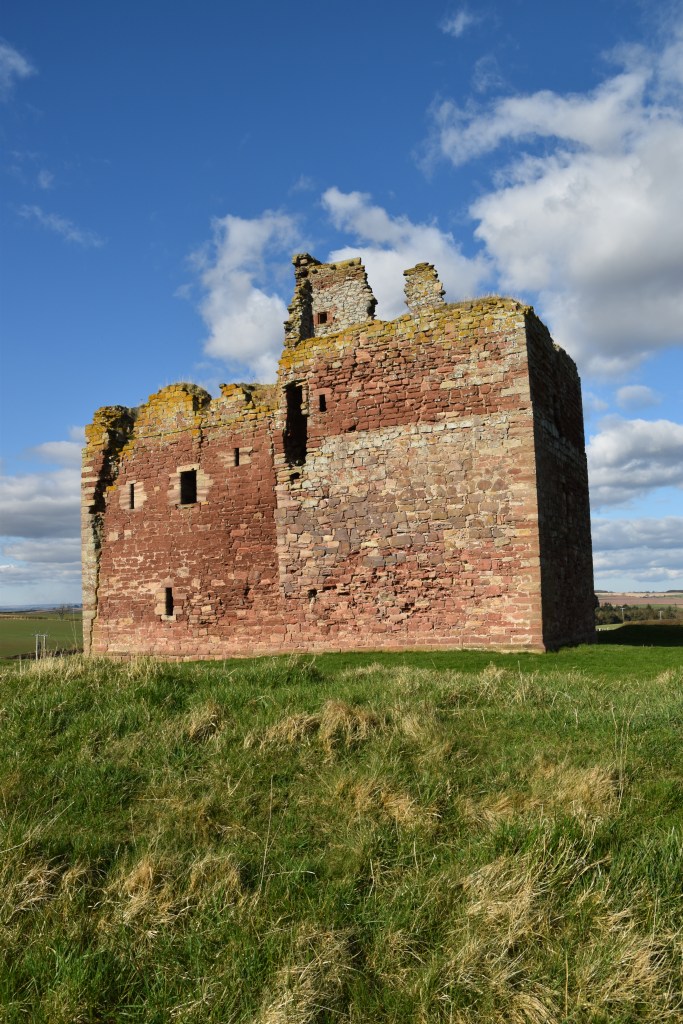
Finding the castle requires some map reading. The castle is shown on an Ordnance Survey map, but it is not signposted. I made two short trips to take these photos and have a look for myself. There is no official parking at the castle and the nearest roads are single track. There are some farm tracks nearby so it is possible to park off-road, but beware of blocking the route of a tractor. Also, the site itself is often grazed by sheep so you need to look where you are walking, keep dogs on a lead, and shut the gate.
Not surprisingly, there are no facilities at the site, the nearest being three miles (5 km) away in the village of Morebattle.

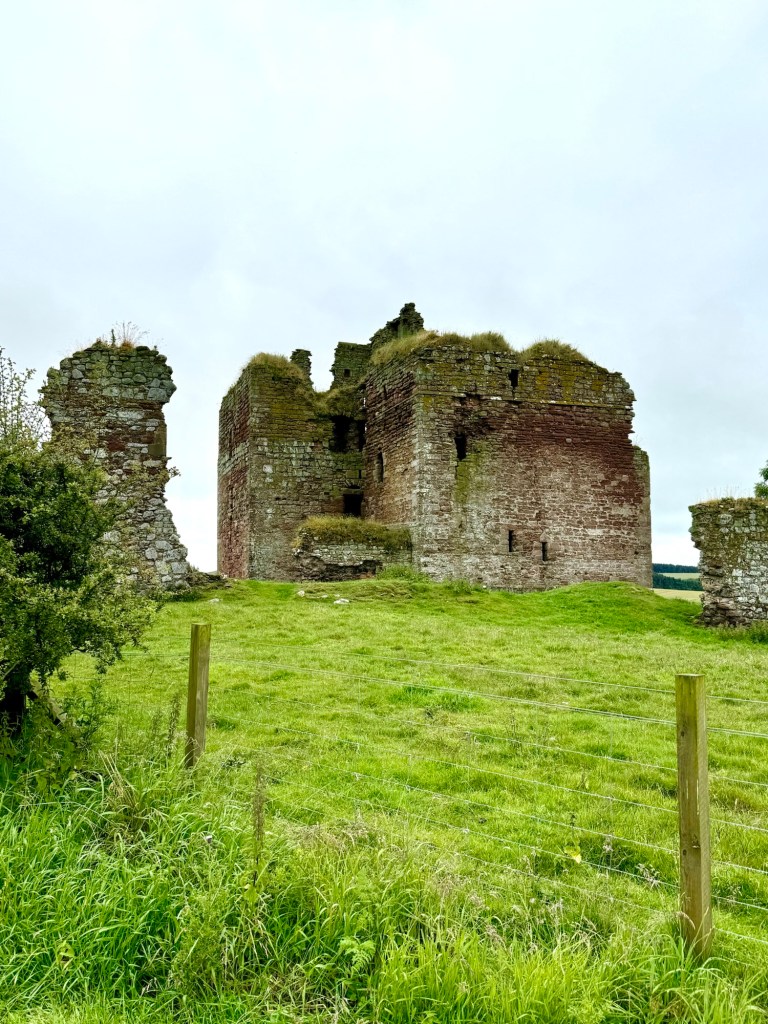
Close up, Cessford Castle certainly looks a mighty building. In its day it must have been formidable. There was a boarded up entrance, but given its state of ruin, I assume this was blocked for safety reasons. Clearly years of Scottish weather have taken their toll, and I know of no plans to try and preserve it. This is sad as there is still plenty of it to be saved.

Further reading:
Gedfrey Watson The Border Reivers 2020 Northern Heritage


 Thistle & Time
Leave a comment