
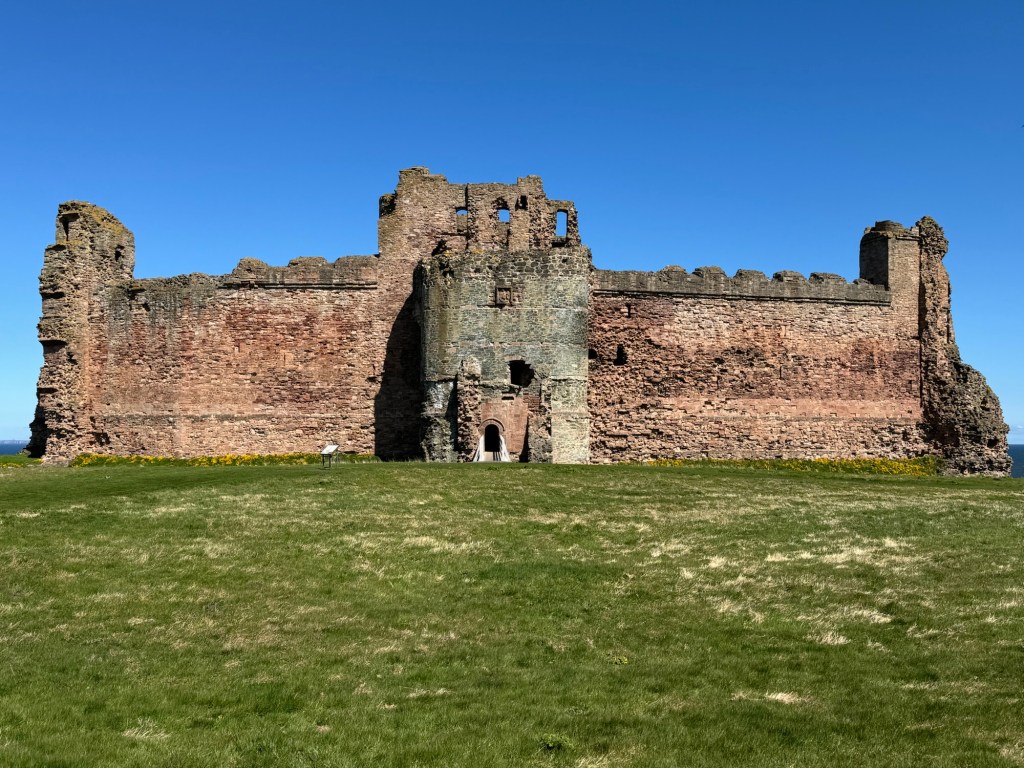
Tantallon Castle, located on a cliff top near North Berwick in East Lothian, was once a formidable fortress, and home to the Earls of Angus (the Red Douglases).
Tantallon was probably built in the mid-14th century, by William Douglas who after returning from France to reclaim his inheritance, became the undisputed head of a very wealthy family.
But when William’s heir, James, was killed at the Battle of Otterburn (during a raid into England), the Douglas inheritance was split in two. The line that became known as the black Douglases kept most of the land, but William’s illegitimate son George was given Tantallon Castle and the title of Earl of Angus, so establishing the Red Douglases.

The subsequent Earls of Angus became powerful players over the course of a century, consolidating the red Douglas lineage and influence. During this period the Earls were (mostly) loyal to the Scottish kings, with the 4th Earl having the privilege of placing the crown on the head of James III.
The castle itself played a significant role in the conflicts between Scotland and the English during the Wars of Scottish Independence.
It was besieged a number of times, most notably in 1491 by King James IV, who sought to weaken the red Douglas family, perhaps in part because of rumours about the 5th Earl’s treasonous negotiations with the English.

During the 16th century, Tantallon Castle underwent further expansions and renovations, becoming a significant stronghold overlooking the Firth of Forth.
When James IV died, it was agreed that his young heir (James V) should be cared for in turn by four different Scottish nobles who were competing for the Regency of Scotland. When the 6th Earl of Angus, Archibald, took his turn he refused to let James V go, effectively holding him prisoner for two years in Edinburgh Castle. When the young James escaped, Archibald went back to Tantallon and started improving its defences.

Not surprisingly, Archibald was charged with treason by James V and Tantallon Castle was besieged. Eventually, through negotiations James V took charge of Tantallon and set about rebuilding the castle.
Archibald returned from exile after James’ death in 1542 and aligned himself with Henry VIII of England. But while the English attacked Scotland in a period that became known as the Rough Wooing, Douglas lands were damaged, and Douglas tombs in Melrose Abbey were desecrated. This prompted Archibald to return to the Scottish side, and he led the Scots to victory over the English at Ancrum Moor. He died peacefully at Tantallon Castle in 1556
After the 8th Earl of Angus was forced into exile for supporting England, the Douglas family’s power declined, and the castle fell into disrepair. It was abandoned in the 17th century, following damage sustained during a siege of the castle in 1651 by Oliver Cromwell’s forces.
So the striking ruins we see today are the result of 650 years of war and weather. It was seeing photographs of Tantallon Castle on Instagram that led us to take a closer look one sunny but windy day last April. We weren’t disappointed.
The area in front of the castle would have housed structures essential to castle life. Much of the space here would also have been taken up with defences, including an outer ditch. Another ditch was cut through bedrock close to the castle.

The standout surviving feature of the castle is its curtain wall. It had three towers projecting from it which served as the main residential accommodation. The Mid Tower in the centre contained the entrance gateway at ground level and had four upper floors. The Douglas Tower, (see photo) was once a great seven-storey tower housing the apartments of the Earl and his family. The great Hall would have been located at the side of the castle.

Tantallon Castle is maintained by Historic Environment Scotland, attracting visitors with its dramatic coastal location and intriguing history. Entrance fees apply.
Access is to the site is from the A198. There is a small car park near the road entrance but if you continue further down the driveway (about 400 metres) a second small car park can be found near the castle shop. Suitable footwear is advised.


 Thistle & Time
Leave a comment