
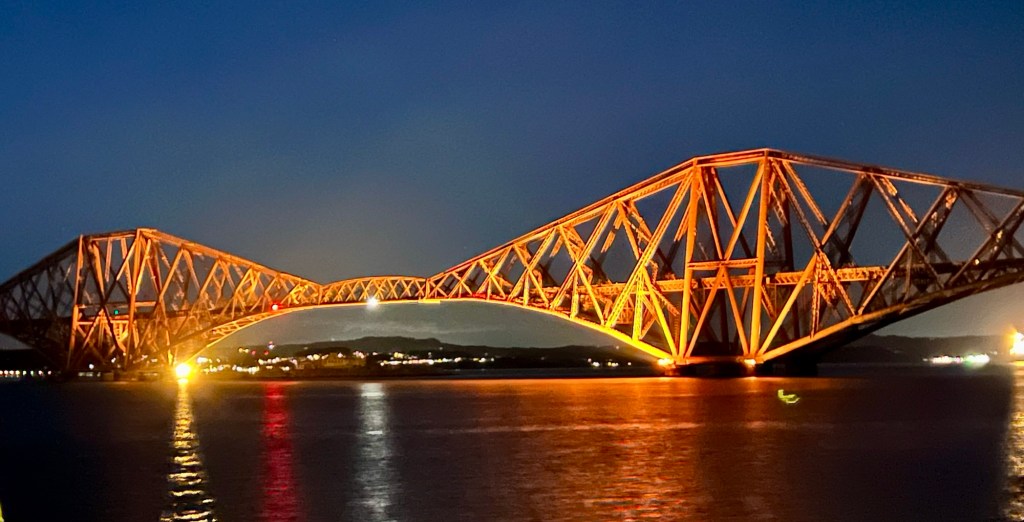
The Forth is one of Scotland’s great rivers, and just to the west of Edinburgh it is spanned by three great bridges. Each is a triumph of engineering from its respective era.
Most famous of all, and oldest, is the Forth Bridge. Next comes the Forth Road Bridge and then most recent is the futuristic looking Queensferry Crossing.

Before the bridges were built, the only way across the river was by boat. The name “Queensferry” comes from the 12th Century monarch, Queen Margaret, wife of King Malcolm III of Scotland. Renowned for her charitable work, she established a ferry service to aid pilgrims traveling to the shrine of St. Andrew in Fife. The ferry connected the two towns that today we know as South and North Queensferry. The crossing became so prominent that the name “Queen’s Ferry” endured.

The Forth Bridge, a red cantilever railway bridge, was completed in 1890. It was an engineering masterpiece, using over 53,000 tons of steel and millions of rivets in its construction. Designed by Sir John Fowler and Sir Benjamin Baker, it was the world’s longest cantilever bridge at the time, spanning 2,467 metres. The structure was a response to earlier disasters, including the collapse of the Tay Bridge in 1879. The need for a robust and resilient design was therefore essential.
Despite its age, the Forth Bridge remains a critical artery for Scotland’s rail network. Its unique cantilever design, creating those iconic steel structures, has made it a UNESCO World Heritage Site since 2015.

The Forth Road Bridge, opened in 1964, was a modern marvel designed to ease growing demand for road transport. At the time of its completion, it was the longest suspension bridge in Europe, stretching 2,512 metres. It’s slim and graceful structure was quite a contrast to the robust Forth Bridge.
The bridge connected Edinburgh and Fife, becoming a crucial link for commuters and travellers. However, as traffic volumes increased over the years, the Forth Road Bridge began to show signs of wear. Issues such as corrosion in its cables led to concerns about its long-term viability.
Today, the Forth Road Bridge can be used only by buses, taxis, cyclists, and pedestrians, as a new bridge (see below) now handles the bulk of vehicle traffic.

The newest addition, the Queensferry Crossing, was opened in 2017. This cable-stayed bridge was designed to tackle the shortcomings of the Forth Road Bridge and to accommodate the increasing level of traffic. At 2.7 kilometres long, it is the longest three-tower, cable-stayed bridge in the world.

The Queensferry Crossing has advanced engineering features, such as wind shielding to reduce disruptions during severe weather, a problem that often plagued the Forth Road Bridge. Its sleek and futuristic design is a fitting complement to its famous neighbours.

Viewing the bridges is easy from the waterfront at South Queensferry. There are even boat tours that will take you under the bridges with some including a visit to Inchcolm Island in the Firth of Forth. You can also take a train in either direction, or travel over the road bridges (but remember, the Forth Road Bridge is not open to private cars or camper vans etc).
South Queensferry itself is an interesting little town, having an attractive High Street with various pubs, restaurants and independent shops. We’ve stayed a couple of times and throughly enjoyed the experience. However, if you go by car keep in mind the limited on-street parking and that on a summer’s weekend, it can get very busy.




 Thistle & Time
Leave a comment