
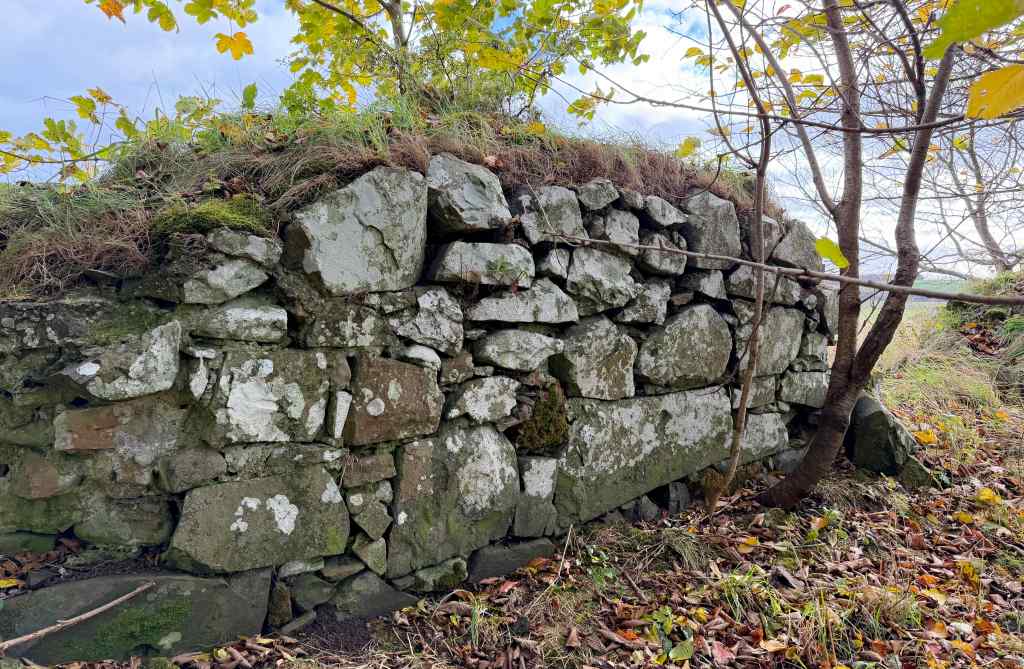
Sadly, excepting the motte on which it stood, and a small section of the curtain wall, there is little left of Bunkle Castle. But in its day, Bunkle Castle was the seat of a barony that touched some of the key episodes in Scottish history. It belonged first to the de Bonkyll family, then passed by marriage into the Stewart family in the late 13th century, and later to the Douglases and eventually the Earls of Home.
Bunkle Castle is often referred to as Bonkyll Castle, a name derived from the Old Scots Bon Cill, meaning “chapel at the foot of the ridge”. There are also various spellings for the castle: Bonkyl, Boncle, Buncle and Bonkill.
The origins of Bunkle Castle are commemorated in one of Berwickshire’s most enduring folk rhymes:
Bunkle, Billie and Blanerne
Three castles strong as airn
Built when Davie was a bairn
They’ll all gang doon,
Wi’ Scotland’s Croon
And ilka ane shall be a cairn
The “Davie” invoked is King David I of Scotland (1084–1153), suggesting that all three fortresses — Bunkle, Billie, and Blanerne — were already standing by the early twelfth century.
The site was carefully chosen. Bunkle stood on a natural knoll rising from the surrounding landscape, its centre levelled to enclose a roughly circular area of around 57 metres in diameter. The edges were reinforced with a bank of earth and stone, and a ditch or moat was dug to the north, west, and south. It was a classic motte-and-bailey castle, the distinctly Norman contribution to the Scottish lowlands, which David I promoted through his policy of granting land to feudal settlers.
Archaeology carried out in 2018 and 2019 by local volunteers confirmed the presence of features dating from as early as the twelfth century, with activity continuing through to the early sixteenth century, the full arc of the castle’s inhabited life.
In 1288, Sir Alexander de Bonkyl’s daughter, Margaret, married John Stewart, the second son of Alexander Stewart, 4th High Steward of Scotland. Through this union, Bunkle Castle passed into the extended Stewart family, bringing with it a wealth, honour and broad territorial influence. It was a marriage that would have consequences reaching across centuries of Scottish history.
When Edward I of England invaded Scotland in 1296, Sir John did not capitulate. He fought alongside William Wallace at the Battle of Falkirk, commanding Scottish bowmen. Unfortunately, they were overrun by the English cavalry, and he was killed. Sir John Stewart is buried in Falkirk Old Parish graveyard, where a gravestone still bears the inscription: “Here lies a Scottish hero, Sir John Stewart, who was killed at the Battle of Falkirk, 22nd July 1298.”
The significance of his death reaches far beyond the battlefield. Through his various sons, Sir John Stewart became the ancestor of an extraordinary number of Scottish noble lines: the Earls of Angus, the Earls of Lennox, the Earls of Galloway, the Lords of Lorne, and, through the Stewarts of Darnley, ultimately the House of Stuart itself.
The transition of Bunkle Castle from the Stewarts to the powerful Douglases came about through scandalous circumstances. Margaret Stewart, sole heiress to the 2nd Earl of Angus, conducted an illicit affair with her brother-in-law, William Douglas. From this liaison came George Douglas, who in 1389 became the 1st Earl of Angus under the Douglas name, and with him, Bunkle Castle passed into Douglas possession. It remained there for nearly four centuries.
The Red Douglases, as they became known, were, of course, one of the great power-brokers of late medieval and early modern Scotland. Bunkle Castle’s association with the family further underlines its connection to national politics.
It was Archibald Douglas, 6th Earl of Angus, who made the most politically controversial marriage of the time. In 1514, the year after the catastrophe of Flodden, he wed Margaret Tudor, widow of James IV and sister of Henry VIII of England. It was a union bitterly resented across Scotland, and led to Margaret losing her position as regent for her son, the infant James V.
The following year, the castle featured in a remarkable piece of cross-border intrigue. In August 1523, the Earl of Surrey suggested that if Margaret Tudor came to Bunkle with her silver plate and jewels, pretending to intercede for the people of the Scottish Borders, he could convey her safely back to England. This suggestion never came to fruition.
Margaret’s husband, the 6th Earl of Angus, Archibald Douglas, was a controversial figure, and throughout his life, it seems he put his own interests before any national interest. Political manoeuvrings saw him exiled, restored, and exiled again, while his shifting loyalties made him a central figure in Border and royal politics. His marriage to Margaret Tudor was not a happy one for personal and political reasons, and they were eventually divorced.
Which brings us to the ironically named Wars of the Rough Wooing. This was Henry VIII’s attempt to force a marriage on Scotland between the young Mary Stewart, Queen of Scots, and his son, Edward.
The 6th Earl of Angus, Archibald Douglas, played a crucial role in this war and embodied the unstable politics of the period. At first he helped the English to negotiate a proposed marriage agreement. Then, when his property and family graves in Scotland were destroyed by English raiders, he swapped sides, fighting for Scotland at the battles of Ancrum Moor and Pinkie Cleugh.
The devastation Henry VIII inflicted on the Scottish lowlands and the borders was extreme, and Bunkle Castle was among its casualties. Along with Blanerne and countless other strongholds across Berwickshire, it was destroyed in 1544. There is no clear evidence that it was ever meaningfully rebuilt. The Douglas family by then had numerous other seats to retreat to, and Bunkle was in all likelihood, quietly abandoned.
When Lady Lucy Montagu Douglas married Cospatrick Alexander Home, the 11th Earl of Home, in 1832, Bunkle Castle, or what was left of it, became the property of the Douglas-Home Earls of Home.
Because so little of it remains, the castle doesn’t seem to have any ghost stories to tell. However, a particularly violent piece of folklore says that when the castle was first built, the laird refused to pay the mason, so in revenge, the mason gained entry to the castle and slew the laird’s wife and child.
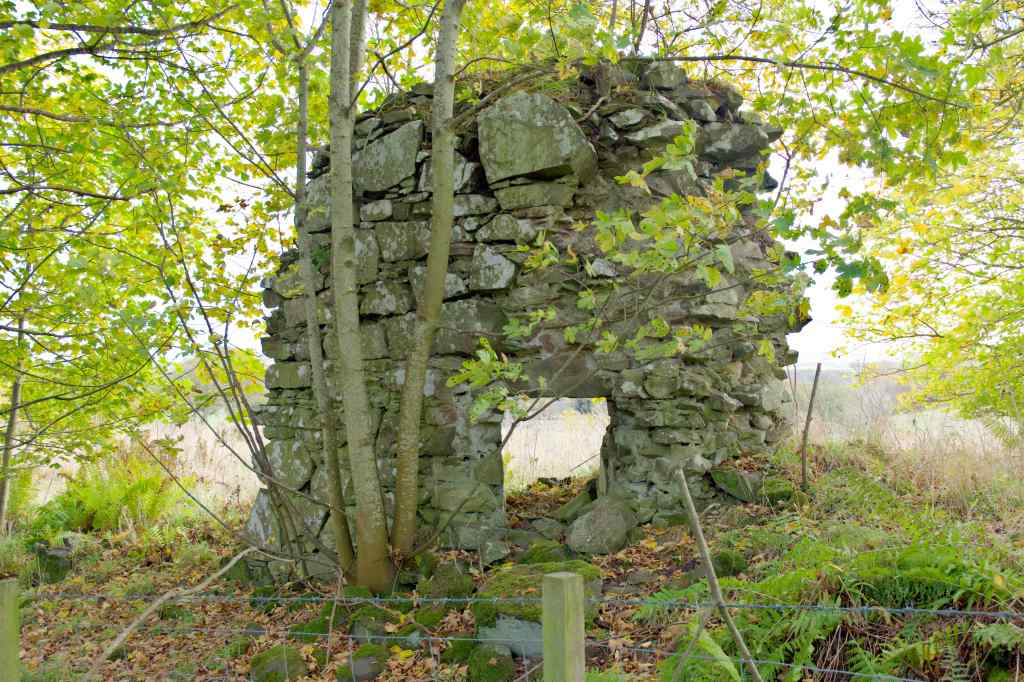
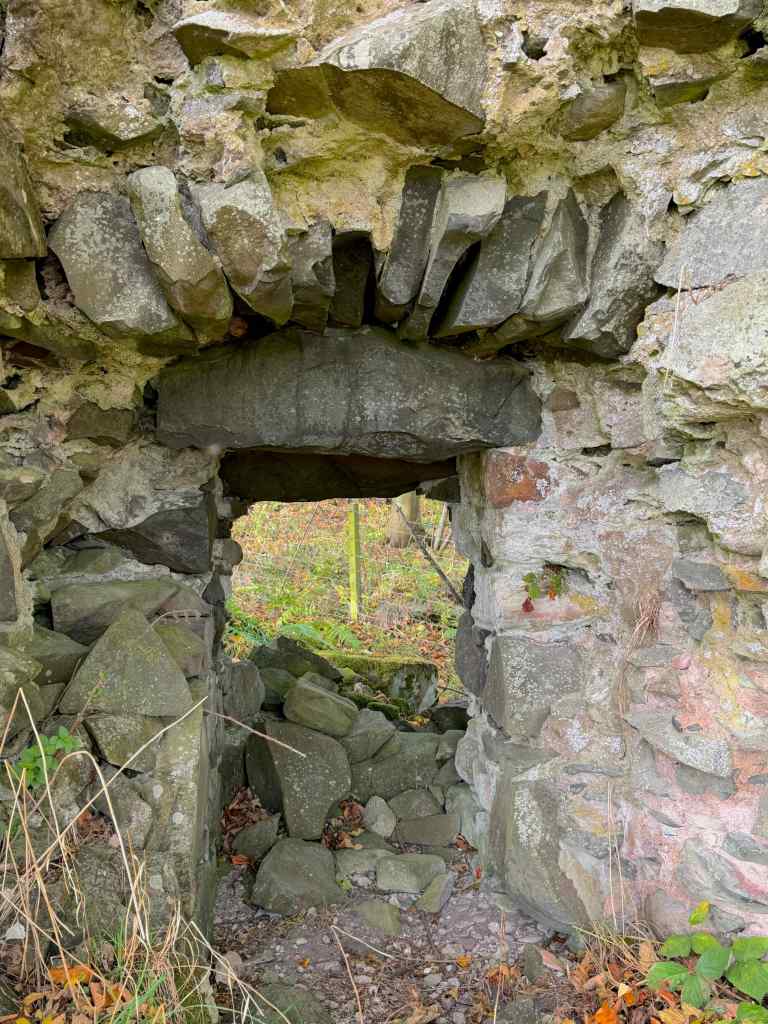
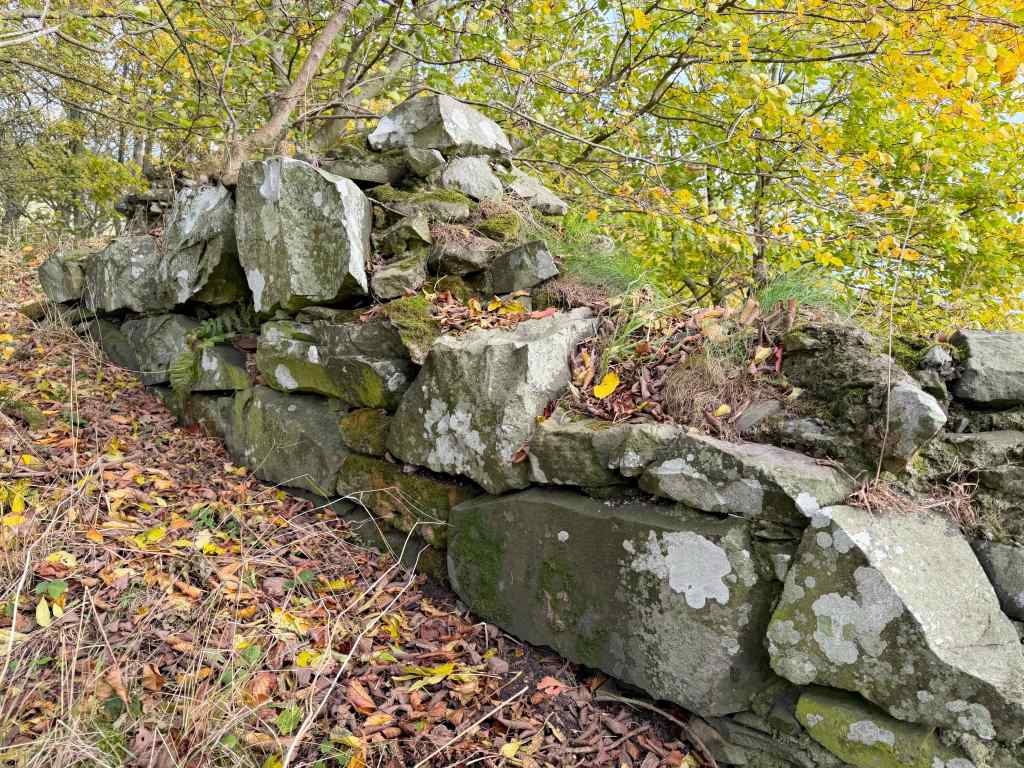
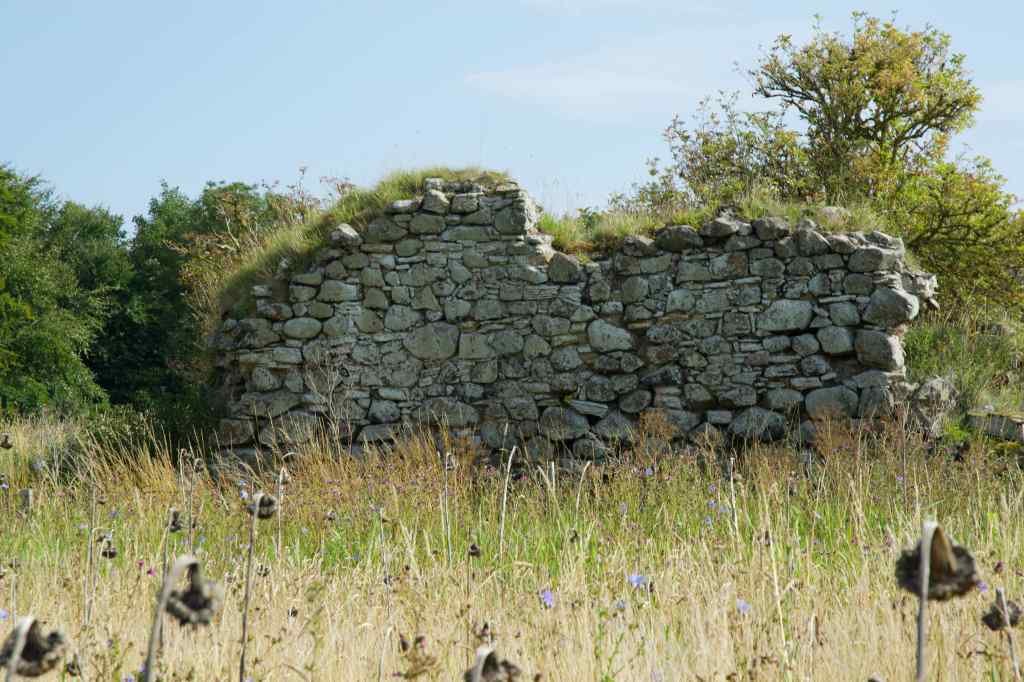
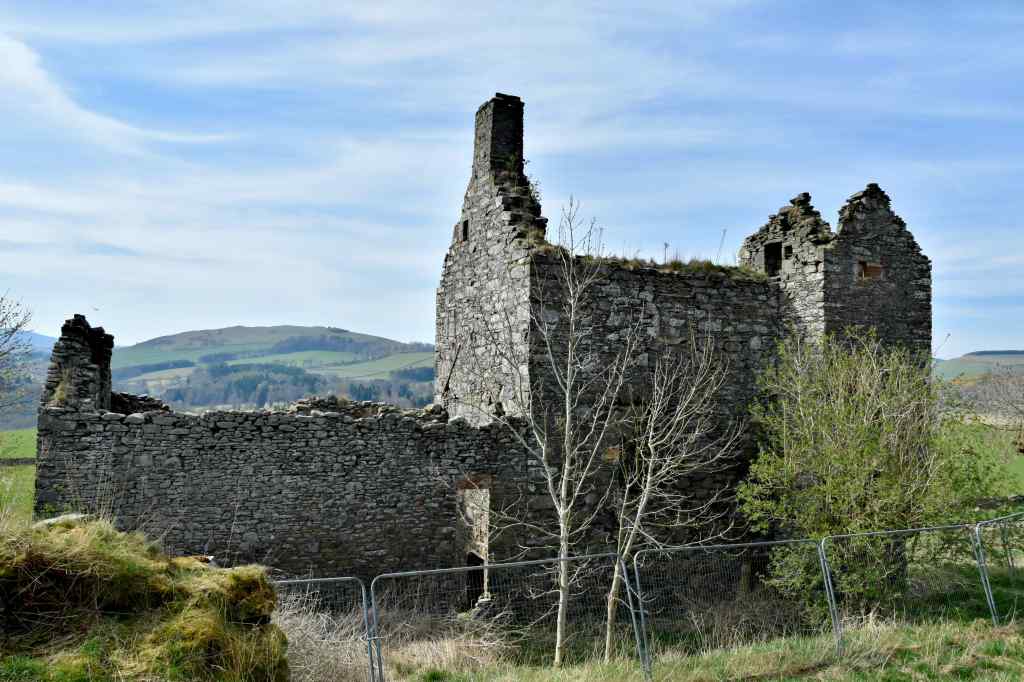
Today, Bunkle Castle’s remains can be found just off the B6438 road, about 4 miles (6.4 km) north of Duns. All that’s left today is a segment of its curtain wall stretching from north to south, measuring about 20 metres long, 1.2 metres high, and up to 1.6 metres thick. Nearby, to the northwest, a sizable section of masonry stands 4 metres long, 4.0 metres high, and a metre thick. The inside area is naturally uneven and overgrown, and unfortunately, no clear signs of buildings or walls are visible anymore.
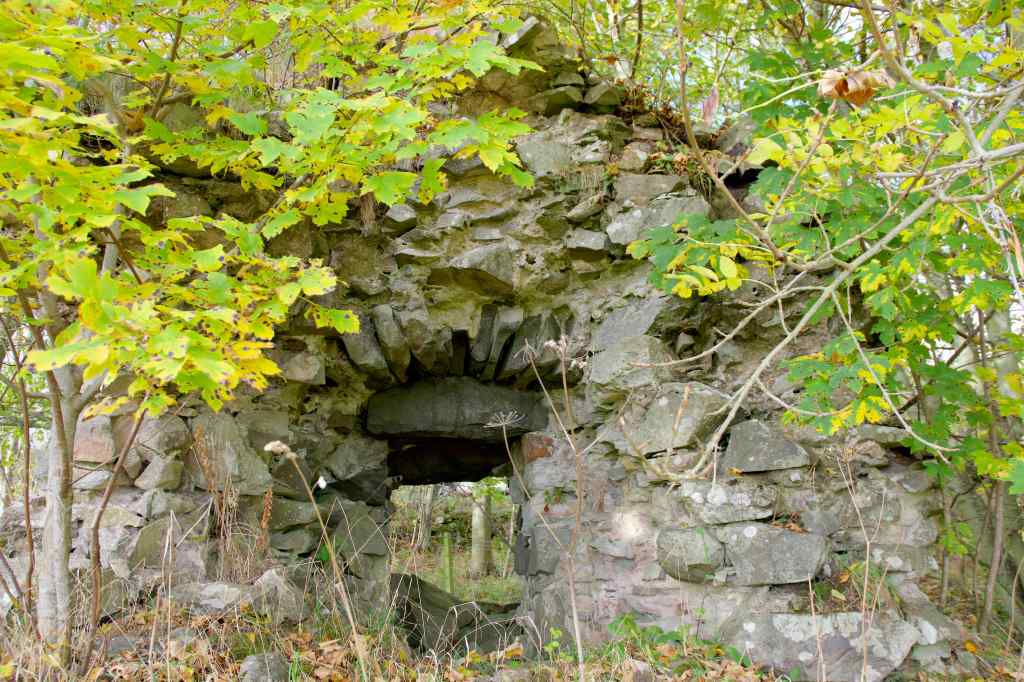
The site is hidden from the road by trees, so to see the remaining castle fragments, we climbed over the wall running along the roadside and then ducked and twisted our way through the branches. A route might be possible from the field, but on the day of our visit, it would have meant negotiating our way around cows, mud and the steepish but heavily overgrown sides of the knoll.
Bunkle Castle: OS National Grid Reference NT 80545 59657
Further reading
Martin Coventry, 2025, The Castles of Scotland (Goblinshead)
Whiteadder, Historic Heart of the Lammermuirs (AOC Archaeology Group)
Wikipedia: Bunkle Castle
Wikipedia: Archibald Douglas, 6th Earl of Angus


 Thistle & Time
Leave a comment