
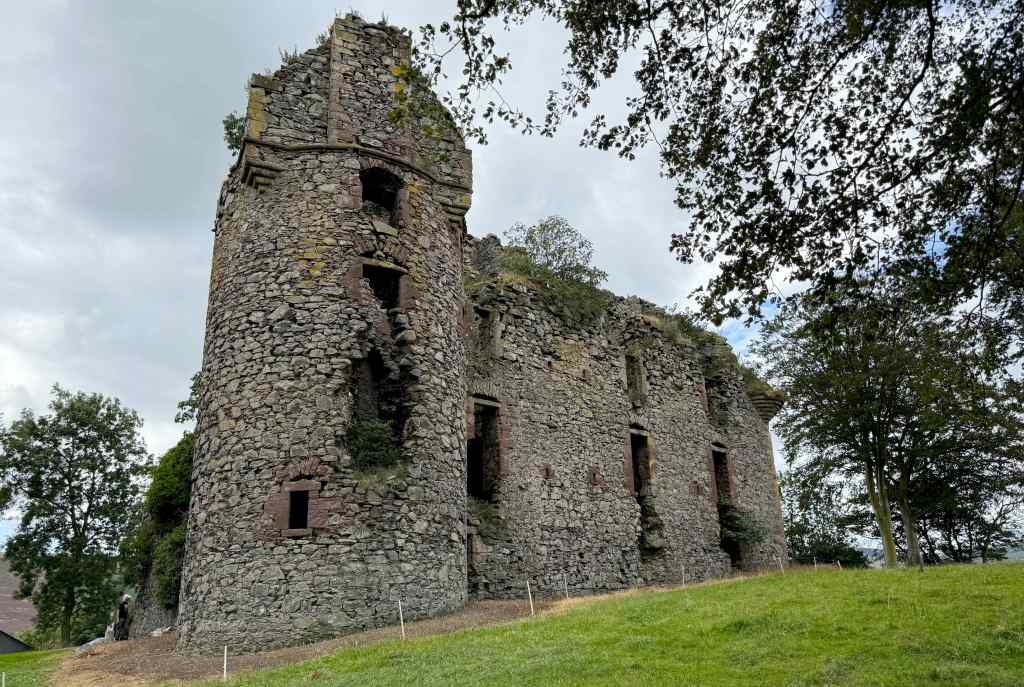
This striking 16th-century ruin is located near the Lyne Water, about 6 miles (10 km) northwest of Peebles. Although apparently never finished, it was still lived in for a while. Not surprisingly, given its builder, it has a history steeped in political ambition and shifting fortunes.
James Douglas, the 4th Earl of Morton and Regent of Scotland, began building Drochil Castle in 1578. Morton planned Drochil as a luxurious retirement palace that doubled as a defensible fortress. But three years later, he was dead, executed in 1581 by the Maiden, a type of Scottish guillotine that he is believed to have introduced.
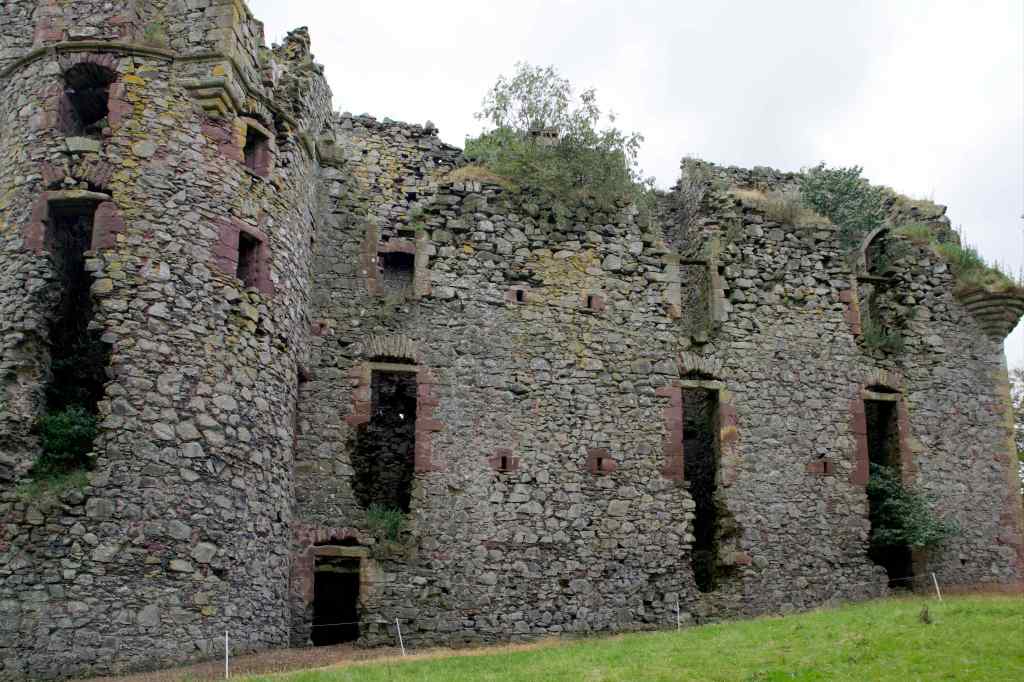
The castle was constructed in a Z-plan layout. Essentially, it was a nearly square block with two opposing towers at its corners. This design incorporated a wide central corridor that provided access to suites of rooms on either side, a highly unusual feature in Scotland at the time. The structure rose four storeys high with a garret, and featured a vaulted basement that housed kitchens and cellars.
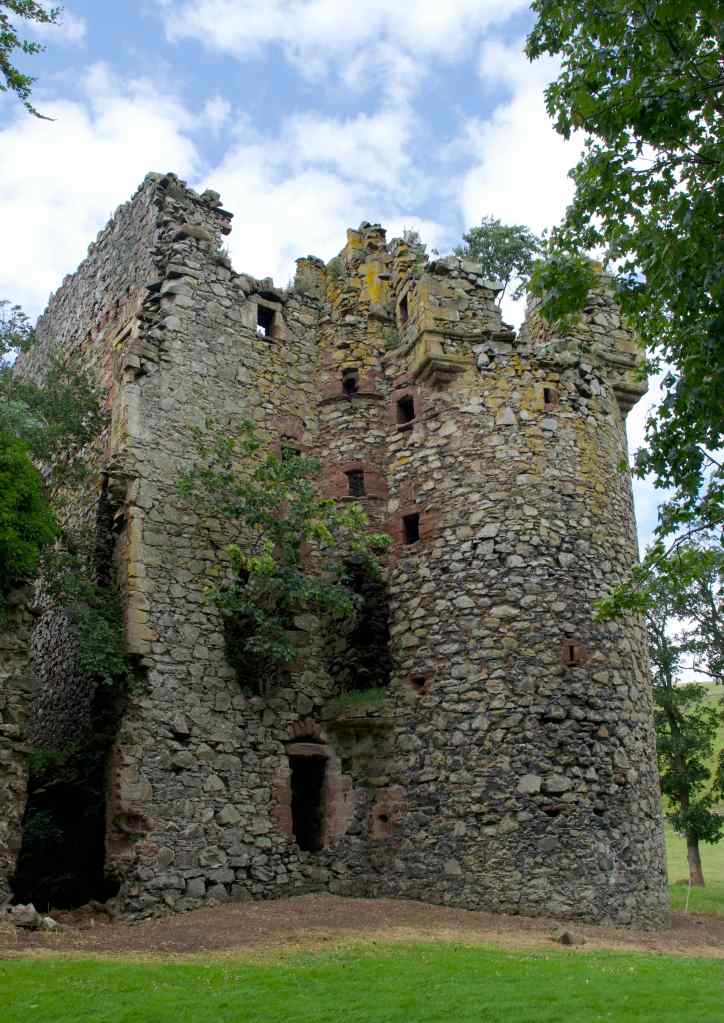
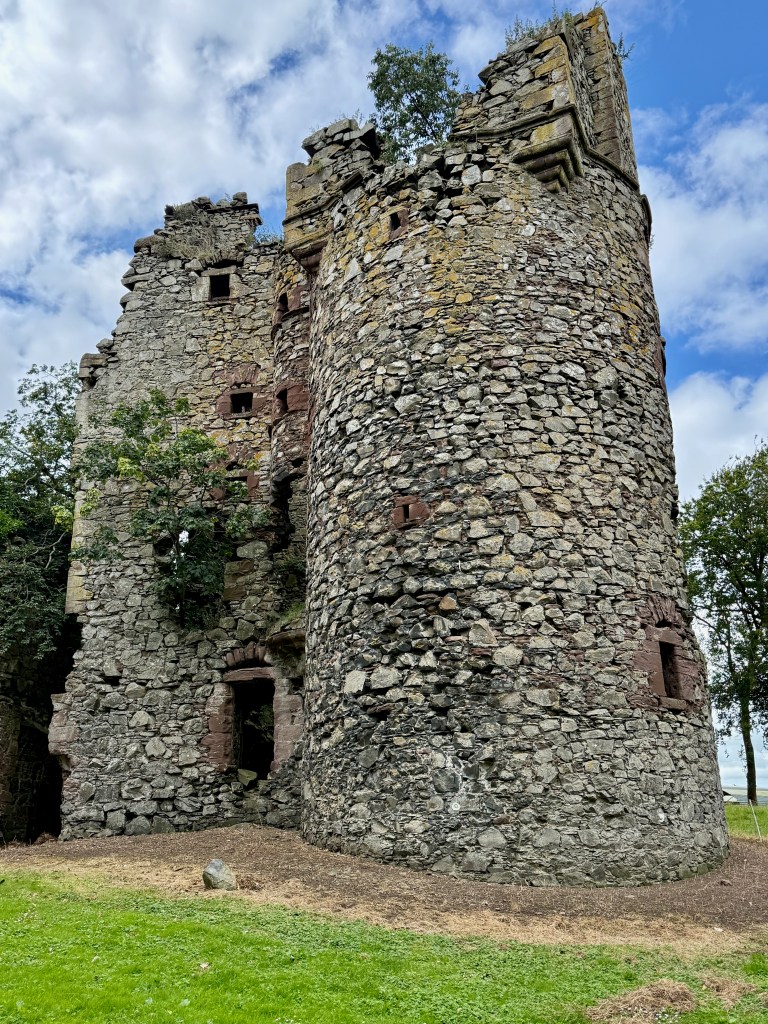
The main block measured 25.6 metres by 21 metres, with each circular tower being 8 metres in diameter. It was built from whinstone rubble, taken from nearby Broomlee Hill, and red sandstone was used for dressing architectural details. As was often the case for grand buildings of the period, the outer walls would have been harled with lime render.
There were many gun loops in the walls.
The ground floor was entered at the west end of the central corridor at that level, just above which the main spiral staircase rises. Unusually for a tower, there was a second service entrance at the east end.
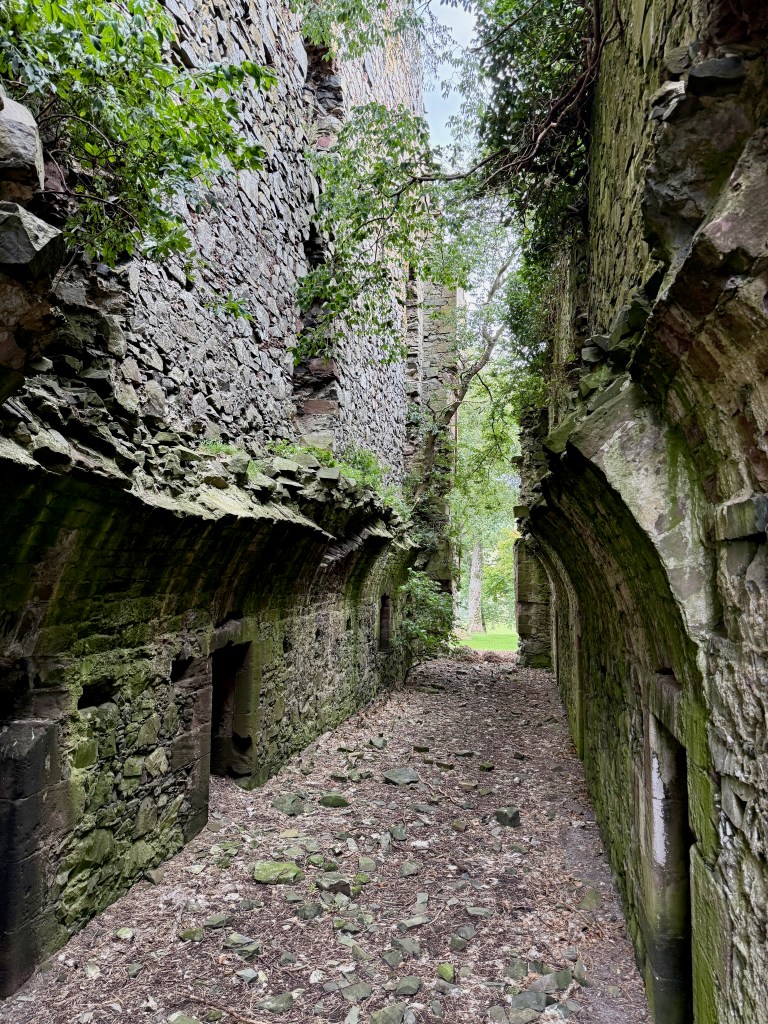
On the first floor, the south side featured a large hall and chamber for lodging, with another chamber in the south-west tower. Additionally, there were more chambers on the north side. All of these rooms seem to have had fireplaces and latrine closets.
James Douglas, 4th Earl of Morton, was born around 1516, the second son of Sir George Douglas of Pittendreich and Elizabeth Douglas. His marriage in 1543 to Elizabeth, daughter of the 3rd Earl of Morton, enabled him to inherit the Morton title and vast estates in 1553.
Douglas quickly made a name for himself in Scottish politics, reaching the position of Chancellor of Scotland in 1563. Early on, he aligned with pro-English groups and supported the Protestant Reformation in Scotland. Because of these alliances, he was actively involved in the tumultuous politics during Mary, Queen of Scots’ reign. He was linked to the murder of her secretary, David Rizzio, and, allegedly, to the death of Lord Darnley, Mary’s husband.
Douglas helped force Mary, Queen of Scots, to abdicate in 1567 in favour of her infant son, James VI. He fought at the decisive Battle of Langside (1568) against Mary and her supporters, and his actions helped to cement the Scottish Reformation.
In 1572, Douglas stepped into the role of Regent of Scotland, caring for the young James VI after three previous regents had met violent ends. His time as regent was tough but brought stability, even though his sharp and ruthless approach earned him many powerful enemies among the Scottish nobility. Douglas stayed actively involved in politics, but his position became increasingly shaky when Esmé Stuart (Stewart), the king’s French-educated cousin, arrived in 1579 and quickly became James VI’s favourite. Eventually, when the political climate turned against him, Douglas was arrested, charged with involvement in Darnley’s murder, and executed in 1581.
But the story of Drochil didn’t quite end there. The castle eventually came into the hands of William Douglas of Lochleven, who became the 6th Earl of Morton — though some call him the 5th Earl. In 1600, Parliament asked him to live at Drochil Castle. Six years later, his heir, also named William Douglas, took over, and he happily gave a life-rent of the castle to his aunt and uncle.
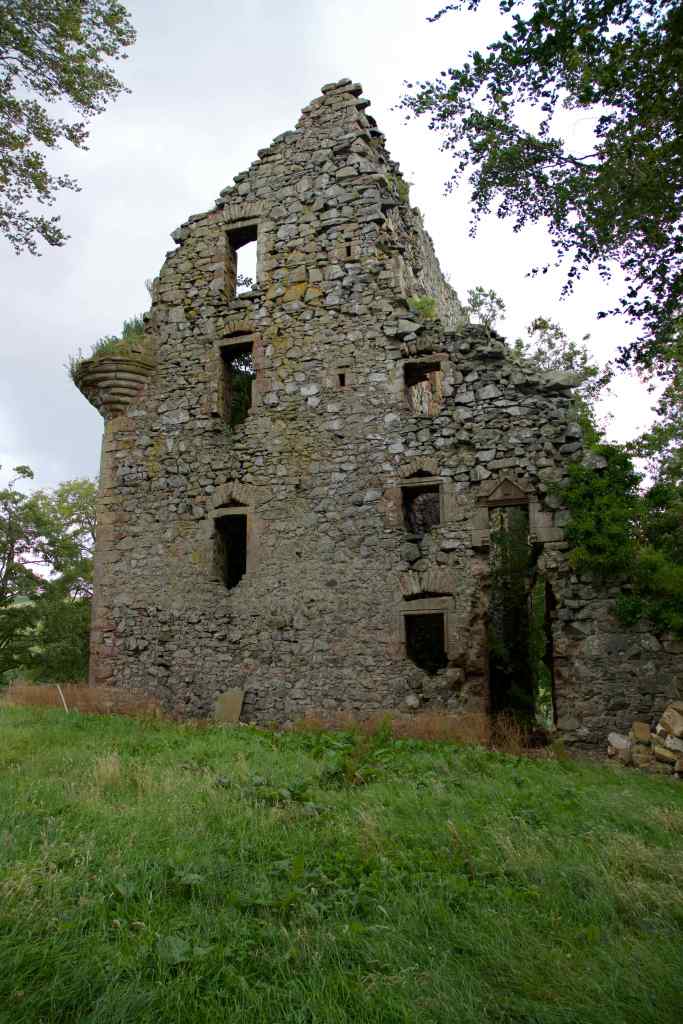
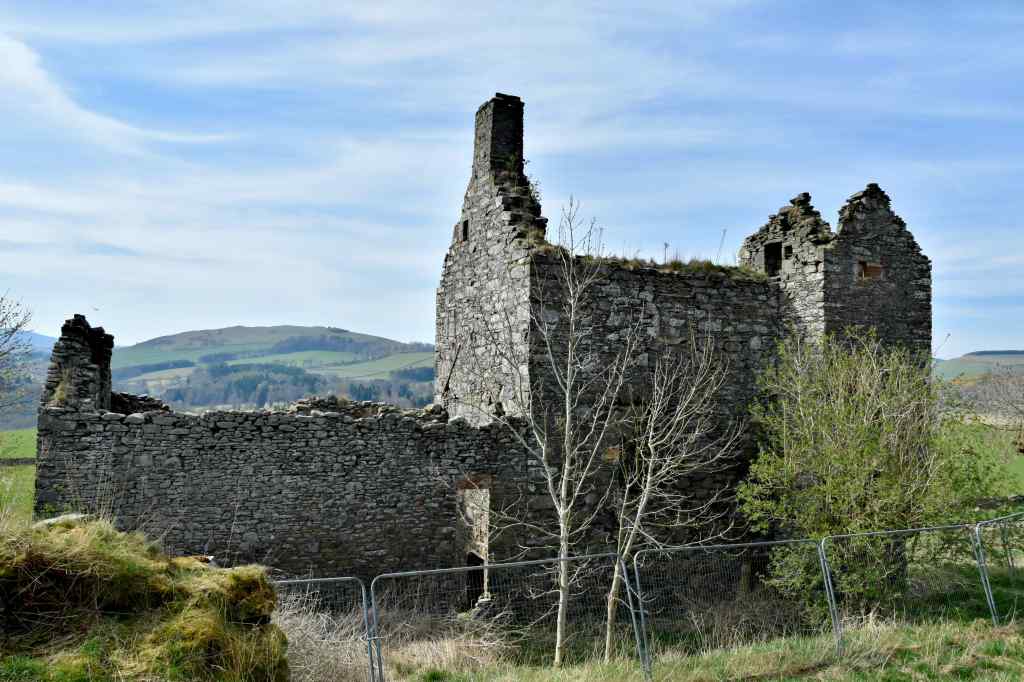
The castle changed hands a few more times over the years, but it probably started to decline in the second half of the 17th century, when it was used as a source of local building materials. Today, only the northern side of the castle reaches close to full height. The southern side is much shorter and covered in thick vegetation. However, the castle’s unique shape is discernible, and its size continues to impress.
Drochil Castle is a fascinating ruin, especially because of its unique structure. Its connection to James Douglas and the turbulent final days of Mary, Queen of Scots, makes it even more intriguing and adds to its charm. Located in the Borders, a region historically known for reivers, the castle showcases the resilient spirit of fortified architecture that once helped communities navigate their challenging surroundings.
The castle is roughly 8 miles (12.9 km) west of Peebles, just off the A72. Take the B7059, and after about 170 metres, turn left toward Drochil Castle Farmhouse. Since the farmhouse is a privately owned bed-and-breakfast venue, please avoid parking in their driveway. The ruins are located north of the farm sheds. When we visited, there was no one around, but it’s a good idea to be ready to explain your visit if asked.
Drochil Castle OS National Grid Reference: NT 16199 43480
Note: Drochil Castle will be the subject of a future podcast episode in the series, Hidden Histories of the Scottish Borders, available on all main platforms.
Further Reading
Alistair Maxwell Irving, 2014, The Border Towers of Scotland Vol. 2 (Maxwell-Irving)
Mike Salter, 1994, The Castles of Lothian and the Borders, Folly Publications
Wikipedia: James Douglas, 4th Earl of Morton



 Thistle & Time
Leave a comment