
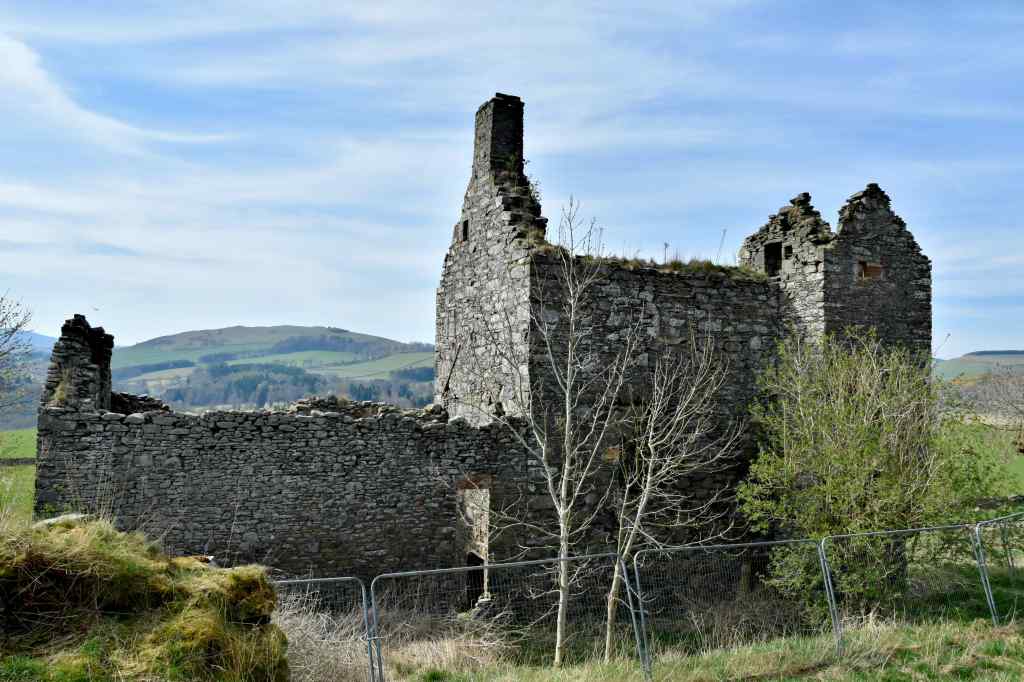
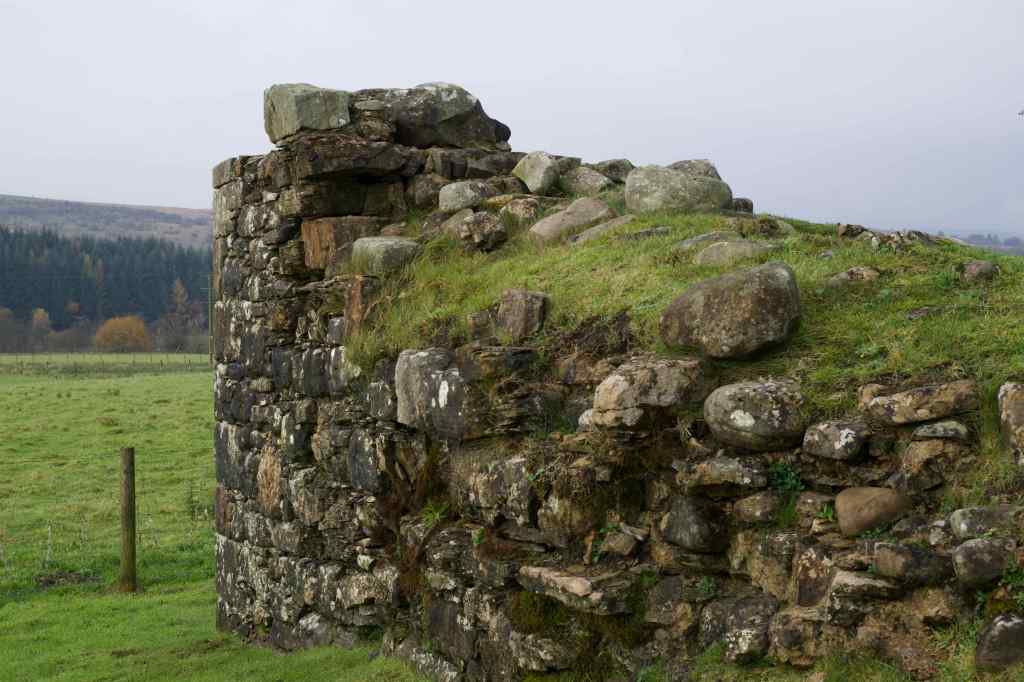
The weathered ruins of Buckholm Tower stand proudly on the hillside above the Gala Water, northwest of Galashiels. This 16th-century tower house once offered sweeping views over the approaches to the town. Built in 1582, it endured the tumultuous decades of the Border Reivers and witnessed the turbulent times following the restoration of the monarchy in 1660.
It looks quiet and lonely now, but if you visit the tower, you can see why it was built in such a location. The views are breathtaking.
But what sort of place was Buckholm Tower, and who lived here?
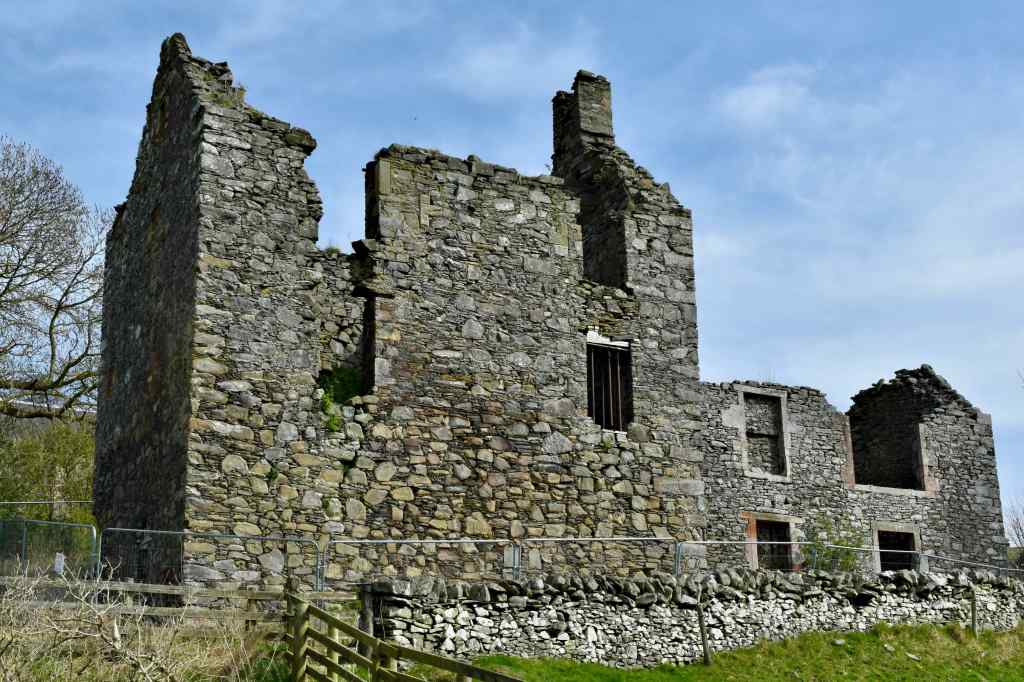
As was typical for border towers, Buckholm Tower skillfully combined defensible features with a working farmstead. Originally, it rose to three storeys with an attic above. A projecting stair wing provided access to the main living areas, reflecting common defensive layouts from a period when threats came from both across the border and within. At some point in the centuries that followed, alterations reduced the tower’s height.
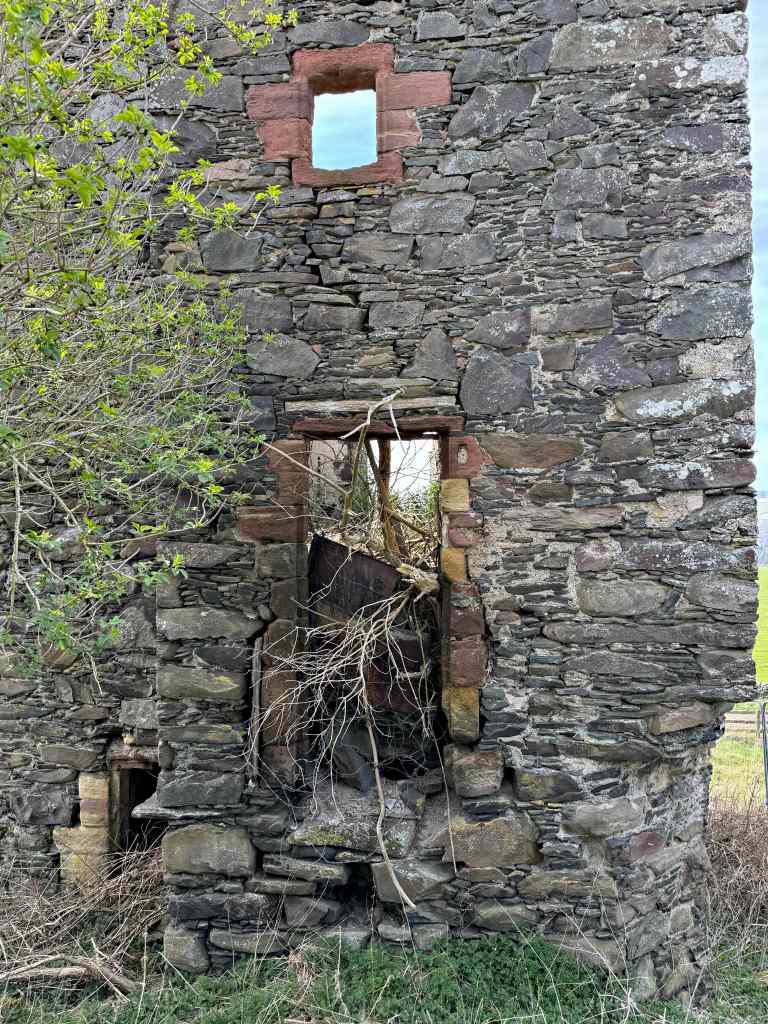
Constructed from sturdy whinstone rubble, with freestone and deep red sandstone dressings, the main block measures 10.7 metres by 7 metres and has walls over 1.1 metres thick. Although now derelict, it remains an imposing building.
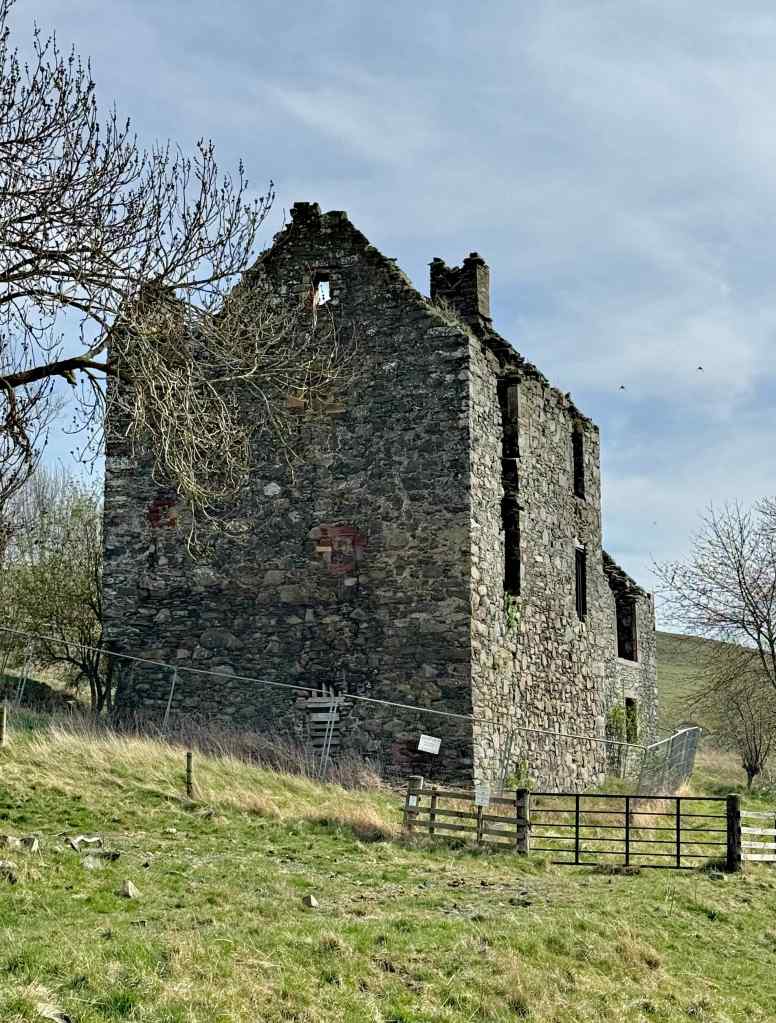
Remarkably for a tower of this era, Buckholm has two entrances. The ground floor entrance, located in the re-entrant angle of the stair wing, leads directly to a vaulted cellar. Inside the north wall is an oval-mouthed gunloop, which appears to be the only such feature in the building. The second entrance is on the first floor, opening into the east wall of the wing, and would have been reached by a bridge or external arched stair from the courtyard wall, known as the barmkin.
The ground-floor entrance led to the great hall, which had a fireplace on the west wall.
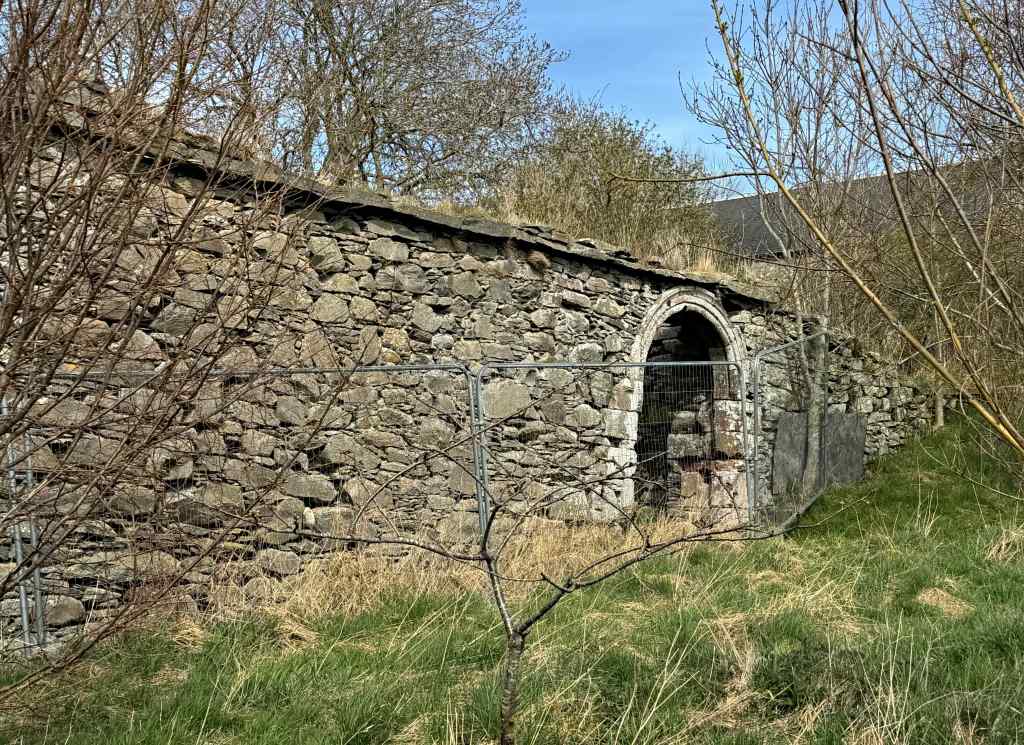
Access to the courtyard was through the barmkin, the only remaining part of which features a wide gateway topped with a semi-circular arch.
Later modifications widened the windows and split the hall into two rooms. In the 18th century, a two-storey extension was built on the south end.
Before this stone tower was built, the lands belonged to Melrose Abbey. Then, in 1547, following the upheaval of the Reformation, the commendator granted Buckholm to James Hoppringle (Pringle) of Tynnes and his wife Agnes Forrester.
However, Buckholm Tower was not the first building on this land. We know that a year after James Hoppringle acquired the land, his relative, Robert Hoppringill of Blyndley, and others faced treason charges for assisting the English and for holding the House of Buckholm for them.
The date coincides with the Rough Wooing, a time when some Scots pledged “assurance” to England.
These Assured Scots often made their pledges for pragmatic reasons, such as protecting their property, or opportunistic ones, like taking advantage of the chaos to raid family rivals alongside English soldiers.
There is no record of an English garrison on Buckholm’s lands, so we can only speculate about the treason charge. It is possible that Pringle members of this earlier house served as guides, hosts, or sources of information for English officers or scouts. However, the fact that the Pringle family continued to hold and even build a new tower at Buckholm indicates their reputation remained strong despite the turbulent times.
It was John Pringle, the son of James (mentioned above), who built Buckholm Tower as a fortified residence in 1582. It was part of a network of tower houses occupied by border riding families. These towers offered refuge during raids and served as bases for local influence during the Reiver period. Although there are no surviving records linking the Tower to specific raids, we do know that the Pringle family was involved in reiving activities.
Jumping forward to the 17th century, the tower’s history takes a darker turn. A Pringle laird of Buckholm, possibly George Pringle, the 5th laird, or his son James, became a committed supporter of the government and a persecutor of Covenanters during the 1670s–1680s.
When Charles II dismantled his settlement with the Covenanters, he reasserted his control over the Church of Scotland. In doing so, he was determined to wipe out disloyalty. The period known as the “Killing Times” (1680–1688) saw brutal enforcement of loyalty oaths, summary executions, transportation, and imprisonment. Royal troops, particularly dragoons, gained notoriety for their harsh treatment of suspected Covenanters. Refusing to acknowledge the king’s authority over the Church could be enough to justify death.
Covenanters resisted the imposition of bishops, state interference in the Kirk (the Church of Scotland), and any claim by the Crown to spiritual supremacy. Most importantly, they opposed what they regarded as tyranny in religious matters, even at the cost of persecution, exile, and death
We don’t have any records to verify the actions taken by this particular Pringle against Covenanters. But folklore says that he helped a troop of Dragoons track down Covenanters on nearby Ladhope Moor. Two men, Geordie and William Elliot, were wounded and captured, and held overnight as prisoners at Buckholm Tower.
Once the dragoons departed, the laird beat both men to death in the cellar and displayed their bodies from hooks in the vaulted ceiling. When the victims’ mother arrived, Pringle, drunk and still blood‑stained, dragged her to the dungeon to gloat over the corpses hanging from ceiling hooks. Confronted with their bodies, she cursed him with “burning” hatred, condemning him for his evil deeds.
Not surprisingly, over the years, the story’s retelling has taken a somewhat supernatural turn. Tradition says Pringle was haunted in life by invisible hounds and the ghosts of the Elliots, driven to terror by phantom baying and scratching. He died a painful, convulsive death, convinced to the end that spectral hounds were ripping him apart. Many tellings interpret this as divine retribution for Covenanting persecution.
On the anniversary of his death, annual sightings of the ghost of the laird running towards Buckholm Tower, chased by baying spectral hounds, were reported. But in another version of the tale from the mid 18th century, the Rev. Henry Davidson is said to have “cast out” the ghost of the laird.
This story of the Pringle laird may be just folklore, but it adds a layer of intrigue to this isolated ruin. And whether or not there is any truth in the tale, it is an example of the stories that people in the Borders have told to make sense of suffering and loss across the centuries.
Today, Buckholm Tower is in a very ruinous, unstable state. Although it stands to a significant height, it is roofless, with large fractures and collapses that make entry dangerous.
To visit it, walk along the farm track from Buckholm. Keep going up the hill to the other side of the cattle grid. Then follow a straight line along the bottom of the field until you see the tower. The walk takes about 15 to 20 minutes. The route is mostly uphill and can be quite uneven in some places. In winter, the mud can be heavy, especially after cattle have trampled the track. From my experience, it’s best to avoid winter and come back when the ground has fully dried out.
Further reading
Alistair Maxwell Irving, 2014, The Border Towers of Scotland Vol. 2 (Maxwell-Irving)



 Thistle & Time
Leave a comment