
Introduction
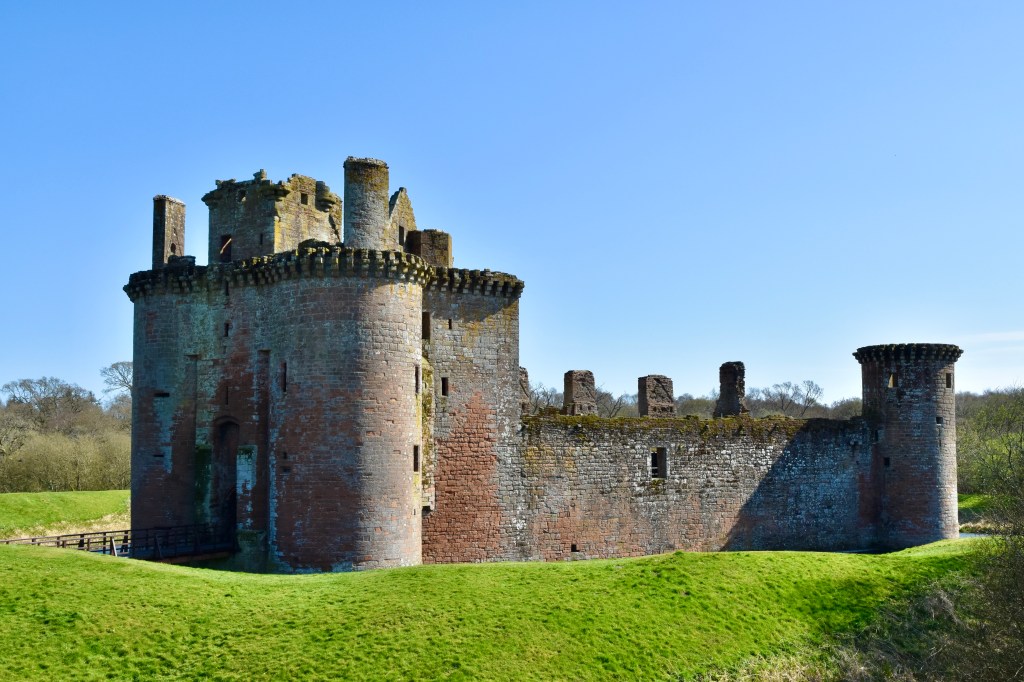
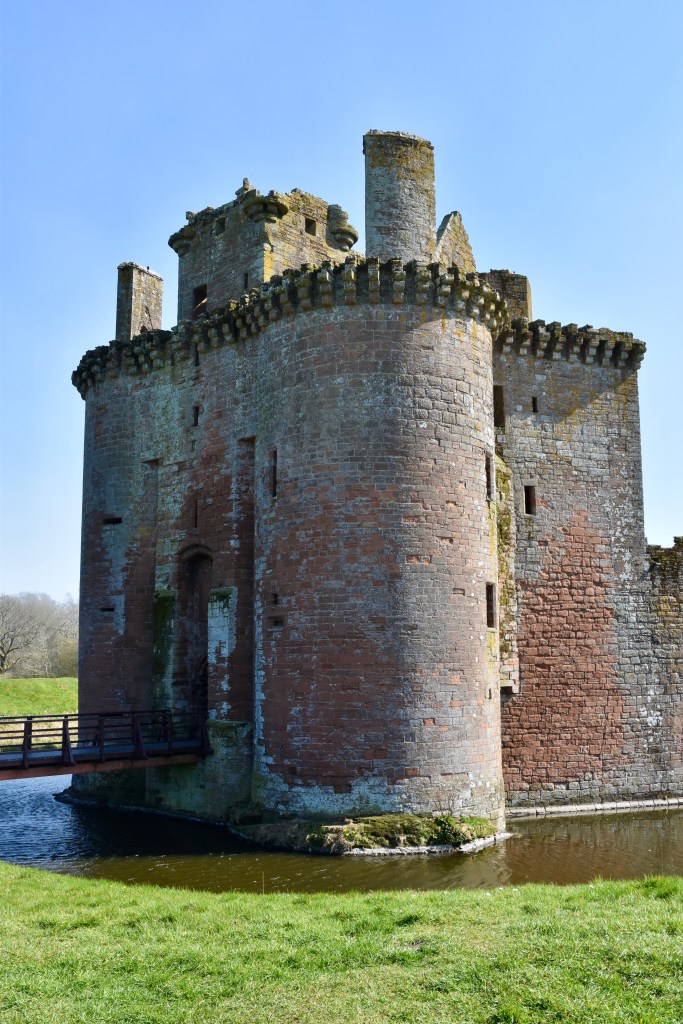
Located in Dumfries and Galloway, a few kilometres from the Solway Firth, stands Caerlaverock Castle. Its distinctive triangular layout, complete with a wide moat, grand gatehouse, and imposing battlements, sets it apart from every other medieval stronghold in Scotland. Indeed, it is surely one of the most impressive ruins that can be seen today.
But aside from its appearance, the castle was also witness to some turbulent historical events, one of which saw the end of its days as a working castle.
The castle’s history
Caerlaverock Castle’s origins trace back to the 1270s when the wealthy Maxwell family, incomers from the eastern borders, began construction of a stone fortress to replace an earlier timber stronghold nearby. This move reflected both rising family prestige (they later became lords of the lands of Caerlaverock) and the increasing need to fortify borders against English incursions.
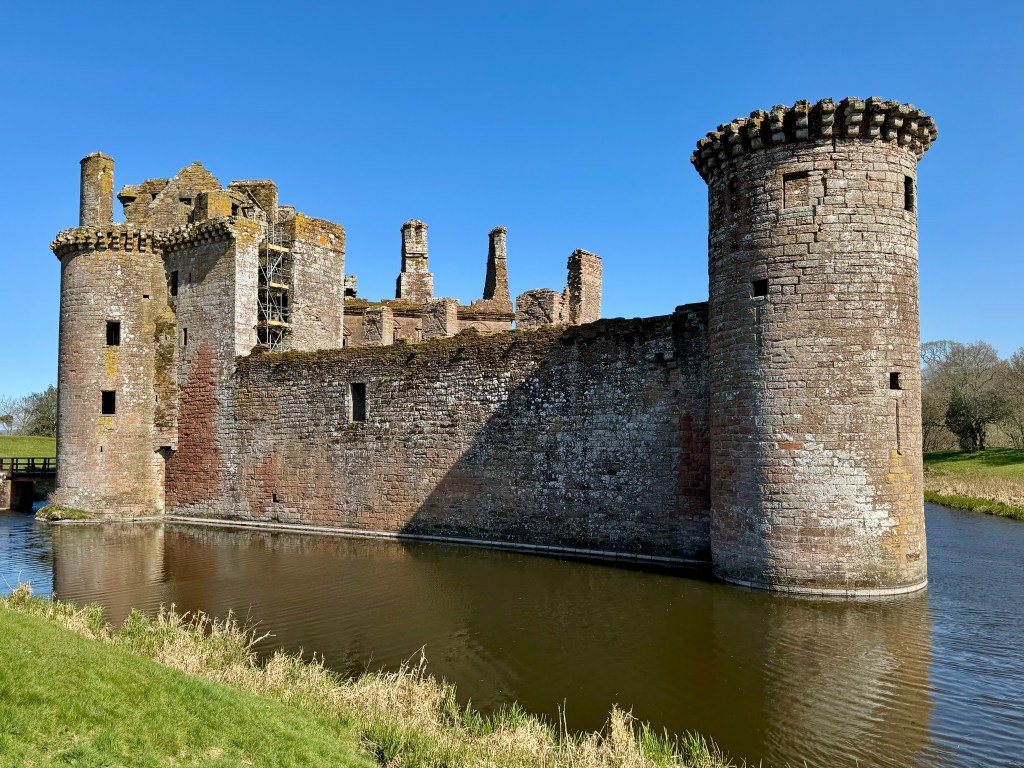
Built using red sandstone quarried locally, its triangular design was likely chosen for defensive purposes, optimising coverage for archers and restricting siege access. By the late 13th century, the castle was already a key component in Scotland’s defensive line along the western border with England.
The first, and perhaps most defining moments in the history of Caerlaverock Castle came in 1300. The English King Edward I, also known as the “Hammer of the Scots,” launched a massive campaign to subdue Scottish resistance to his occupation. Edward brought a huge army, including over 87 knights, to besiege the castle complete with an array of siege engines.
Despite being vastly outnumbered, the castle, mounted a valiant defence. The assault began with English foot soldiers “discharging arrows, bolts and stones” against the hold, but the defenders “sent these tokens back again” with such ferocity that “in one short hour were many maimed and wounded, many slain.” This significant resistance became legendary and was immortalised at the time by an English heraldic poem, The Roll of Caerlaverock. On the second day the seige engines were brought into play, bombarding the castle with giant rocks. This proved decisive, and when the castle finally fell, the garrison was found to be just 60 strong. The poem claims that the 60 surrendering men were allowed to go free, but other accounts say they were taken prisoner or hanged.

The castle remained in English hands until 1312, when the keeper was Sir Eustace Maxwell, who at the time was loyal to the English King Edward II. But shortly afterwards he changed sides to support the King of Scots, Robert I (Robert the Bruce). The castle was again besieged but this time it held out. However, to avoid its further use to the English, Robert I ordered it to be demolished. Sir Eustace Maxwell duly complied.
However, Maxwell’s loyalty was more dynastic than nationalistic. Following Robert I’s death, his young son David was crowned king at just 5 years old. But Edward Balliol (whose family were traditional rivals of the Bruces), had a claim on the Scottish throne, and as an English vassel, he was crowned at Scone in 1332. Maxwell shifted allegiance once again, supporting Balliol. He then began repairs to Caerlaverock, aiming to restore it as a stronghold for the Balliol monarchy in their ongoing struggle with the Bruce faction. But Edward Balliol’s grip on the crown was short-lived. Supporters of the young David Bruce (David II) ejected Balliol into England in December of the same year.
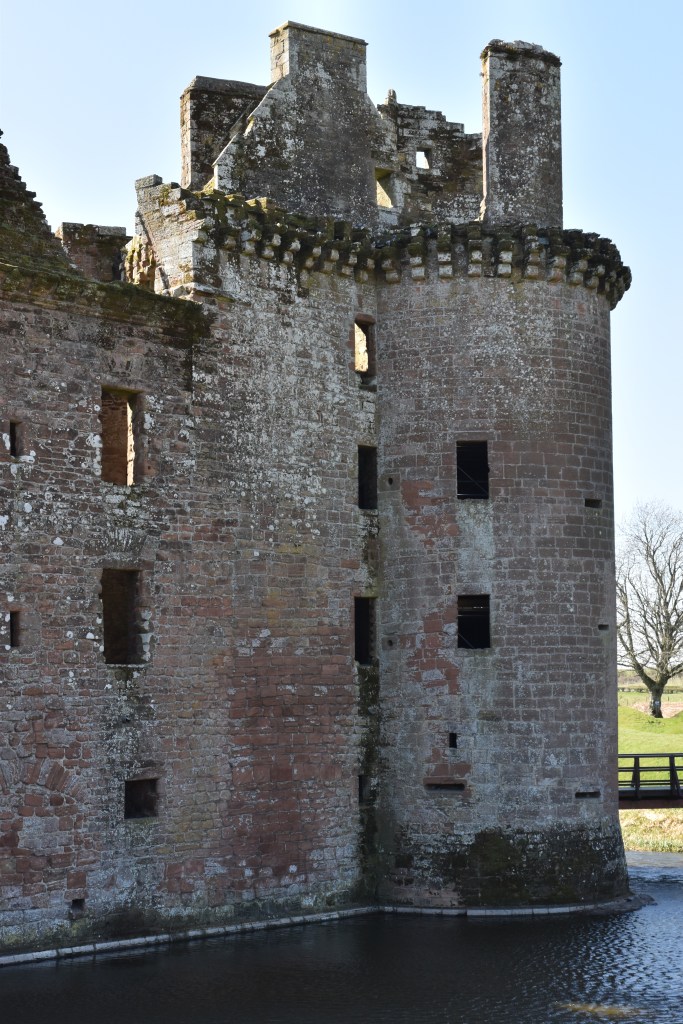
Quite what happened next to Caerlaverock Castle isn’t clear, but in or around 1356, the castle was returned to the Scottish Crown by force and badly damaged. Rebuilding began in 1370, and much of what stands today is from this time. The process was a lengthy affair and continued into the 1400s.
The Maxwell’s, despite choosing the losing side in earlier conflicts, must have been politically astute in the late medieval period. Their influence grew and in 1536, Robert, the 5th Lord Maxwell, achieved a prestigious position as one of six vice-regents of Scotland. This prominence was further emphasised when King James V visited Caerlaverock Castle in 1542, shortly before the disastrous Battle of Solway Moss. Robert participated in this battle and was captured, highlighting the family’s continued involvement in the Anglo-Scottish conflicts that defined the border region.
Indeed, just two years later in 1544, Caerlaverock fell to an English attack but was swiftly recaptured by Scottish forces. Another English assault in 1570 temporarily placed the castle in English hands before it reverted to Maxwell control. These repeated sieges and exchanges underscore Caerlaverock’s strategic importance in the contentious border region.
The Union of the Crowns in 1603, when Scotland’s James VI also became James I of England, brought peace along the border. It led to a new found confidence and by 1634, the Maxwell’s were overseeing more building work. It resulted in the construction of an ornate Renaissance mansion within the medieval castle walls known as the Nithsdale Lodging.
Sadly, the peace was shattered when Charles I ascended to the thrones of England and Scotland, and tried to impose an English book of prayer on Scotland. This lead to outright resistance and the signing of the National Covenant.
Caerlaverock’s long military history then came to an end in 1640 when it faced its final siege at the hands of the Presbyterian Covenanters army. The Maxwells, supporters of the king, held out for 13 weeks before finally being forced to surrender.
This religious conflict, part of the broader Wars of the Three Kingdoms, marked the conclusion of the castle’s role as an active fortification. Following this siege, Caerlaverock was abandoned, ending approximately four centuries of continuous occupation and military use. The partial demolition that occurred in 1640 left the castle in the ruined state largely preserved to this day.
What you can see
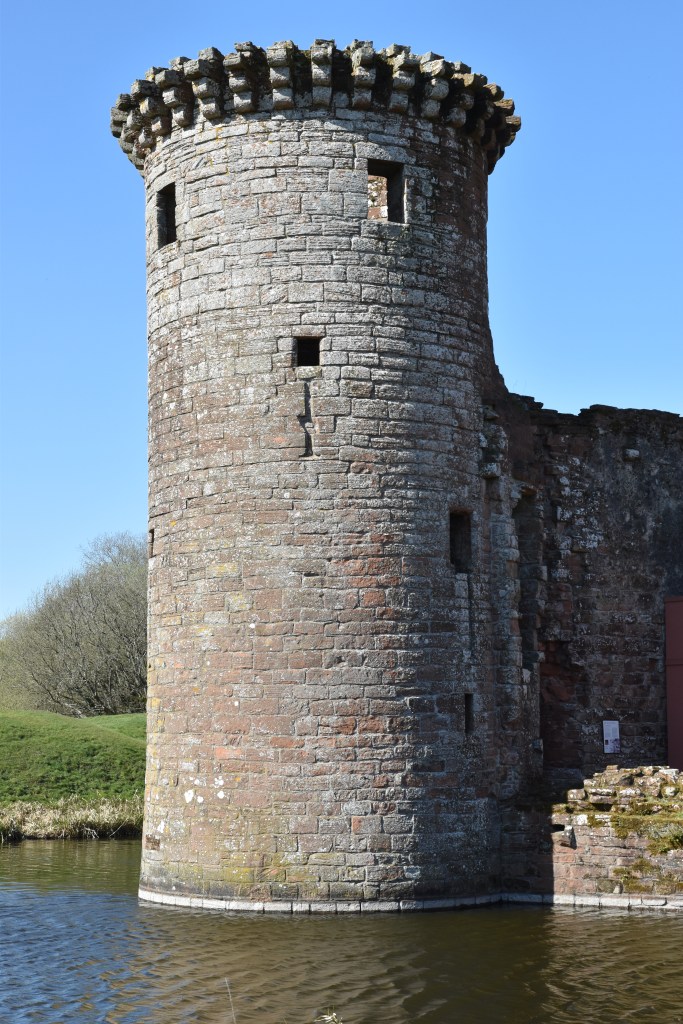
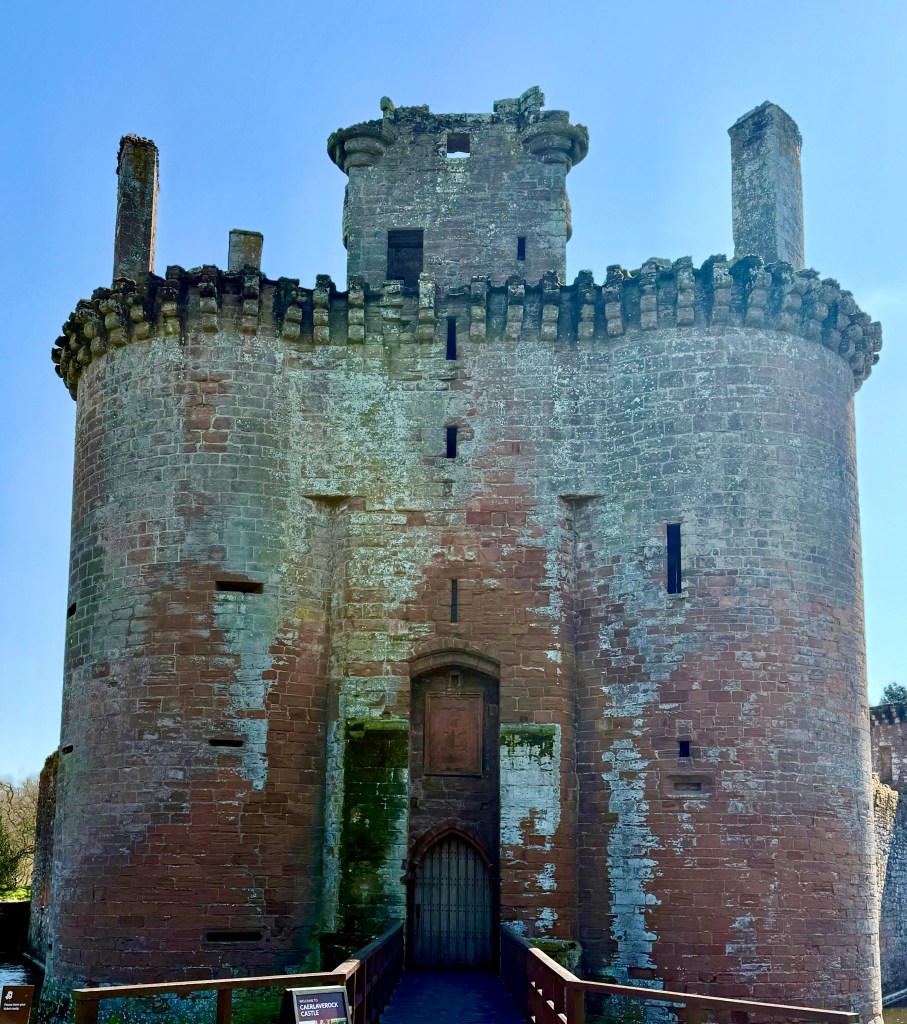
Visitors to the castle can see all but one of the three towers, starting with the imposing but beautifully rounded gatehouse with its bridge over the moat. Within the walls are the slotted defences that would be used for dropping missiles. The caphouse on top was added in the 1500s.
The passage through the gatehouse opens into a courtyard. This would have been the heart of the castle, with busy people going about their duties. Originally the curtain walls were lined with wooden buildings, but over time these were replaced with stone buildings.
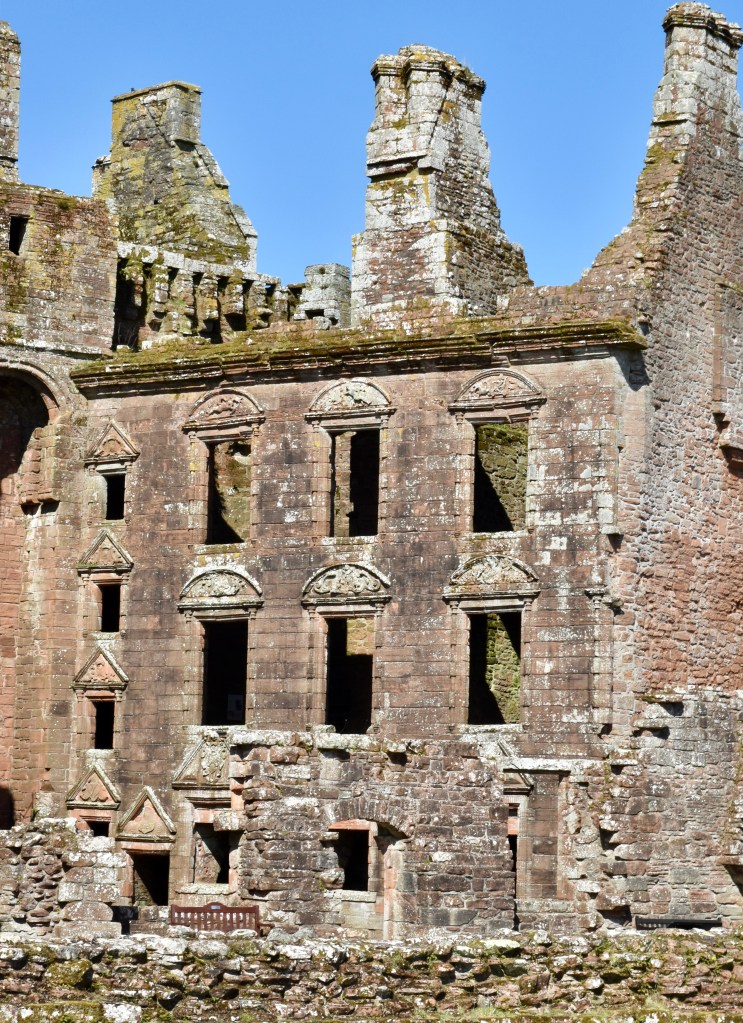
The most striking part of the castle interior is the Nithsdale Lodging. The main façade has a stone carving above each of its two doorways and 13 windows. These include the Maxwell coat of arms, the Maxwell heraldic crest, a female figure reaching up to heaven and Neptune in a chariot drawn by sea creatures.
As well as the moat, the castle is surrounded by earth workings and what was once a second outer-moat. This can make it difficult to navigate if you have restricted mobility. Also, after rain it could be quite slippery so appropriate footwear is advised.
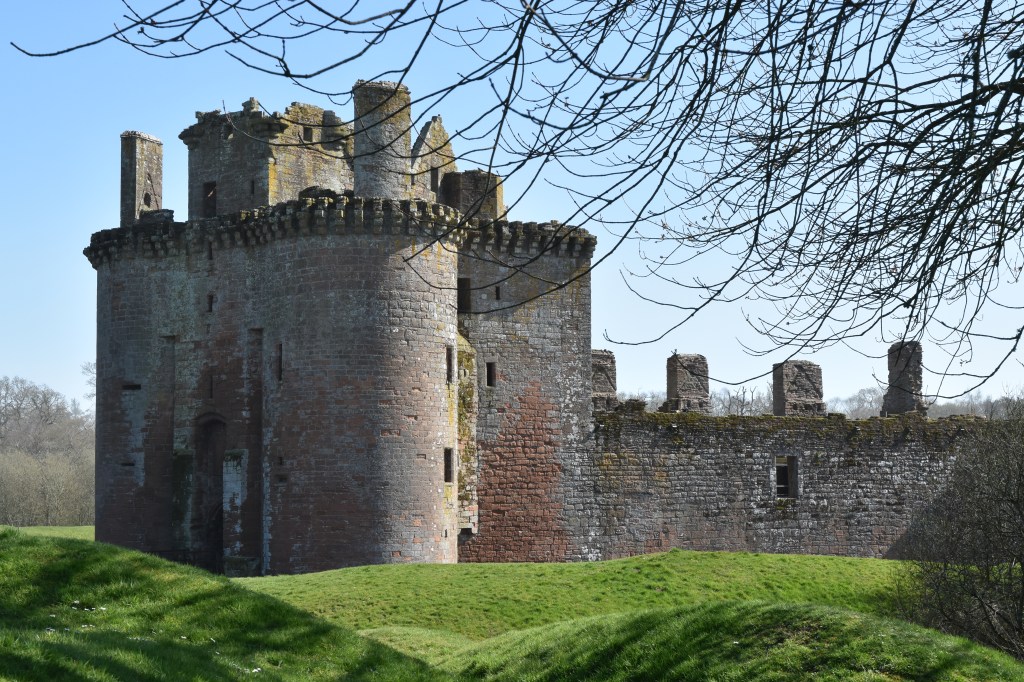
Perhaps the best views of the castle are from the banks of the moat. Walking right around I could take in views from every angle. For me, the fabulous towers and the large curtain walls really set the imagination alight and prompted all sorts of questions… What was this castle really like back in its day? How many lives were lost fighting over its occupancy? How was the castle built without modern technology?
But imagination aside, Caerlaverock Castle is a testament to medieval architecture and engineering. Its unique triangular design not only maximised defensive capabilities but created a visually striking and memorable structure that has withstood the test of time. Today, the castle is protected as a scheduled monument under the care of Historic Environment Scotland.
Visiting the castle
If you ever visit the region of Dumfries and Galloway, I recommend you put this castle on your itinerary.
Getting there requires transport. It is located 14km south and slightly west of Dumfries. There are signposts along this route, or you can use a satnav. There is a small car park on site, about 25 metres from the visitor centre. Admission prices apply.
Facilities include a café, gift shop and toilets (including an adapted toilet). The castle is about 200 metres from the visitor centre, over tarmac, paved and grass surfaces.
Nearing the castle after the moat there is a short but steep (1:6) downwards grass section. The main level route inside the castle is paved, and this allows access around the courtyard to the south range from where there are excellent views of the east range and the moat. There are steps down into some rooms, but most of these can also be viewed from the path.
Dogs are allowed on site if kept on a lead, but are not allowed in any roofed areas (unless assistance dogs). The castle is set in beautiful grounds that includes a woodland walk, part of which takes you to the site of the old castle..
For more information about visiting Caerlaverock Castle please see the HES website.
Further reading:
Official Souvenir Guide Caerlaverock Castle (Historic Environment Scotland)



 Thistle & Time
Leave a comment