

Stirling is one of Scotland’s most iconic and visited castles. Standing atop a volcanic rock, it was of great strategic importance and also, until the union of the crowns, a royal residence. On a very cold but sunny day in January we went to see it for ourselves.
Over the years the castle has undergone many changes. It consists today of buildings around two squares (the Outer and Inner Closes), a guardroom area, gardens, outer defensive walls and a lower enclosure known as the Nether Bailey. The main buildings date from the late 15th and 16th centuries and they have undergone extensive restoration to return the interiors to how they most likely looked back in their day. This work has been carried out by Historic Environment Scotland (HES), and there is no doubt, they have done a terrific job re-creating the period splendour enjoyed by the Stewart monarchs of Scotland.

Entering the Outer Close through the large arch with its turrets (the Forework) you are greeted by the colourful Great Hall and to the left, the Palace. Continue through to the Inner Close and the Stewarts’ legacy can really be appreciated. On each side is a grand building, which is described in more detail below.
The Palace is one of Scotland’s finest renaissance buildings. Stone figures adorn the exterior but many are now badly weathered. Commissioned by King James V in 1583, he most likely died before it was finished. But it was completed by his wife Mary of Guise, who made her court at the Palace. The building is arranged around a central area known as the Lion’s Den (according to legend, James kept a lion here).

But step inside the palace and it really brings to life what the royal court looked like. The 10 year refurbishment and restoration project by HES involved recreating tapestries, furniture and ceilings, including the famous Stirling heads: copies of the original, and fragile oak-carved portraits. Moving through the different rooms, we couldn’t help but be stunned by the beauty on display and the authentic nod to opulence.

During his life, James V owned many tapestries, including two sets featuring unicorns. Although the originals have been lost, new tapestries were commissioned by HES, based on a 1500s design, to provide a rich and authentic covering to the walls of the Queen’s Inner Hall.

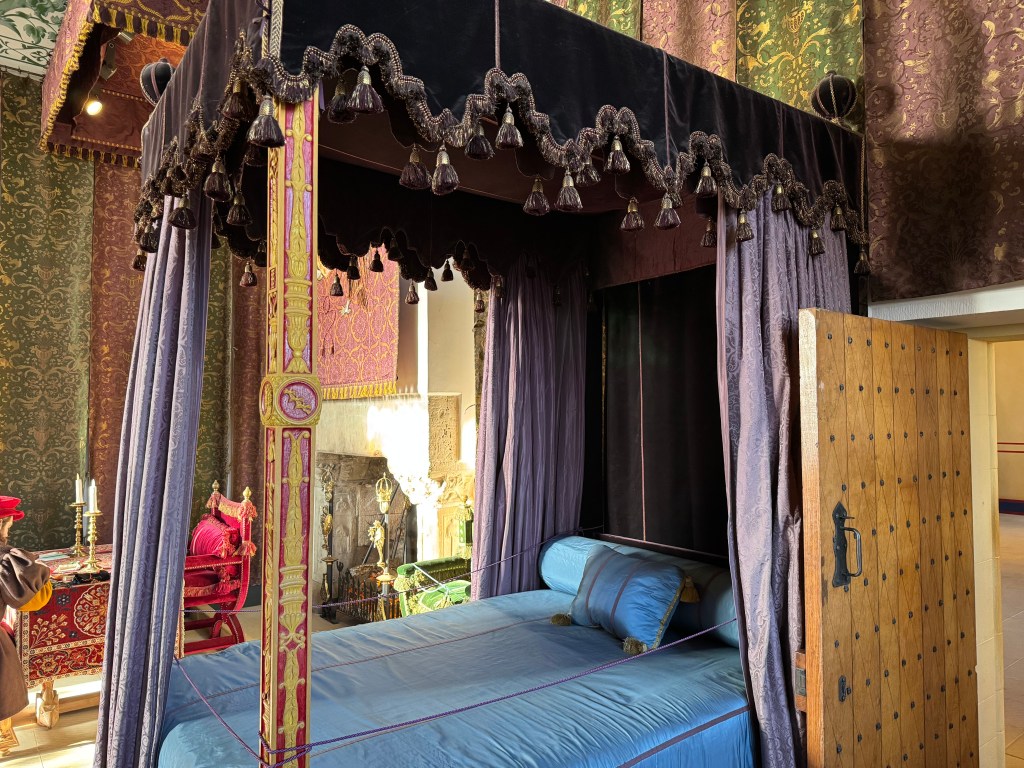
The “Stirling heads”, a display of 37 roundels in high relief, adorn the ceiling of the King’s Inner Hall in the Palace. The originals were removed in 1777 but many survived. However, they were too fragile to go back up and are now displayed behind glass in a special gallery.


The Great Hall was built around 1500 to 1503 by James IV and is one of the largest late -medieval buildings in Scotland. Its exterior colour comes from the authentic lime render that was applied to such buildings at the time. This helped protect the stonework from weathering. In the low winter sun, and when wet, the Great Hall takes on a deep golden appearance.

Stepping inside, the size of the space is very apparent. It was no doubt a prestigious venue for banquets and big state occasions . To heat the hall are five large fireplaces, while two massive bay windows provide daylight to the raised dias, where the king, queen and honoured guests would have sat.

Coming back out into the Inner Close, the building opposite is the Kings Old Building. This was built in the 1490s as the personal residence of James IV. After Stirling Castle was abandoned as a royal residence, the Kings Old Building was adapted for military purposes. Today it holds the museum of the Argyll and Sutherland Highlanders.

The final building of the Inner Close is the Chapel Royal. It was commissioned by James VI in 1594, and replaced an earlier chapel that stood roughly on the same site. James VI’s son Henry was baptised in the chapel and it was said to have been a very lavish affair with many European guests being present. Unfortunately, Henry died aged 18, and it was his younger brother Charles who succeeded James.

I’ve covered some of the castle’s history in the preceeding paragraphs. But Stirling’s story goes back many hundreds of years.
The castle was first recorded as a royal residence in 1110 during Alexander I’s reign, who dedicated a chapel within its walls. His successor, David I, elevated Stirling to a Royal Burgh in 1124. There is also documentary evidence of activity under Robert II, the first Stewart King, but all that survives from this period is the North Gate.
The Wars of Independence (1296–1357) had a profound impact on Stirling Castle, highlighting its strategic and symbolic importance.
In 1304 Edward I of England lay siege to the castle, using a large number of catapults and trebuchets. At the time, Stirling Castle was the last bastion of Scottish resistance. After holding out for 3 months, and even launching counter attacks, the castle defenders led by Sir William Oliphant, offered to surrender. Edward refused at first, wanting to see his Warwolf, the largest trebuchet ever built, in action. He only accepted the surrender once an entire wall of the castle had been destroyed.
During the wars the castle changed hands at least eight times , reflecting its central role in controlling movement between northern and southern Scotland. Notably two important battles, Stirling Bridge and Bannockburn, took place just a short distance from the castle.

After Bannockburn, Robert the Bruce ordered Stirling Castle’s defences dismantled to prevent future English occupation. However, these were rebuilt by the English when they occupied the castle again in 1336.

From the 14th century onward, Stirling Castle became a favoured residence for Scottish monarchs. As described above, the Stewarts contributed significantly to its architecture and lavish interiors. Mary Queen of Scots, who became queen when just a week old, lived at the castle as a child and was crowned here on 9 September 1543 in the old chapel royal (which no longer exists).
Oliver Cromwell’s forces took control of the castle in 1651 but this ended after the restoration of the monarchy in 1660. In later years the castle became a military base. Consequently, the military defences were redeveloped in 1708-14. The Argyll and Sutherland Highlanders, formed in 1881, were headquartered at Stirling Castle. The castle esplanade, which is now the visitors car park, was previously used as a parade ground.

In 1746, the castle was besieged by the Jacobites as Bonnie Prince Charlie’s forces sought to restore the Stewarts to the British throne. The Jacobites had initially bypassed Stirling in 1745. The siege began after the town itself has surrendered to the Jacobites after only a few days. Taking the castle would have been of both symbolic and strategic value. But the Jacobite army made little progress with the siege and were forced to abandon their attempt on the castle. As recently as January 2024, new evidence of the siege was discovered at Stirling Castle. Damage believed to have been caused by musket balls was found on a recently-discovered medieval gate, indicating a previously unknown attacking probe by Jacobite troops.
In 1906 Stirling Castle was transferred to the care of the state, and is now managed by Historic Environment Scotland. The castle is open almost all year round and entrance fees apply. It is a popular attraction so booking online is recommended, especially during the summer months. Facilities include two shops and a cafe. However, dogs are not allowed.
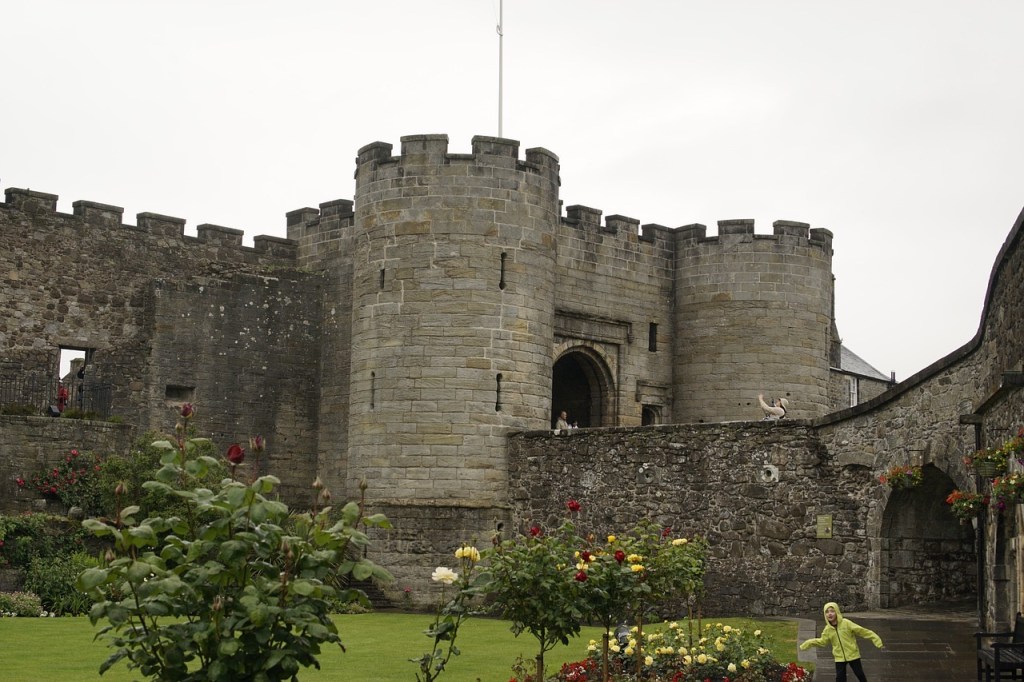
Clearly there is much more to see and say about the castle than I have covered in this blog post. At least half a day, ideally more, is needed to explore every area and see all the exhibits. Sadly, we had dogs to return to so were a little pushed for time.
There is also a whole lot more that can be said about the history of the castle, so I have tried to concentrate on some of the key events. To find out more I would recommend the comprehensive Souvenir Guide.
Overall, Stirling Castle is a great place to visit, bringing Scottish history to life in a fascinating setting. Indeed, the Palace and the Great Hall are unmissable. We had a very enjoyable morning walking in the footsteps of Scotland’s kings and queens, and we would certainly visit again. If you plan to visit Stirling then put the castle on your itinerary.
Note: The Unicorn is Scotland’s national animal, adopted as such by Scottish royalty in the mid 1500s, and appearing in the royal coat of arms.
Sources:
Dr. Murray Cook, Stirling Archaeology
Historic Environment Scotland Stirling Castle Official Souvenir Guide
Adrian Pettifer Scottish Castles 2024, The Boydell Press



 Thistle & Time
Leave a comment